Siavash Kasraei lived in many cities during his tumultuous 70-year life: Tehran, Kabul, Moscow, and finally Vienna. Only Vienna has honored this renowned Iranian poet and registered his final residence as “cultural heritage.”
Death in exile has surprised many Iranian artists in recent decades who had left their homeland either by choice or by force. Some of these artists and writers spent their final days yearning to return to their homeland, dreaming of “leaning on a palm tree and drinking a cool glass of water” (Sadegh Chubak), while others continued “hoping to appear on stage” and sing for their compatriots (Manir Vakili). The heartfelt wish of most of these exiled artists was “to die peacefully in their own home”—a wish that some took to their graves. For years now, most cemeteries in European and American cities have become the eternal resting place of many faces of Iranian art and literature: Bizhan Alavi (writer) in Berlin, Gholam-Hossein Saedi (playwright and fiction writer) in Paris, Ardeshir Mohasses (painter and cartoonist) in New York, Bahman Mohasses (painter and sculptor) in Rome, Homa Nategh (writer and historian) in Paris.
Siavash Kasraei, the poet of the enduring epic “Arash the Archer,” was among these figures who always harbored the desire to return to Iran. After years of residence in Kabul and Moscow, and following the collapse of the Soviet Union, he migrated to Austria. However, Kasraei’s stay in Vienna was not long-lasting. The poet of “My heart yearns for the sun” suddenly developed pneumonia after a heart surgery and died in the hospital. He was buried near the “Artists’ Section” of Vienna’s Central Cemetery.
Yet Kasraei’s eternal resting place differs markedly from the graves of other artists who ended their eternal journey beyond borders: Vienna has registered the tomb of the singer of “A Song from the Moon’s Window” as an “Honorary Grave.” Ms. Shams Asadi, head of this city’s human rights office, speaking with Deutsche Welle about the significance of bestowing this title, says: “This is a gift that Vienna’s municipal government has given to Iranian residents living in Vienna. This decision by the municipal government is comparable to declaring Sadegh Hedayat’s grave in Paris as an honorary grave, which thousands of Iranians visit year after year.” Shams Asadi emphasizes that this section of the city’s central cemetery has special characteristics: “Near this area, there are graves of artists like Beethoven and Mozart.”
Awaiting Return to the Homeland
Although Kasraei generally called death “a frightening lie”* and had written that “my heart does not believe in my own death, no, I do not believe in this certainty,” he not only always yearned to return to Iran but preferred that “his lifeless body be buried in his homeland’s soil.” This wish was not possible at the time of his death in 1996 due to the oppressive political and social atmosphere prevailing in the country during the final years of Hashemi Rafsanjani’s presidency. In that year, the regime’s operatives could not even bear to hold a befitting ceremony for his death in one of Tehran’s mosques, and men with clubs from the “Ansar Hezbollah” group, led by Zibihollah Bakhshizadeh, disrupted the “Khatam” gathering that some of Kasraei’s friends and ideological colleagues had organized.
Gorji Marzbān, an Iranian poet and writer residing in Vienna who played an active role in the occasion of granting Vienna’s honorary grave status, tells Deutsche Welle: “After Siavash Kasraei’s death, naturally efforts were made to bring his body back to Iran. However, political conflicts and the oppressive security and police atmosphere prevented the poet’s return and burial in the soil of his beloved homeland. For this reason, they placed him in an iron coffin to be temporarily buried in Vienna while awaiting his return.”
Preserving “a Part of the History of Contemporary Iranian Culture”
Death in exile reveals another unpleasant aspect: bearing the heavy costs of shroud, burial, and grave maintenance. According to Gorji Marzbān, who also manages the Iranian Cultural House in Vienna, Kasraei’s family bore these substantial expenses for years. Initially, “Kasraei’s admirers were able to find a suitable grave for him in a location a few steps away from the artists’ section. Although this grave was just an ordinary one like others and was renewed and repaired every few years by Kasraei’s relatives and survivors. When the poet’s elderly wife decided to permanently leave Vienna and return to the homeland, her great concern was the loss of Kasraei’s grave, as the contract for the continued use of his resting place was nearly expiring. This matter deeply troubled Kasraei’s wife… Finally, at our last meeting, she entrusted this important matter to me so that, in whatever way possible, I would preserve Siavash Kasraei’s grave and, with it, a part of the history of contemporary Iranian culture in a framework befitting the singer of the epic ‘Arash the Archer’ from the passage of time.”
“Cultural Heritage”
Converting an ordinary grave into an honorary resting place bearing the title of “cultural heritage” is not a simple matter in Austria. For this reason, Gorji Marzbān consulted with Ms. Asadi, who is more familiar with Vienna’s administrative references and regulations.
According to Vienna’s human rights office chief, a written request to register an honorary grave and its related documents and records are examined in three different stages by three different cultural institutions, separately from one another. Each of these institutions has the right to reject the registration request. Furthermore, “in the final stage, Vienna’s mayor must accept this request. After that, the municipal government, having obtained permission from the artist’s family, declares the grave as an honorary grave, which is also considered “cultural heritage,” and the municipal government must maintain and protect it forever.”
Kasraei’s Activities in Vienna
Although Kasraei’s stay in Vienna, a city where approximately 9,000 Iranians and people of Iranian descent live, was very brief, the cultural and artistic activities of the singer of the poem “Wave” brought joy and hope to his admirers during this short opportunity. According to Marzbān, when Kasraei arrived in Vienna, “lovers of culture and political and human rights activists gathered around him. He became a symbol of hope for the formation of a literary and artistic circle. This group enabled the publication of his epic ‘The Red Bead.’ But death soon took the pen from Iran’s great poet and left this gathering in mourning and sorrow.” Years later, on the fifteenth anniversary of his death, the translation of the epic “Arash the Archer” by Anahita Shaaeian into German was also published, which earned the translator an award.
In Vienna, Kasraei did not merely content himself with introducing and publishing his works. By his presence at cultural meetings and giving lectures, he also paid respect to the activities and accomplishments of Iranian artists and encouraged “newcomers” to continue their path. His stirring speech at the opening ceremony of an exhibition of paintings by Behrouz Hashmati, an Austrian artist of Iranian descent held at the city’s Artists’ House, is one of Shams Asadi’s lasting memories of Kasraei, which also demonstrates the humor of this “people’s poet.” Asadi says in this regard: “I had the honor of translating his poetry and speech into German at this ceremony, which was attended by many renowned Austrian and Iranian artists… After the session, Mr. Kasraei came to me and, with much thanks for my translation, jokingly said that ‘soon I will give a speech in German myself.'”
The Cornerstone of the Final Residence
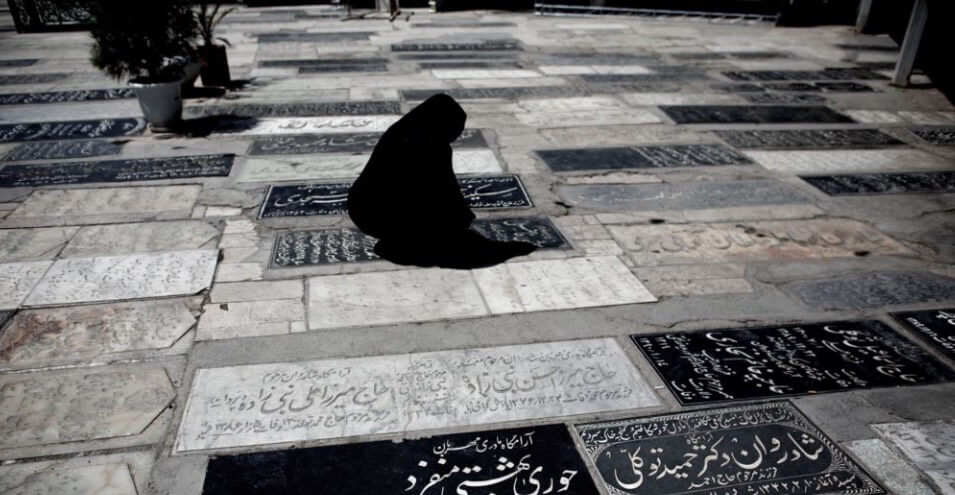
Vienna has made no changes to the construction and decoration of Kasraei’s grave, which had been designed in 1996 according to his family’s wishes. On the marble stone of the grave of the singer of the poem “Homeland,” only his name and birth and death dates are inscribed in Persian and Latin. According to Shams Asadi: “Generally, graves in Vienna are devoid of any designs, inscriptions, or decorations.”
Kasraei’s grave in Vienna’s Central Cemetery is, above all, a guardian of a part of the history of irreversible exile that eternally permeates “his belief in the garden of life”:
…
Cursed be this lie, this frightening lie
My poetry’s bridge extends to the shore of the future
So that intoxicated travelers may cross it
My message to the kiss of lips and hands
Flutters and flies
May lovers glance once at such a reconciling messenger
In the endless exploration of lips and hands
For this image of mankind
On the tablet of time
Becomes eternal
This particle of our gentle warm silence
Will one day, no doubt
Rise somewhere and become the sun
As long as I love you
As long as I love you
As long as our tears drip on each other’s cheeks from affection
As long as there is one soul of a lover in the world
How can death
Erase my name from the memory of time?
Many flowers the wind has taken from my hand
But I, sorrowful one
Do not flutter the flowers of anyone’s memory
I do not believe in the death of any dear one
Eventually
One day my petal will fall
One day my eye too will sleep in dreams
From this sleep of the eye there is no escape for anyone
But within the garden
Always the fragrance of my belief fills the air
* Excerpted from the poem “Belief”