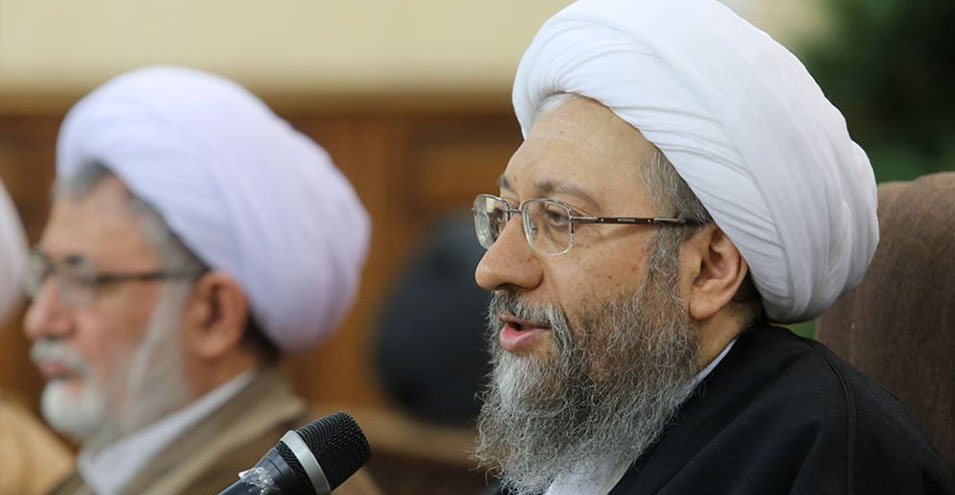
The head of Iran’s judiciary described the annual report of the US State Department on human rights conditions in Iran as “flimsy and false claims” and “unwarranted insults,” and asked the human rights headquarters of the judiciary and the Foreign Ministry to respond “line by line” to the allegations raised in this report.
According to Iran’s state news agency IRNA, Sadegh Amoli Larijani on Monday, April 19, emphasized that every country has “its own values and norms” and the United States “has no right to impose its false and humanistic standards on others.”
He described the allegations raised in the report regarding prisoner deaths as “irrelevant talk” and said that “the death of prisoners, especially elderly people and some drug-addicted individuals, is an issue that is almost possible in all prisons.”
The head of the judiciary added: “Of course, proving that some deaths may be due to torture is a different matter that is merely a claim, and it cannot be accepted without evidence.”
Mr. Larijani rejected “sentencing to death for murder” and said: “In the laws of the Islamic Republic of Iran, we do not have execution for murder, but rather this is retribution which is a kind of right, a right that the heirs of the victim have, and this right is not necessarily always exercised… therefore, the death penalty for murder is a ridiculous statement.”
The US State Department in its annual report cited violations of human rights in Iran, including severe restrictions on civil freedoms, limitations on the ability to conduct free elections through peaceful and fair processes, and the increasing use of capital punishment for juveniles or crimes that are not even recognized as “serious crimes,” as the most important human rights problems in Iran.
Amoli Larijani described prisoner deaths from torture as “irrelevant talk” while in recent years multiple reports have been published about the deaths of some individuals in detention centers as a result of torture complications, including the death of Sattar Beheshti, a worker and blogger.
Also, in a forensic medicine report, the cause of death of “Mohammad Kamrani,” “Amir Javadifar,” and “Mohsen Ruholamini,” detainees at Kahrizak detention center in 2009, was reported as blunt force trauma to “soft body tissues” 72 hours before death and poor detention conditions.
There have also been reports about the deaths of some prisoners, including Hadi Saber and Akbar Mohammadi, due to lack of medical attention during hunger strikes.
The head of the judiciary further called the US State Department’s claim about issuing death sentences on charges of “conspiracy against national security” and “insulting high-ranking officials of the country” a “lie.”
He said: “In this report, it is claimed that enmity with God also results in a death sentence, while their reference is to a jurisprudential and legal discussion of ‘moharebeh’ (warfare against God) which has its own special conditions.”
These remarks come while Iran’s judiciary has repeatedly issued death sentences for individuals who have expressed opinions about Islam or written materials on the subject, some of which have been overturned by the Supreme Court.
For example, after the execution of Mohsen Amir-Eslami, a political prisoner at Rajaishahr Prison on September 23, 2014, his family and some of his friends stated that he was executed on charges such as “presenting a new interpretation of the Quran, insulting Prophet Joseph, and religious innovation.”
According to the US State Department report, the laws of the Islamic Republic provide for capital punishment for matters such as “moharebeh,” “spreading corruption on earth,” “actions against national security,” or even charges such as insulting Supreme Leader Khamenei and Ayatollah Khomeini. At the same time, the charge of “warfare against God” is also used to issue death sentences for political prisoners.
Mr. Larijani on Monday also responded to criticism from the US State Department over the issuance of death sentences in Iran for drug traffickers, saying that “Western countries, instead of encouraging Iran in this fight, attack us.”
The US State Department, referring to estimates by the “Iran Human Rights Documentation Center,” put the number of executions in 2015 at 964 cases, “sentences that, according to reports, many of them were issued in a process that did not take into account the basic principles of fair trial.”
Islamic Republic officials state that “90 percent” of Iran’s execution statistics are related to drug offenses, and some parliamentary representatives have announced the preparation of bills to abolish execution for unarmed drug traffickers.
Meanwhile, Zeid Ra’ad Al-Hussein, the UN High Commissioner for Human Rights, on Thursday, April 16, issued a statement calling on Iran to refrain from executing these convicts while the parliament decides on laws related to the punishment of drug traffickers.
Source: Radio Farda