Ayatollah Sobhani: Usurers Have No Concern with the System, Deal with Improperly Veiled Women
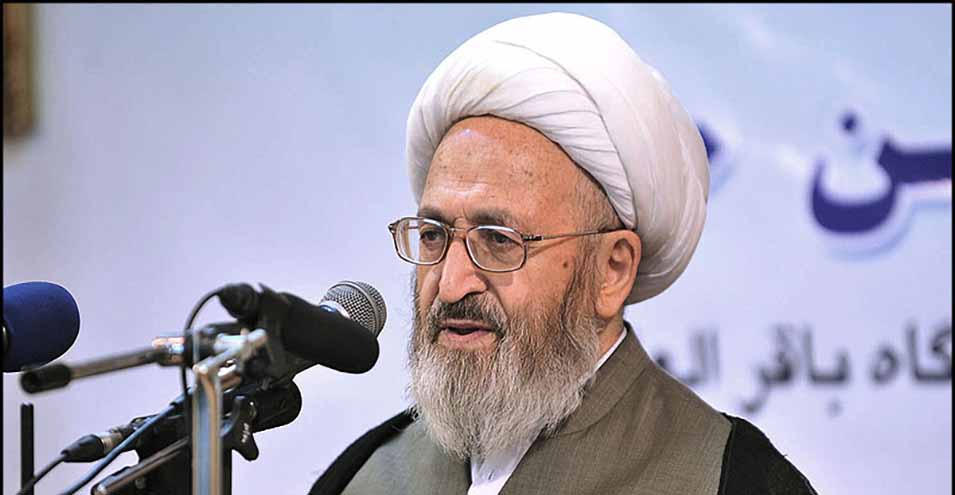
According to reports from the Farsi-speaking Christian News Network, citing Ruz Online: Ayatollah Jafar Sobhani, one of the sources of emulation residing in Qom, warned during a meeting with the commander of law enforcement about what he called “the emergence of some moral and social abnormalities in the holy city of Qom,” and said: “Some have the mission to eliminate the ugliness of improper hijab in Qom.”
According to a report on Entekhab website, Sobhani emphasized: “The law has determined the sphere of responsibility; if there is no interference, it is better for law enforcement not to act beyond its duty; now addressing the issue of hijab is more important than addressing usury.” He added: “Hijab is a symbol of the Islamic Republic; improperly veiled women mock the system, while usurers have no concern with the system and engage in usury in shops for more profit; these improperly veiled women are those who mock the system, and the actions of improperly veiled women are worse than usurers.” Sobhani also said: “It is very clear that people who are seeking to eliminate the ugliness of improper hijab around the shrine of Lady Ma’sumah (peace be upon her) are supported by foreign factors; if law enforcement takes tough measures against these people a few times, this issue will be resolved in the holy city of Qom.”
Simultaneously, statements by Ayatollah Hossein Nouri-Hamadani were also released, in which he too, during a meeting with Brigadier General Hossein Ashteri, the commander of law enforcement, emphasized dealing with improper hijab and said: “Dealing with improperly veiled women should not take this long, and the relevant institutions should have acted according to their duties from the beginning, rather than each institution shifting its responsibility to another.”
He added: “Law enforcement should take more action regarding commanding good and forbidding evil against improperly veiled women, especially in summer and in places with many travelers. Improper hijab exists in society, but when dealing with improperly veiled women and implementing designed programs in this regard, some relevant officials had a negative view, and some shifted their responsibility to other institutions.”
Nouri-Hamadani also criticized Islamic Republic of Iran Broadcasting, saying: “Showing certain films on state television encourages some women toward improper hijab.”
The law enforcement commander, who has been meeting with religious authorities in Qom for several days, met last week with Ayatollah Makarem Shirazi, where he emphasized that there is no necessity for women’s presence in stadiums.
The meeting between the law enforcement commander and some religious authorities took place after Hassan Rouhani called for the enforcement of the law by law enforcement and emphasized that “implementing Islam” is not the duty of law enforcement. He said in early Ordibehesht month at a nationwide conference of law enforcement commanders and managers: “Police are not obligated to implement Islam; rather, the police’s duty is to enforce the law, and if it were otherwise, we would be in intellectual confusion and would entrap people as well.”
These remarks sparked widespread protests among conservatives in the Islamic Republic. They viewed Rouhani’s main point as a reference to street-level enforcement regarding “improper hijab.” For example, Ahmad Bakhshayesh Ardestani, a conservative parliamentary representative, said: “It seems the president does not believe in this matter, and what he means is that the police should not be involved in these activities. If the law says to prevent it, but if there is no law in this regard, the police should not interfere. […] Rouhani does not believe in dealing with improper hijab, but he is saying it in a roundabout way and not saying it outright.”
The disagreement among officials of the Islamic Republic over how to address the issue of women’s hijab in Iran is such that it has even led to verbal disputes.
Hassan Rouhani said in Shahrivar of last year: “We believe that developing society is through vans, minibuses, police officers and soldiers, but culture is not developed this way.”
He added: “The way to promote culture is through scholars, great men and seminaries, researchers and university professors. How are we encouraging it? That is, the way to chastity for our women is a van? Do we have no other way? Our own women, who are the intellectuals of society, academics, researchers and university professors themselves—don’t they know the way to establish chastity in this society and promote hijab?”
Rouhani continued: “At one time after the revolution, someone told me that this sidewalk has many problems. I asked why? He said, because men and women walk on the same sidewalk, and the only solution is a wall, and we should build a wall in the middle. I said, well, please make it a short wall so we can find people.”
Nevertheless, it appears that the issue of hijab and improper hijab, as Ayatollah Sobhani also alluded to, has transformed from a purely jurisprudential matter into an issue of identity and politics for the Islamic Republic. The notion that improper hijab is a kind of “mocking the system” is something that apparently is also discussed behind the scenes in Iran’s power dynamics.
In late Shahrivar of last year, Hojatoleslam Ghaem-Maqami said at a meeting of Supporters of Hezbollah in Tehran: “Sometimes a person thinks to themselves that, for example, so-and-so person is not bound by hijab, they can be unbound in their home, of course they have committed sin, but what insistence do they have to bring this to society. Of course, the answer is completely clear. Displaying a phenomenon means invitation, propaganda, and politics—that is, when people come and through their appearance, behavior, and conduct oppose custom and religion in a way, they want to say that the space of society belongs to them and at a further level the government should also belong to them.”
The transformation of improper hijab into a security crisis for the system led to the direct intervention of the Supreme Leader of the Islamic Republic. Sardar Mohammad Ali Jafari, commander of the Islamic Revolutionary Guard Corps, revealed in December 2013, in response to a question from a Basiji who had asked “why does the IRGC not take measures in the discussion of chastity and hijab”: “In countering improper hijab and the issue of chastity and hijab, the IRGC and Basij are prohibited by the directive of the Supreme Leader, especially from negative measures. What we can do is negative measures. Of course, for the past 4 to 5 years we have been involved in positive action, which is very difficult work. Countering improper hijab is very difficult work. Currently, the work has been handed over to law enforcement.”
He added: “His Excellency has detailed and specific views that proceed under the ‘good people plan’ and the ‘commanding good and forbidding evil plan’ under his supervision, and we must be patient for a while.”
Subsequently, the plan to support those who command good was approved in parliament, and after several exchanges between parliament and the Guardian Council, it reached final approval. This law, after being approved, was not circulated by Hassan Rouhani, and ultimately the parliament speaker circulated it.