Three-Thousand-Year-Old Fashion “Collection” Unearthed at Solomon’s Prophet Mines
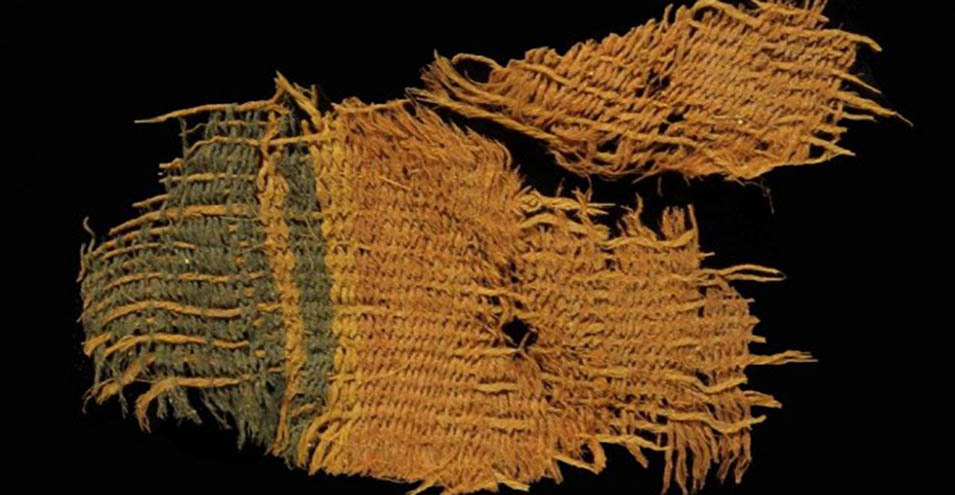
Fabrics with intricate designs and beautiful colors, preserved due to the region’s special arid climate, were discovered in Timna, southern Israel.
Tel Aviv University announced on Wednesday that archaeologists have discovered a rich collection of fabrics in southern Israel dating back 3,000 years, to the era of David and Solomon, the kings of the Bible.
Archaeologists said these artifacts were found during excavation operations of Tel Aviv University’s team, led by Dr. Erez Ben-Yosef at the Timna copper mines, Arava Mound. These findings are the first fabric discoveries from this period and include fabrics of various colors, designs, and origins.
Ben-Yosef said, “Until now, from this era, no fabrics have been excavated in areas such as Jerusalem, Megiddo, Hazor. What we have now obtained gives us a unique opportunity to view a panorama of life from a period we previously had no access to. In this discovery, we have obtained samples of fabrics from bags, clothing, tents, rope, and thread.”
The university announced in a press report that the fabric pieces, sometimes measuring 5 centimeters by 5 centimeters, are of various colors, weaves, and decorations.
Dr. Orit Shamir, a senior researcher at Israel’s Ancient Testament Research Office who led the fabric studies, stated that some of these fabrics resemble fabrics that were only produced during the Roman period.
Timna Valley, now a national park, was a mine during King Solomon’s reign and housed dozens of metal smelting facilities.
Fragments of kilns, clothing, fabric, rope, and various particles of food materials were found in 2013 excavations, which were announced to the public on Wednesday. These artifacts date back to the tenth century BCE, when, according to the Bible, King Solomon reigned over ancient Israel.
Also, from the same period, the Sheva (seven), consisting of two grains and seven fruits that grew only in the land of Israel, were discovered. This discovery was determined and confirmed by radiocarbon dating.
Ben-Yosef stated that it is said these mines were administered by Edomite tribes. A glimpse into the complex methods of social life of this tribe has become possible through these discoveries.
According to Ben-Yosef, the diversity of fabrics also provides new and important information about the Edomites who, according to the Bible, went to war with the Kingdom of Israel. We have found fabrics with simple weaves and complex designs that belonged to the clothing of the upper classes of society. Luxury fabrics that skilled and reputable craftsmen and artisans who operated the copper furnaces wore. They were operators of metal smelting furnaces, which themselves had a very difficult and complex process.
The university, in a press report, said that artifacts found at this site show that copper mines were the “Silicon Valleys” of their time. Copper was used to make tools and military equipment and was one of the most valuable resources of ancient societies. Ancient Timna miners were likely composed of slaves or prisoners. However, the operation of smelting ore and converting it to metal required considerable skill and very sensitive adjustments.
Ben-Yosef added that “control over copper mines meant possessing enormous power, much like oil does today. If someone had sufficient knowledge and skill to produce copper, they were considered a respected and valuable individual in the complex technology of that time. They might even be considered magical or superhuman, and held social status and rank on this basis.”
The university explained that “on this basis, food, water, and fabric had to be transported from distant points to the desert, into the valley, and into the mines and copper facilities.”
The latest discoveries, which included fabrics, most of which were produced in very distant points from Timna and in specialized textile workshops, shed light on the commercial methods and economy of the region at that time.
Vanessa Workman, a graduate student at Tel Aviv University, said, “In the discoveries, we found fabrics that were not locally produced. They were most likely transferred from the Jordan Valley or northern Israel. Many of these fabrics are made of sheep’s wool, which has not been found in discoveries from this time period. In this way, we see how advanced and complex the textile industry and trade were.”