Women Garbage Collectors, a New Product of Tehran’s Social Harms! / A Woman Garbage Collector: “The Municipality Won’t Let Us Work During the Day”
Vaqaye Ettefaqiyeh newspaper wrote: The pungent smell of garbage emanating from the abandoned house makes the woman pull the black cloth around her neck closer to her mouth so the stench doesn’t make her sick
After some haggling, she hands the garbage bag to the scrap dealer and waits for her payment. The loud voice of an old scrap collector echoes through the alley: “Do you want goods or money?”.
I’m not an addict, I’m just earning my living, give me the money… This is Darvazeqar; the throbbing heart of Tehran’s social harms. No passerby crosses this area in the evening. Darkness is a terrifying characteristic of many streets in this district. It seems light is not meant to expose the naked face of reality to you.
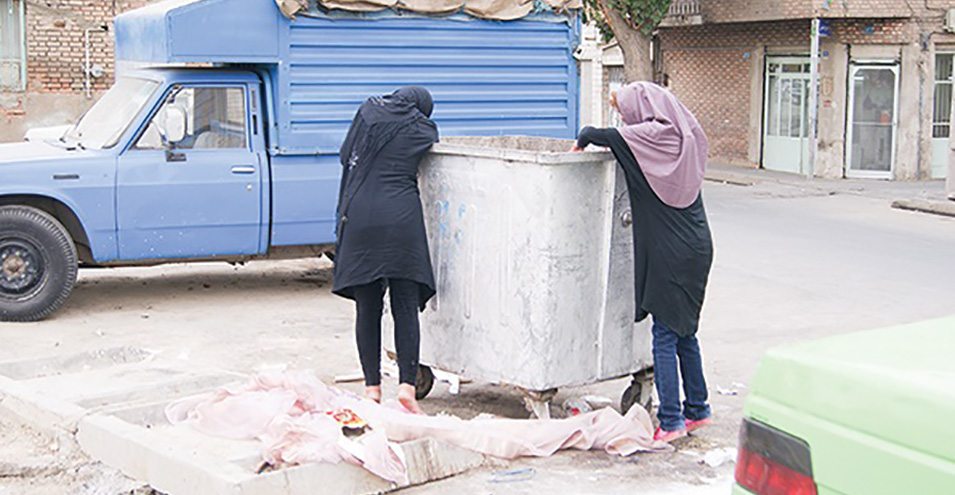
If it weren’t for the sounds of celebration and joy of the homeless who gather around each other in the late night, singing and dancing, you wouldn’t hear any sound from this area at all. Beyond the circles of 20 to 30 people using drugs on the sidewalk edges, in the back alleys you encounter people searching for their bread in garbage cans. Sometimes if you look carefully, a woman pulls her head out of a garbage can and steals a glance away from you. Local residents say that in recent years the number of women garbage collectors has increased more than before. Unemployment, poverty, and addiction are the main reasons for the increase in the number of women garbage collectors in the southern areas of Tehran. If civic rights for the middle and upper classes are defined with slogans such as gender justice, the right to access work and equal wages, the right to enjoy personal freedoms and anything like that, here poverty is distributed among everyone without any gender distinction.
First Account: Night, Always Outsider, Darvazeqar
“They brought some food, it will reach all of us if we wait”… A group is sitting in an alley using drugs. A woman with a masculine appearance stands with a half-empty hand truck of soda and mineral water bottles next to a scrap dealer and hears a man’s voice saying come on let’s get some alms food, but she seems unable to move herself. Her cigarette falls from her lip for the second time: “The grass under our feet turned green, now if she clears this ownerless thing.” She curses at earth and time. She had no patience to talk to anyone and her haggard face concealed her age. Perhaps 47 or 48, maybe even 10 years younger: “Now you came to report on our situation, what will happen. You want to write, they’ll film me and say does Tehran even have these kinds of people?” She says this loudly addressing us as we offer an interview from inside the car. A patrol vehicle suddenly enters the alley and everyone scatters. The hand truck is left next to the scrap dealer but we find Zeinab two or three alleys further. She sits on a curb next to the street and after persistent insistence, tells us about the hardships of her work: “The municipality won’t let us work during the day, if they see us collecting garbage they take it from us and empty it into recycling trucks. That’s from the nights too…
What most women garbage collectors complain about most is how recycling officials treat people who informally separate garbage and deliver it to garbage depots: “The municipality says the garbage is ours, you don’t have the right to collect garbage… If we don’t collect garbage, if we don’t do street vending, how else will we fill our stomachs?” She says under her breath: “It’s like garbage cans have owners in this country.”
Zeinab says collecting garbage is dangerous for women and children. Harassment and assault are the main problems for working women who are garbage collectors. They have another fundamental problem; buying garbage at the lowest price: “Because the municipality doesn’t buy garbage directly from women, we have to sell it to scrap dealers, and they beat us down so much that nothing is left of it, for a kilogram of aluminum they give us 1000 to 2000 tomans. Even that, if the men hadn’t told them, they would have calculated even less with us.”
She adds that the scrap dealers, who according to her are ultimately the municipality’s intermediaries, encourage them that if they want better income from this work, they should go to upper areas of the city and collect better quality materials. Zeinab points to some of the places she herself visits to collect garbage and says: “From Lavisan upwards are good places and the end of Tehranpars where the garbage depot is; these are places where you can find all kinds of garbage.”
According to her, most workers who choose garbage collecting as daily wage work are actually cheap tools for garbage buying intermediaries. Meanwhile, the situation of women and children who, without any support, pull their heads out of garbage cans due to poverty and need is far worse.
Zeinab says: “At night around 7 or 8 when it’s around Azari Intersection and Farahzad and City Park, it’s full of garbage collectors who are either addicts or have been forced into this work out of necessity. Otherwise who wants to go home every night smelling like garbage or like us become the subject of jokes every night in front of the kids in the shelter.” Zeinab points to the problems that await women and children in garbage transactions and says: “They buy very little. Very often they fool women and children or if they realize you’re an addict, they want other things from you before buying at a price. And if you don’t know the difference in garbage, they buy you below the real price.”
I ask her what garbage scrap dealers usually buy more of and she says: “All kinds of garbage; from iron, copper, soda and juice bottles to hospital waste. Each one has a price.”
City Park, Shush, Darvazeqar, Molavi, Azari Intersection, Farahzad, Lavisan Park, these are just some of the areas of Tehran where, besides children and men, you might occasionally encounter women garbage collectors. Yellow wounds, skin blisters and other sensitivities transmitted through direct hand contact with objects contaminated by humans are lurking for all garbage collectors.
Although men and children remain by far the main workers of garbage collection in formal and informal centers, from the accounts of women garbage collectors it appears that the destination for selling their garbage is mostly informal centers. Women usually move towards informal recycling centers (abandoned houses that are garbage depots) around 9-10 pm and hand over their garbage to people called superintendents for sale. Garbage collectors usually call these centers scrap dealers.
Second Account: Day, Always Outsider, Shush, Fedaiyan Islam Street
Bent at the waist inside the metal garbage can, pulling out black plastic bags one by one. It’s now around 5 in the afternoon. A black cloth is tied over her mouth so the stench of garbage doesn’t bother her. Her hands, without gloves, search among the garbage for “something useful” to collect. Upon opening one of the bags she says: “These are full of cans and glass, a few years ago one of these cut my hand almost to my wrist, I suffered a lot until the wound closed.” I ask why she doesn’t wear gloves. She answers: I had gloves, the kids stole them from me.
These are Shahla’s words, a woman garbage collector who has been collecting garbage for three years now. “I work from evening until around 11:30 pm or midnight. It doesn’t matter, I go everywhere. From Shush and Molavi to up there. The higher you go towards Shemiran and that way, the garbage becomes more useful. A few times so far I’ve gone towards Qeitriyeh, found gold, mirrors and candelabras among the garbage. Now I’m not saying it’s always like this but metal, cans, iron and everything is better than down in the city. Lady, the garbage of upper-city people is different from down-city.” Shahla is 52 years old and has a history of drug abuse. She says she doesn’t have the ability to work in the mornings until evening. “Until you fix yourself, you can’t work. When I get high, I get to work. Not just me but my other children who work in this area are the same.” It’s difficult for a woman her age to do such hard work as garbage collecting every day with a frail, lean physique for whom normal walking is difficult.
Shahla says sometimes delivering garbage is drawn out until the middle of the night. “It depends on how much you need. The more you collect the more money you get.” According to her, not all women who make a living this way are substance abusers. “Whatever we earn we spend on our drugs but some come to this work out of sheer necessity.”
She says she knows a woman who has a respectable reputation among neighbors and relatives and only does garbage collecting with her son to cover her living expenses and barely makes it through by selling recycled garbage. During our conversation, a fight breaks out among garbage collectors across the street. Shahla says: “See what kind of trouble they bring upon themselves here over two cents, sometimes accidents happen from these things too but I’ve never fought over money, God provides… ” I ask her who they sell the garbage to. She calls her friend Fereshteh and says: “I’m not going up there tonight, you guys go.” Then she turns to me, takes a cigarette from her pocket and says: “We have to separate the garbage first. Cans, metal, iron and glass each have different prices. Then at the end of the night we take them to these scrap dealers. They calculate with us very little there. The truth is I didn’t know how to do it before. Generally they don’t buy well from women, because intermediaries think it’s easier to fool women.”
The money paid for each kilogram of garbage to these people is around 1000 to 2000 tomans. Fereshteh, another woman garbage collector from Darvazeqar, says: “Sometimes instead of money they give goods to the kids. For example they say I’ll give you glass. I don’t use anymore, I say give me the money but they beat him down so much that I get nothing.”
Fereshteh is a 50-year-old woman who has been garbage collecting for a few years longer than Shahla. She separated from her husband about 15 years ago and has no news of her two children. “After my divorce I became an addict. First hashish and then heroin but now it’s been a year that I’m clean. Because of my expenses I work.” She says women in this area are not even accepted for household work and they have to do various jobs like garbage collecting to cover their expenses. When I ask her about the variety of people who collect garbage, she says: “All kinds. Children, women and men. In the beginning there were fewer women doing this work. Then there were more. It’s very hard work. Not everyone can handle it. Some do family work. That is, the husband is an addict so he brings his wife and child into the work…” Fereshteh talks about how she came to choose garbage collecting as her source of income, saying: “They stole my birth certificate, I said wherever I want to go look for work I need to have an ID document. I didn’t have money. One of my friends in the shelter said come collect garbage.” Fereshteh goes to a garbage can across the street and while digging through the garbage, speaks to us: “When Muharram comes, they buy aluminum containers well. I crumple them into these bags. This way I collect a lot of garbage. There’s so much scattered around, don’t even ask. In the end God provides. Just please tell people not to throw broken glass in the garbage. The kids don’t have gloves…..
Source: Online News