Revolutionary Guard’s Fear of the Streets; Intelligence Preparing for Crackdown on Future Protests
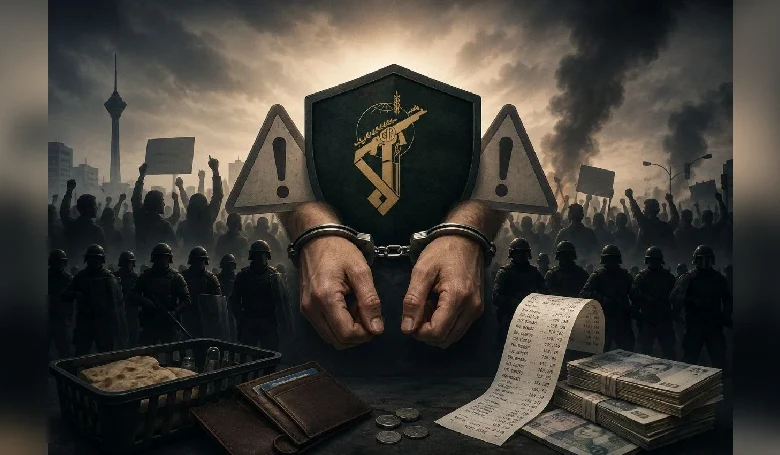
A warning from the Revolutionary Guard’s intelligence organization about the possibility of a new wave of protests, coinciding with the arrest of 30 citizens in Central Province and intensifying economic pressure, presents a clear picture of the government’s concern about people returning to the streets; a government that, instead of responding to the livelihood crisis and public discontent, has once again blamed the “enemy” and speaks of readiness for a security response to protesters.
The intelligence organization of the Islamic Revolutionary Guard Corps has issued a new statement warning about the possibility of a new wave of protests in Iran; a statement released simultaneously with intensifying economic pressures, rising currency rates, fuel shortages, and the arrest of citizens in connection with December protests, indicating that the Islamic Republic’s security apparatus is once again preparing itself to confront social discontent.
In its statement, the Guard’s intelligence claimed that the United States and Israel, after failing to change the government through military attacks, are now seeking to apply pressure from within, and that opponents of the Islamic Republic are changing their strategy. The security institution also mentioned “activation of crisis-generating centers, psychological warfare, inflation of monetary and financial markets, and anti-security operations” as part of what it calls “options for managing the Iran file.”
However, behind the security rhetoric of this statement lies a fundamental question: if public discontent is merely a product of foreign design, why have Iran’s economic and social crises become so deep?
The Guard’s intelligence statement attributed part of the internal problems to opponents’ attempts to “exaggerate and misuse” them. This is while reports from international media speak of severe economic pressure on Iranian society.
The Wall Street Journal in its latest report has reported on increasing economic pressure, labor protests, panic buying of essential goods, long fuel lines, and the collapse of Iran’s currency value. The media outlet has also reported that workers in sectors such as oil, petrochemicals, and education have protested due to unpaid wages and difficult living conditions.
Reuters has also written in its latest assessment that Iran’s economy, as a result of war, sanctions, and restrictions on oil exports, is under severe pressure, and the risk of domestic unrest has increased; in these circumstances, the government has adopted a harder line against opponents.
Therefore, the issue is not merely enemy psychological warfare. A significant portion of existing discontent stems from conditions that people face every day: inflation, reduced purchasing power, fuel shortages, employment crisis, and economic instability.
Turning all these problems into an “enemy project” may be simple for the security apparatus, but it is not a real answer to society’s demands.
Simultaneously with the Guard’s intelligence warning, Iran’s Ministry of Intelligence reported the arrest of 30 citizens in the towns of Mahallati and Nimvor in Central Province. The Ministry of Intelligence claimed that these individuals participated in December 2025 protests and played a role in destroying or setting fire to homes, shops, banks, ambulances, private vehicles, and some government and public buildings.
It was also claimed that cold weapons, alcoholic beverages, and narcotics were found from some of the detainees. However, the important point is that the released announcement did not disclose the names of any of the 30 people, the exact time of arrest, the place of detention, or the formal charges against each of them. The HRANA news agency has also noted this lack of information. This situation makes it difficult to independently verify the Ministry of Intelligence’s claims.
Accusations of destruction of public property or attacks on government centers are, if proven, serious matters; however, merely announcing an accusation by a security institution does not substitute for a transparent judicial process and fair trial.
The nationwide December 2025 protests did not remain confined to the streets of a few cities. The protests began with strikes and gatherings of shopkeepers and bazaar merchants and then spread to other groups and cities.
During the crackdown on these protests, multiple reports were released of protester deaths, injured citizens, and widespread arrests.
The UN Human Rights Council in January 2026 condemned the crackdown on Iran’s protests and, by extending the mandate for investigating the human rights situation, called for continued documentation of human rights violations for possible use in future legal proceedings. Volker Türk, UN High Commissioner for Human Rights, also said: “Violent suppression of the Iranian people does not solve any of the country’s problems; on the contrary, it creates conditions for further human rights violations, instability, and bloodshed.”
This position indicates that concern about the Islamic Republic’s treatment of protests is not limited to government opponents or Persian-language media and has been raised at the level of international human rights institutions.
The main concern about the new arrests is not only the deprivation of freedom. In recent months, protest-related cases have in some instances led to serious security charges and death sentences.
Amnesty International announced in May that since the beginning of American and Israeli attacks in February 2026, more than 6,000 people have been arbitrarily arrested in Iran; these individuals include protesters, journalists, lawyers, human rights defenders, and members of various social and religious groups. The organization has also warned about unfair trials, torture, forced confessions, and the execution of death sentences.
Amnesty International also reported in another report in July that at least 60 others, including three who were children at the time of the alleged crime, face the risk of execution. The organization also stated that the Islamic Republic, in the first half of 2026, has increasingly used broad security charges, including “espionage” and “cooperation with hostile governments,” to issue severe sentences against arrested protesters.
This process underscores the importance of the recent Guard’s intelligence warning: the government is not merely speaking of the possibility of new protests; simultaneously, the security and judicial mechanisms for dealing with protesters remain active.
One of the consistent features of the Islamic Republic’s security rhetoric is attributing internal discontent to foreign powers.
This time, too, the United States and Israel have been placed at the center of the Guard’s intelligence narrative. Of course, there is no doubt that foreign powers pursue their own political and security interests in Iran’s developments and may use internal discontent to pressure the government. However, the existence of such efforts does not erase the principle of people’s discontent.
If people are dissatisfied with high prices, if workers have not received their wages, if fuel has become scarce or the national currency’s value has collapsed, one cannot eliminate the root problem by attributing all these issues to “enemy operations.” Even if a foreign enemy is truly seeking to exploit people’s discontent, the question still stands: what has made society so discontent that foreign exploitation of this discontent has become possible?
In this tense atmosphere, Donald Trump has also reacted to the crackdown on protesters in Iran. Trump wrote on his Truth Social account, describing the Islamic Republic as being in a state of collapse: “The Islamic Republic of Iran, which is collapsing, does not even pay the salaries of large portions of its own military forces and at the same time kills protesters at levels never seen before, even when they are not protesting. This is a massive human tragedy and must be stopped now.”
These remarks were widely echoed in Persian-language and regional media and were released simultaneously with reports about the continued issuance and execution of death sentences in Iran.
Nevertheless, Trump’s reaction should also be seen within the broader framework of the U.S. government’s policy toward the Islamic Republic; a policy that has simultaneously included economic pressure, sanctions, and military measures. Therefore, Washington’s defense of protesters’ rights does not necessarily mean American political neutrality toward Iran.
Perhaps the most important part of the Guard’s intelligence statement is not its accusations against the United States and Israel, but rather its implicit admission of concern about the return of protests. When a security apparatus formally warns about “the transfer of discontent to the streets,” it is in fact admitting that social discontent is a real and serious matter.
If society were completely calm and satisfied, there would be no need for such widespread warnings about “crisis-generating centers,” “market inflation,” “psychological warfare,” and the possibility of street protests. On the other hand, the arrest of 30 people in Central Province in connection with protests months earlier shows that the security apparatus continues to pursue files from past protests. These arrests, alongside new warnings, present a picture of a concerned government preparing for security prevention of future protests.
The United Nations has also warned that violent suppression not only fails to solve Iran’s problems but creates conditions for further instability and bloodshed. Therefore, the Guard’s intelligence warning can be read from another angle: “This is not merely a warning about ‘future protests’; it is an admission that the government still faces deep discontent that security responses have failed to resolve.”
In the Islamic Republic’s narrative, a protester may be an “enemy agent,” and in the narrative of some foreign powers, people’s protests can be an opportunity to pressure Iran’s government. However, between these two narratives, one human truth must not be lost: the Iranian people have the right to protest about their living conditions without being labeled spies, agitators, or tools of a foreign power.
If someone has committed a violent crime, they should be tried in a fair court with access to a lawyer. However, peaceful protest, criticism of the government, and demands for a better life should not be an excuse for suppression, arbitrary arrest, or deadly punishment.
What is being seen in Iran today is, more than anything, a vicious cycle: “Economic crisis, discontent, protest, labeling as ‘enemy,’ arrest and crackdown, increased anger and distrust, and then government concern about the next protest.”
Perhaps breaking out of this cycle lies not in intensifying crackdowns, but in accepting people’s right to be heard, government accountability, and respect for human dignity. And if the government continues to see every protest as an “enemy project,” it may eventually face a reality that can no longer be explained away by security statements: people who are dissatisfied with their lives and are no longer willing to have their real problems hidden behind the word “enemy.”