Behind the 200,000 Toman Dollar: People with Nothing Left to Cut
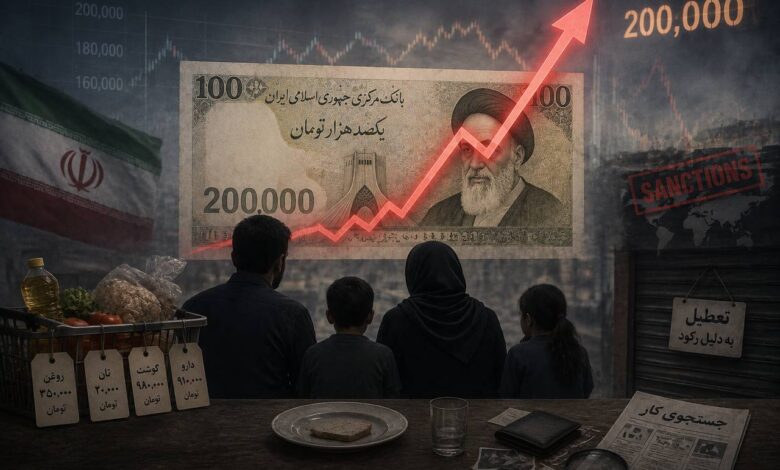
The dollar’s crossing the 200,000 toman threshold is not merely the setting of a new record in the foreign exchange market; it is a snapshot of an economy whose cost of collapse ordinary people are bearing by shrinking their tables, eliminating medical treatment and leisure, selling assets, and losing jobs. While fresh American sanctions and political uncertainty have placed greater pressure on Iran’s economy, accounts published by citizens reveal that many have moved beyond economizing and have reached the stage of cutting essential needs from their lives.
In Iran, the dollar exchange rate is no longer merely an economic indicator. Every jump in currency prices reflects itself in the cost of food, medicine, housing, automobiles, clothing, and services, directly reducing household purchasing power.
The dollar has risen from around 100,000 tomans to over 200,000 tomans in the span of one year—an event that signals a severe devaluation of national currency and increased pressure on a population whose incomes have not kept pace with inflation.
But behind this number stands the life of millions. Behind the 200,000 toman dollar stands a teacher whose salary does not last until the beginning of the month; a mother forced to sell her car to cover budget shortfalls; a family that removes meat and dairy from the table; an employee who postpones homeownership indefinitely; and a doctor worried that rising medicine prices will force patients to cut food and other essential needs.
The accounts recently published by citizens on social media regarding their economic condition share a common thread: people first cut entertainment and travel, then clothing and unnecessary purchases, then restaurants, sports, and supplementary education; but now economic pressure has reached a point where even basic foodstuffs and primary needs are being eliminated from household budgets.
An elementary school teacher with a monthly income of around 20 million tomans has said that her salary, with inflation, does not even last the first ten days of the month.
She spoke of cutting out cinema, theater, concerts, and clothing purchases, and reducing consumption of fruit and meat, emphasizing that families of her students also lack the means to pay school expenses or send their children on field trips.
This is no longer economizing; it is the gradual shrinking of life. When a family stops traveling, then eliminates restaurants, then cuts clothing purchases, then reduces meat and dairy, and finally their only concern becomes “filling our stomachs,” the economy is no longer merely playing games with people; it is consuming their quality of life and their future.
One published account presents a sobering picture of the livelihood situation: everything is purchased on installment, even food provision has become installment-based and turned into part of household debt. This sentence may seem simple, but it reveals the depth of a crisis.
A society in which people are forced to purchase basic necessities on installment plans is not merely facing inflation but confronting a purchasing power crisis. In such conditions, each price increase means the elimination of another aspect of life.
If a family cannot afford meat today, perhaps they will cut dairy tomorrow. If they cannot afford rent, they move to a cheaper neighborhood. If they can no longer bear housing costs, they are forced to sell assets, and finally, when nothing remains to sell or cut, what then?
Among the published accounts, a 51-year-old woman who identified herself as a household provider said her monthly income is around 33 million tomans, while she estimates the cost of a normal life at 90 to 100 million tomans. To bridge this gap, she sold her car.
This account raises a fundamental question: “How many times can assets be sold to compensate for declining purchasing power? A car can be sold once, gold can be sold, savings can be spent, but what comes after?”
When income and living costs diverge by multiples, a family is no longer managing economically; it is consuming its own future. The crisis is not merely about the dinner table; the future is also being eliminated.
One of the most dangerous effects of economic crisis is not only hunger or reduced consumption; it is the loss of the ability to plan for the future.
In the published accounts, individuals speak of forgoing home purchases, migrating to cheaper cities, selling cars, cutting sports and education, and worrying about their children’s futures.
A 42-year-old employee with an income of around 40 million tomans and personal property has said that steep increases in gold and housing prices have caused his plans for buying a home and other financial goals to be essentially abandoned. This means the economic crisis has not targeted only the poorest segments; the middle class is also retreating, and when the middle class shrinks, society will face a far deeper crisis than mere price increases.
New American sanctions and political and military tensions have also cast a shadow over this situation. Reduced economic activity, job losses, trade disruptions, and increased uncertainty place greater pressure on families that already had limited financial means. But ultimately, who pays the cost of these crises?
Not those making decisions about sanctions from outside Iran, not officials or authorities with special privileges; but the Iranian family inside the country bears the main cost—the same family that must purchase goods priced in dollars with rial wages and live with an uncertain future.
Iranians should not be seen through statistics; behind every number is a life. The 200,000 toman dollar may be just a number on a chart for an economic official, but for a mother it means increased medical costs for her child; for a teacher, it means removing meat and fruit from the table; for a renter, it means inability to pay rent; for a young person, it means the dream of marriage and homeownership receding further; for a worker, it means fear of unemployment; and for a family, it means they can no longer plan even for the next few months.
Iran’s economy cannot be explained solely through exchange rates, inflation, and official indices. Iran’s economy must be seen in people’s tables, in refrigerators becoming emptier, in medicines being delayed, in homes being sold, in jobs disappearing, in children being withdrawn from classes and trips, in body parts being sold due to poverty, and in young people viewing their futures as impossible.
Eyes must be opened to people’s lives. What is happening in Iran today is not merely a currency crisis. A crisis exists when a family is forced to purchase food on installment; a crisis exists when a mother and household provider sells her car to pay living expenses; a crisis exists when a teacher, despite working full-time, runs out of salary before month’s end; a crisis exists when people forgo purchasing medicine, fruit, meat, clothing, housing, and even travel and leisure; and a greater crisis exists when people feel there is no horizon for improvement.
Iranians should not be seen only when protests form or statistics are published. Behind every dollar surge, behind every price increase, and behind every inflation chart live human beings who have been paying for years the cost of political, economic, and administrative decisions from their own pockets and tables.
If the world’s eyes are to be opened to Iran, one must look beyond the number 200,000 tomans and see the people standing behind this figure; a people with nothing left to cut from their lives.
Author: M.R