Islamic Republic and Years of Suppression of Religious Minorities in Iran: Three Bahai Women Behind Bars
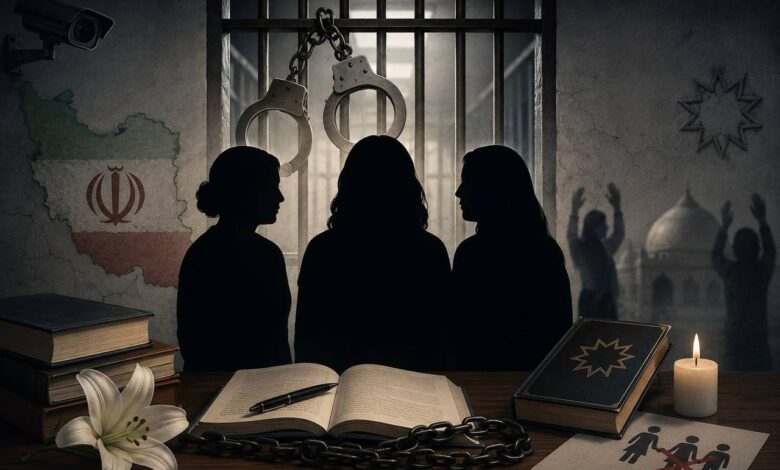
The one-month extension of the detention of Soraya Manoochehrzadeh, Shima Senai, and Fakhra Zahedi in Sari has once again drawn attention to the systematic suppression of religious minorities in Iran; a place where Bahais and Christians have for years faced arrest, deprivation, security pressure, and restrictions on freedom of worship and expression of religious beliefs.
Soraya Manoochehrzadeh, Shima Senai, and Fakhra Zahedi, three Bahai citizens residing in Sari, continue to spend time in Tirkal Prison following seven days of detention, and their detention order has been extended for another month.
These three women were arrested on Saturday, August 31, 2026, by government forces. According to HRANA, their families visited the Sari Prosecution Office on Wednesday, September 4, and were verbally informed of the extension of their detention order.
According to human rights reports, Shima Senai was arrested at her father’s residence by forces of the Ministry of Intelligence, and the house was simultaneously searched. Books, religious images, and some of her personal belongings were confiscated. It has also been reported that in the case of Soraya Manoochehrzadeh, security forces searched her family’s residence during the arrest and confiscated personal and electronic items.
Maral Roushani and Negar Badi’i were also arrested in Sari on the same day, but were released after a few hours. In total, five Bahai women in Sari were subjected to arrest. This case cannot be examined separately from the long history of the Islamic Republic’s dealings with the Bahai community.
The global Bahai community has announced that between August 31 and September 3, homes and business premises of Bahais in seven provinces of Iran were searched, and at least 11 Bahai citizens were arrested or sent to prison to serve previous sentences. Personal property, business equipment, cash, and other items were also confiscated in some cases.
These pressures are not limited to arrests alone; Bahais in Iran have faced, over the years, deprivation of education, employment restrictions, business closures, confiscation of property, and judicial pressures. The U.S. International Commission on Religious Freedom has also criticized Iran for suppressing religious minorities, including Bahais and Christians.
The Christian community in Iran has also faced security and judicial pressures over the past decades; particularly convert Christians and house churches that are not recognized by the government.
The British government report on the situation of Christians in Iran in June 2026 states that Christians, especially those who have converted from Islam to Christianity since the 1978 Revolution, are not recognized in Iran as an official Christian community.
The Center for Human Rights in Iran has also reported that in recent years, hundreds of Christians in Tehran have been persecuted, and a significant number have faced sentences of long-term imprisonment.
Therefore, what befalls the Bahais is part of a broader issue: the Islamic Republic accepts freedom of religion and conscience only insofar as it does not conflict with the government’s ideological framework.
Bahais and Christians, despite their doctrinal differences, share a common point: their right to choose and express their religious beliefs has repeatedly been met with government interference.
In the case of Bahais, this pressure has even extended to economic deprivation and confiscation of property, and concerning Christians, arrest, trial, and restrictions on church activities have been reported.
Therefore, the extension of detention of three Bahai women in Sari is not merely a legal news item; it is a repeated reminder that in the Islamic Republic, religious minorities have for years paid the price for their most basic right: to live and worship according to their beliefs.
For a government that presents itself as a defender of religion, suppressing people because of their faith is one of the most serious contradictions. Faith should not be a crime, and no government should arrogate to itself the right to determine people’s beliefs.