Death Sentence for “Reza Zanganeh,” Victim of Murky Case Accused of Collaboration with Mossad
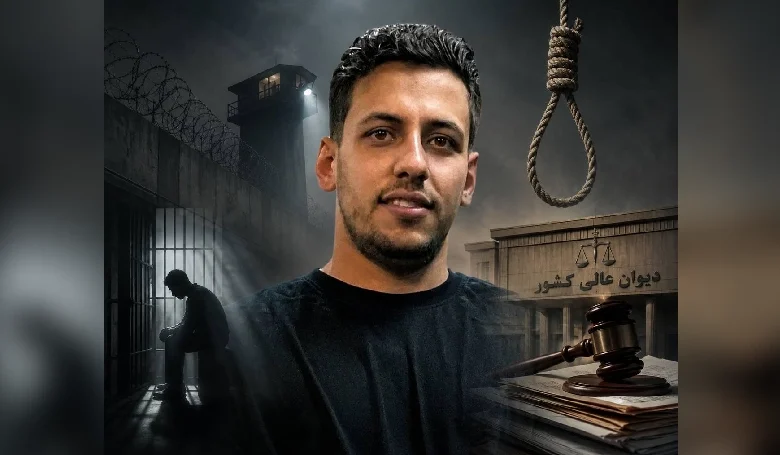
“Reza Zanganeh,” a 27-year-old young man and newlywed who, according to his family, faces charges of “collaboration with Mossad” solely because of his occupation as a foreign car mechanic and his work-related travels abroad, now faces a death sentence in Qazal-Hassar Prison. This is a case in which the details of the evidence against him remain unclear, and now the fate of a young citizen is being decided in the Supreme Court of the country.
Reza Zanganeh, a 27-year-old citizen from “Kalil-Abad village” in Malayer and resident of Malard, is currently held in Qazal-Hassar Prison in Karaj in circumstances where his fate may end with the execution of a death sentence following the issuance of the judgment.
According to reports released by human rights sources and Iran Wire, Zanganeh faced charges of “moharebeh” (waging war against the state) following his arrest in Farvardin 1405 (April 2026), and his case has been sent to the Supreme Court for review of his appeal. Iran Wire confirmed in its English report that the charge of “collaboration with Mossad” has been raised in the case, but the evidence or specific action that formed the basis for the charge of “moharebeh” remains unclear.
This point is the most critical aspect of Reza Zanganeh’s case: a death sentence has been issued in circumstances where even the details of the legal basis of the main charge have not been clarified to the public.
Reza Zanganeh returned from Malayer to Karaj on April 2, 2026, corresponding to 13 Farvardin 1405, and the next day, when he opened his workplace, security forces entered and arrested him. Several shopkeepers in the area witnessed his arrest and informed his family.
Zanganeh was a technician and mechanic specializing in foreign cars—a profession that, according to his family and associates, has now become one of the focal points for formulating the charge of “collaboration with Mossad” against him. His family and associates have rejected this charge, stating that his foreign travels and professional activities in foreign car repair have been used as a pretext to level accusations against him.
Nevertheless, until the Islamic Republic’s judicial system releases specific evidence from the case, there is no possibility of independently assessing the claims made against Zanganeh.
The charge of “collaboration with Mossad” has been raised in recent years in several security-related cases in Iran and can have severe consequences for the accused. However, in Zanganeh’s case, what has been released so far from independent sources does not present a clear picture of specific actions that could prove this charge.
Iran Wire has stated that it is unclear what evidence or actions have been used to prove the charge of moharebeh in his case. This ambiguity becomes more serious when we consider that the case has now gone to the Supreme Court and the result of the review could determine the fate of a 27-year-old young man.
“Moharebeh” in the Islamic Republic’s criminal system is among those charges that can carry a death sentence.
Human rights reports have repeatedly warned in recent years about the use of charges such as “moharebeh” and “efsad fi-l-arz” (corruption on earth) in security and political cases.
The U.S. State Department’s report on Iran’s human rights situation previously stated that Revolutionary Courts have in numerous cases deprived defendants of fair trial and, in some cases, have used forced or coerced confessions as evidence.
This precedent alone does not prove that such an occurrence has happened in Reza Zanganeh’s case; however, it doubles the importance of questions regarding the right to access a lawyer, the transparency of evidence, and the fairness of legal proceedings.
Zanganeh’s family has also been under pressure throughout the months of his detention, and this has prevented information about his case from being released for a long time.
Iran Wire has also reported that pressure on the families of detainees and the creation of forced silence, particularly regarding cases related to protests and the 40-day conflict, has prevented public access to accurate information about the stages of interrogation and investigation.
In such circumstances, not only must the family of a prisoner live with anxiety over the fate of their loved one, but they may also, for fear of security consequences, not even have the ability to freely inform the public about the case.
Amid heavy legal terms such as “moharebeh” and “collaboration with Mossad,” a human reality is easily forgotten: “Reza Zanganeh, 27 years old, was recently married.”
Before his arrest, he was a car mechanic—a young man pursuing his professional and personal life, and now his fate is entangled in a security case with a death sentence. For a judicial system that imposes capital punishment in such cases, the burden of proving the charge must be equally weighty. When the punishment is taking a human life, ambiguity cannot substitute for evidence.
Reza Zanganeh’s case has arisen at a time when the Islamic Republic continues to use the extensive application of capital punishment and security charges to deal with critics, protesters, and those accused in political cases.
Human rights organizations have repeatedly warned in recent years about the use of capital punishment as a tool of political repression in Iran. The Iran Human Rights Organization has also documented in its reports the use of charges such as “moharebeh” in political and protest cases.
In such an environment, the case of a 27-year-old young man who, according to his family, has been charged with espionage linked to his profession and foreign travels, raises serious questions about judicial standards and the level of transparency of the Islamic Republic’s judicial system.
Of course, a distinction must be made between accusation and proof of guilt. Neither the charge of “collaboration with Mossad” nor the charge of “moharebeh” is, in itself, proof of guilt without the presentation of reviewable evidence; however, all eyes are now on the Supreme Court.
After the issuance of the judgment, Zanganeh’s family had only 12 days to file an appeal, and the case is now before the Supreme Court for review. Thus, the case has entered a phase that could be one of the most important opportunities for independent review of evidence, examination of the proceedings, and protection of the defendant’s right to defense.
The fundamental question is: “If there is evidence against Reza Zanganeh, why have its details not been clarified to the public and independent institutions? And if no such evidence exists, is the Islamic Republic’s judicial system willing to prevent the conversion of a security charge into a death sentence?”
For a human being, there is no opportunity for return from death. For this reason, in a case whose likely outcome is execution, transparency, fair trial, and real access to legal counsel should not be privileges but rather the minimum rights of a human being.
Reza Zanganeh is now awaiting the decision of the Supreme Court—a decision that for him is not merely a legal ruling but could mean the difference between returning to life and the most irreversible punishment possible.