Buildings Can Be Restored, But Reviving a Diaspora Community Is Far More Difficult
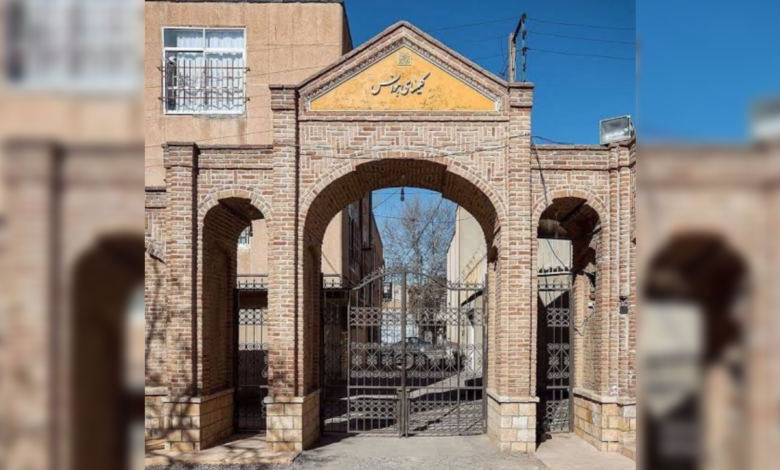
The historic Hovhannes Church in Maragheh was restored after years of renovation and reconstruction at a cost exceeding 100 billion rials, but behind the news of this Christian structure’s revival lies a more bitter reality: a church that once served as a place of worship and life for the Armenian community of the city now stands in a city where virtually no Christians remain, and the heritage of an ancient community has become a memorial to the past rather than a living center of religious life.
After several years of restoration work, the reconstruction of the historic Hovhannes Church in Maragheh has been completed—a structure that represents one of the most important indicators of the historical presence of Armenians in this city and is considered a significant Christian monument in Azerbaijan, Iran.
According to published reports, over 100 billion rials have been spent on the restoration and rehabilitation of this complex. The project has been pursued in several phases since 1396 (2017-18), with various sections of the building, grounds, and facilities undergoing restoration and organization.
Hovhannes Church is also registered in Iran’s list of national monuments and holds particular significance from an architectural perspective, in the history of Christianity in the region, and regarding the historical presence of Armenians in Maragheh. Available sources on the history of this site contain varying accounts; some Persian sources trace its roots to the fifth and sixth centuries CE, while other historical sources speak of a church from the sixteenth century, and the current building is attributed to 1840 CE.
For this reason, the importance of Hovhannes is not limited to the antiquity of a single structure. This church is part of the centuries-long history of the Armenian community in Iran—a community that for centuries had a presence in cities such as Maragheh, Tabriz, Khoy, Salmas, and Isfahan, and played a role in shaping Iranian culture, education, commerce, and social life.
The Hovhannes building is not merely a simple place of worship. This historic complex consists of sections for worship, a school, and the bishop’s residence, and its architecture possesses characteristics that distinguish it from many other religious buildings in the region.
The building’s entrance is situated beneath a vaulted arch, with a pyramidal dome and the church’s belfry located in this section. The worship space is located in the eastern part of the building and includes three arches with wing-shaped vaults. The central arch is larger and has windows with colored glass.
These architectural details acquire their true meaning and function when we understand that the church was not merely a building structure, but was part of the life of a Christian community. The school, place of worship, and clergy residence stood adjacent to one another, and the church was effectively one of the centers of the social and religious life of Maragheh’s Armenians. Today, however, this social function has largely disappeared.
One of the most important aspects of the Hovhannes story is not the building itself, but the community that no longer surrounds it.
A report published in 2012 by the Armenian media outlet Hetq regarding the restoration of Hovhannes Church noted that Maragheh was once a region with a significant Armenian population. According to this report, in the 1960s approximately 60 Armenian families lived in the city and an Armenian school was active in Maragheh; but by the time of publication, no Armenians remained in the city, and most had migrated to Tabriz.
This reality gives the news of the church’s restoration two dimensions. On one hand, the preservation and reconstruction of a historic Christian building is a positive development and can be a sign of the importance of Armenian heritage in Iran’s history. On the other hand, when a church that once served as a place of worship and education for a living community remains today without a local Christian community, its restoration alone cannot be equated with preserving that community’s heritage.
The building has remained, but the community for which it was built no longer has a presence in that city. Now Hovhannes has transformed from being a place for regular Christian worship into a historical monument and tourist attraction.
This change in function is the fate of many historic churches in regions of Iran that have experienced a decline in Armenian population in recent decades. Churches, schools, cemeteries, and other markers of Armenian life continue to exist in parts of cities, but the community that gave them meaning has either shrunk or migrated to other cities and even outside Iran.
An Armenian report on the restoration of Hovhannes in 2012 also pointed to this contradiction: “The Iranian government was spending money to preserve a historic church, even though no Armenians remained in Maragheh.”
This situation raises an important question: Is the preservation of a religious building sufficient without preserving the community that kept it alive?
The exodus of Armenians from Maragheh cannot be attributed to a single factor. Historical research on Armenian migration from Iran shows that this process had various political, economic, and social roots and intensified during different periods.
A study published in the digital library of Armenian universities describes the migration of Armenians from Iran in the second half of the twentieth century as an important political and social transformation for the Armenian community and Armenia, and points to complex political and economic conditions following World War II and during the 1960s.
Other studies view the factors of migration more broadly—from the 1979 revolution and the Iran-Iraq War to economic conditions, sanctions, and social restrictions. Based on research on Iran’s Armenian community indexed in UN sources, the Armenian population in Iran was far greater in the 1960s and 1970s than it is today, and following the Islamic Revolution, another wave of migration occurred.
As a result, the depopulation of Maragheh of Armenians should not be reduced merely to an individual decision or simple economic migration. This occurrence is part of a larger process of reduction and displacement of certain historic Armenian communities in Iran.
Hovhannes Church is now restored; its walls, roof, and historic sections have been preserved, and the building can again find an important place in the region’s tourism map, but cultural heritage is not merely brick, stone, domes, and windows.
A community’s heritage is its language, its rituals, its schools, its families, its memories, and a generation that transmits these elements to the next generation. When a community leaves a city, preservation of the remaining structures, while necessary, preserves only part of the story.
In the case of Hovhannes, this contradiction is seen symbolically: a Christian church is restored with considerable public funding, but the community that once worshipped there, had schools, and lived in the same city has been virtually erased from Maragheh’s social scene, much like St. Peter’s Church on Thirty-Tir Avenue in Tehran.
This contradiction raises a larger question about the policy of preserving the heritage of religious minorities in Iran. The preservation of historical monuments will be more complete when, alongside buildings, the possibility of presence, activity, and continuity of historic communities is also ensured.
Hovhannes Church in Maragheh can be considered an example of a larger reality: Iran is not only home to pre-Islamic ancient monuments; churches, monasteries, and other Christian structures are also part of this land’s history.
Even official Armenian institutions have registered Hovhannes Church in Maragheh in the list of buildings belonging to the Armenian Catholicosate of the Caucasus. Therefore, the restoration of Hovhannes should be considered a positive development for the preservation of Iran’s Christian heritage. But the true value of this measure will be greater when such preservation efforts are not limited to reconstructing the walls of a historic building, and the issue of the continuity of cultural and religious life of Iran’s Christian communities is also given attention.
Today Hovhannes stands, but the sound of its bell is no longer an ordinary part of daily life in Maragheh’s Armenian community. Perhaps this image itself is the most eloquent account of the fate of part of Iran’s Christian heritage: “Buildings can be restored, but reviving a diaspora community is far more difficult.”