Out-of-School Children: While Poverty is Iranians’ Share and Billions of Dollars Fund Proxy Forces
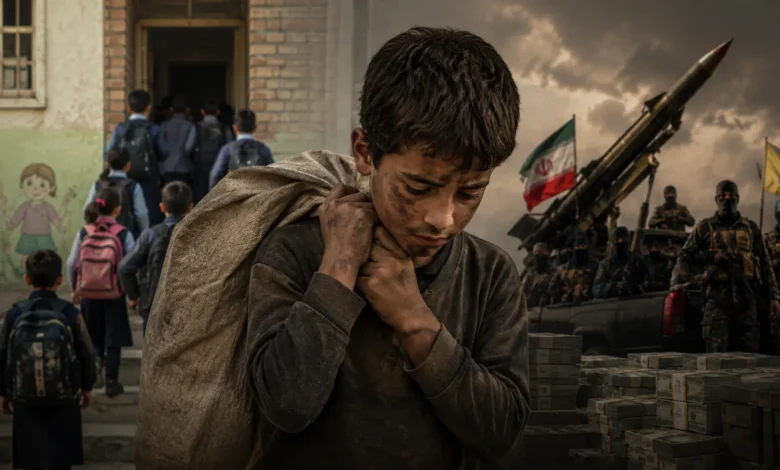
In Iran, for thousands of children and adolescents, school is no longer just a few kilometers away; sometimes it lies behind walls of poverty, forced labor, lack of transportation, and family deprivation. Meanwhile, resources that could have been allocated to the education and future of these very children are being spent on the Islamic Republic’s regional policies and financial support for proxy groups. Yet every Iranian child has the right to go to school without their family’s poverty determining their future, to receive an education, and to build their own destiny.
As the new school year approaches, fresh reports on the state of education in Iran have once again highlighted an issue that has been repeated for years in official statistics and independent reports: poverty is one of the most important obstacles to children’s access to education.
In West Azerbaijan, the provincial director of education reported identifying 17,848 out-of-school students. According to these figures, 4,634 students have dropped out of school due to employment and helping to cover family expenses, while poverty has been cited as the reason for 2,701 students’ dropout. Marriage and distance from school have also been mentioned as other reasons.
These numbers are not just statistics. Behind each figure stands a child; a child who, instead of sitting at a school desk, may work to help their family, walk kilometers to reach school, or drop out entirely due to lack of educational facilities.
Previous reports on deprived areas in West Azerbaijan have also documented the role of geographic distance, lack of educational spaces, poverty, and child labor in intensifying this crisis. In the same province, education officials have spoken of dilapidated schools, overcrowded classrooms, and shortage of educational facilities.
However, the problem is not limited to one province. Analysis by “Iran Open Data” based on available data shows that Iran’s education crisis has taken on national dimensions. The organization reported that nearly one-third of young adults aged 18 to 24 lack diplomas, and in some provinces the situation is far more critical. Furthermore, based on the data reviewed, poverty and class inequality have directly impacted the educational opportunities of children and adolescents.
BBC Monitoring also, citing a report by the Parliamentary Research Center on child labor, noted that approximately 15 percent of children under 15 in Iran participate in some form of economic activity, and two-thirds of these children do not attend school. The same report stated that the number of out-of-school children in the 2022-2023 academic year reached approximately 960,000.
In other words, a child who should be worried about exams, books, and university prospects may instead be worried about rent, feeding the family, or daily expenses. In such circumstances, the question is not merely “Why are children dropping out of school?” The bigger question is: why should poverty determine a child’s future in a country with enormous energy resources and oil revenues?
This question becomes even more pressing when we place the heavy costs of the Islamic Republic’s regional policies alongside the living conditions of ordinary people.
In November 2025, John Hurley, U.S. Deputy Treasury Secretary for Terrorism and Financial Intelligence, told Reuters that Iran transferred approximately one billion dollars to Lebanon’s Hezbollah that same year. The U.S. Treasury Department also stated that the Quds Force of the Islamic Revolutionary Guard Corps has transferred more than one billion dollars to Hezbollah since the beginning of 2025, primarily through currency exchange companies and networks.
This point must be clear: this one billion dollars is not aid to the people of Lebanon. The issue is financing Hezbollah, an armed group allied with the Islamic Republic. In contrast, millions of Iranians inside the country struggle with inflation, reduced purchasing power, and costs of healthcare, housing, and education.
It is within this gap that a major moral and social question takes shape: when an Iranian family cannot afford school supplies or transportation costs for their child, should not the priority of the state’s public resources be to provide education, healthcare, food security, and a future for these children?
Article 30 of the Islamic Republic’s Constitution also obligates the state to provide free educational facilities for all people through the end of secondary education. Yet multiple reports on school dropout, child labor, and educational deprivation indicate that a deep gap has formed between this constitutional promise and the reality of life for many families.
The tragedy is not only visible in empty classrooms and working children. Economic pressure and the collapse of social support can put families in conditions where the consequences sometimes lead to fatal tragedies.
In a recent case, the Hrana news agency reported, citing Rokna, the murder of a 23-year-old woman and her two young children in Mashhad; a 26-year-old man ended his life by jumping from a parking garage following this crime. Hoghugho also announced the victims’ identities, noting that the motive for the crime was unclear at the time of reporting.
Therefore, one cannot definitively attribute this crime to poverty without valid evidence. However, such incidents, alongside the economic crisis, increasing social harms, and weak support for vulnerable families, send a serious alarm about the country’s social condition.
In another case reported in Mashhad, a 46-year-old father spoke about the pressure from his child’s condition after killing his 10-year-old son who suffered from a brain tumor, and his wife subsequently attempted suicide (but survived). This case too shows how families struggling with illness, heavy costs, and inadequate support can face severe crises; though one cannot extract a general and definitive relationship between poverty and murder or suicide from a single case.
But the problem extends beyond one family or one city. A child who drops out of school today is Iran’s future tomorrow. If poverty pushes them into early labor, if lack of school and educational services keeps them from the classroom, if their family must choose between bread and education, the country loses not just a student, but part of its future. Iranian children should not pay the price for policies they had no role in shaping.
Iran’s wealth and resources must first and foremost serve the lives of Iran’s people; for a school that a rural child can reach, for books that a poor family can afford, for school transportation that brings a girl or boy from a border village to class, for the treatment of a sick child, and for a family that should not have to sacrifice their child’s future out of desperation.
The people of Lebanon, like the people of Iran, deserve life, security, and prosperity; but supporting the Lebanese people is not the same as financing armed groups. If the Islamic Republic truly cares about the region’s people, its first duty should be to respect the rights of Iran’s people and allocate the country’s resources to their basic needs.
The right to education is not a privilege; it is every child’s right. No child should drop out of school because their family is poor. No adolescent should trade books and classes for work to make a living, and no government should sacrifice the future of the next generation to its political and military priorities. The Iranian child has the right to remain a child, to study, to dream, and to build their own future.