United Nations Demands Clarification on Confiscation of St. Peter’s Church
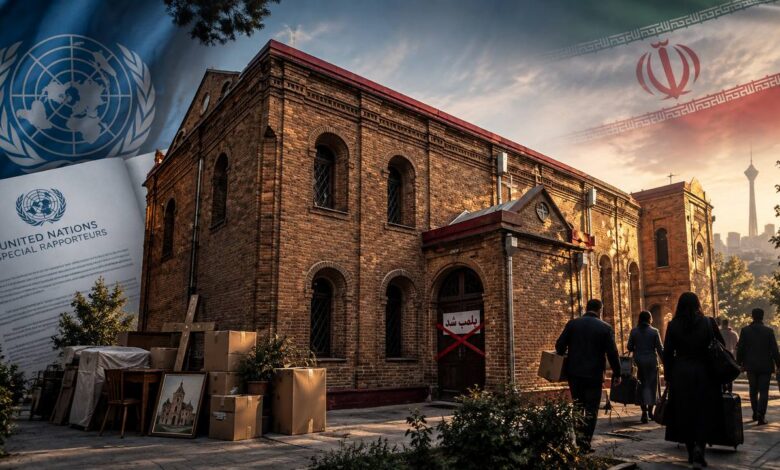
Two United Nations special rapporteurs have expressed serious concern by publishing details of an official correspondence with the Islamic Republic regarding the confiscation of the historic evangelical St. Peter’s Church complex in Tehran, the expulsion of 27 residents, and the forced closure of the church. According to UN experts, this action is not an isolated incident, but part of a multi-decade process of restricting Iran’s Christian community, particularly Persian-speaking Christians. The correspondence, sent on July 10, was made public on September 11, 2026, after the 60-day response period expired, during which the Islamic Republic had not provided any response to the rapporteurs’ questions.
Mai Sato, UN special rapporteur on human rights in Iran, and Nazila Ghanea, UN special rapporteur on freedom of religion or belief, have formally requested clarification from the Iranian government regarding the fate of St. Peter’s Church and its residents. They stated that received information shows that 20 families living in the complex, comprising 27 members of Armenian and Assyrian Christian communities, were given only two weeks to vacate their homes—families, some of whom had lived in this location for years and even decades.
According to the UN document, in late June 2026, eviction orders were issued to families residing in the complex, and worshippers were instructed to attend services at other churches. It has also been reported that six Ministry of Intelligence officers entered the complex on June 28 and told residents they had “come to get them accustomed to their presence.” Church leaders faced arrest threats if families resisted the eviction.
However, the matter has now moved beyond the “threat of confiscation” stage. The church complex has been confiscated, the resident families have been expelled, and the church itself has been forcibly closed. The UN special rapporteurs stated that guards have been posted in front of the church to prevent worshippers from re-entering.
St. Peter’s Church is not merely a place of worship. The church is part of a historic complex in central Tehran spanning approximately 4 hectares, which, in addition to the church building, houses two schools, residences for Christian families, and offices of organizations such as the Bible Society and the Council of Evangelical Churches of Iran. The Council of Evangelical Churches of Iran is listed as the owner of the complex.
The legal basis for the confiscation dates back to a 1998 Revolutionary Court ruling, according to which the entire complex should be transferred to the “Execution Headquarters of the Imam’s Decree.” However, the Council of Evangelical Churches of Iran stated it was unaware of this ruling until 2008, and according to UN reports, the case was closed at the order of the office of Iran’s Supreme Leader after they filed an objection.
The UN special rapporteurs referenced this history in their letter and questioned what the actual legal basis was for implementing this ruling after nearly three decades and why its execution was pursued at this particular time. They also requested that the Iranian government explain what legal procedures, right to appeal, compensation, or alternative housing have been provided to the expelled families.
Perhaps the most significant aspect of this correspondence is placing the St. Peter’s Church case within a larger framework. UN experts emphasized that what happened to this church is not “an isolated incident,” but rather the continuation of a multi-decade process against Iran’s Christian community, particularly Persian-speaking Christian worship.
Within this context, the UN has also referenced other cases: the Assyrian Protestant Church in Tabriz, which was closed in 2019; the Protestant Church of Mashhad, which was demolished without prior warning in June 2026; a facility belonging to the Divine Assembly Churches in Karaj, which was confiscated in 2018; and a church in Gorgan that, following forced closure, remained vacant for years before being put up for auction.
UN experts also painted a concerning picture of the state of Persian-language worship. According to them, at one time approximately 50 Protestant churches in Iran held services in Persian, but today virtually none of them have the ability to operate as they did in the past. Three Anglican churches in Tehran, Isfahan, and Shiraz, which were permitted to hold sermons and services in Persian, have not been allowed to reopen since the coronavirus pandemic.
These restrictions hold special significance for Iranian Christians with Muslim backgrounds—a group for whom Persian-language worship is fundamentally important. The special rapporteurs explicitly asked the Islamic Republic what measures it has taken to enable Persian-speaking Christians, including those with Muslim backgrounds, to worship freely and in their mother tongue without fear of arrest and legal persecution.
Notably, the Council of Evangelical Churches of Iran has been unable to re-register since 1980, and the Bible Society, which was apparently temporarily closed in 1990, has remained shut for over 35 years. The UN rapporteurs have requested that Tehran provide formal clarification on both matters.
UN experts reminded in their letter that freedom of religion and belief is not limited to holding a belief in one’s mind; this freedom includes the ability to worship, hold religious gatherings, and establish and maintain places of worship. They stated, citing international human rights covenants, that such actions could conflict with Iran’s international obligations regarding freedom of religion, minority rights, freedom of association, and the right to adequate housing.
From the perspective of a Christian media outlet, the St. Peter’s Church case is far more than a simple property dispute; it raises serious questions about a Christian community’s right to have a home, a church, and the ability to worship. When families who have lived in a church complex for years are forced from their homes with short notice, and simultaneously the doors of their place of worship are closed, the consequence is not merely the loss of a building; part of the life and identity of a Christian community comes under pressure.
The response of the global Christian community underscores the significance of this issue. The World Council of Churches in July 2026 condemned the confiscation of the St. Peter’s complex and the expulsion of its residents, calling for the return of the complex to the Council of Evangelical Churches of Iran, the return of residents and worshippers, and the protection of Christian communities and places of worship.
Now the fundamental question is: why does the Islamic Republic, despite presenting itself as committed to legal protection for certain religious minorities, in practice see churches closed, Persian-language worship restricted, church properties confiscated, and Christians under pressure? More importantly, why has Tehran still not provided a response to the specific questions raised by the two UN special rapporteurs?
The St. Peter’s Church case ultimately presents a clear picture of the gap between claims of “religious freedom” and the reality of life for many Christians in the Islamic Republic—a gap that this time has been noted not only by Christian organizations and human rights groups, but in an official correspondence by UN experts as well.