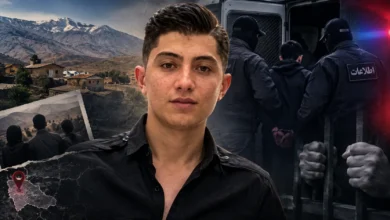
Two Protesters from December Demonstrations in Mashhad Sentenced to Death
A wave of death sentences against protesters from the December 2025 demonstrations continues; Hossein Nazari and Hossein Rasooli-Nasab, two political prisoners held in Vakilabad Prison in Mashhad, have been sentenced to death by the city’s Revolutionary Court. Nazari has been convicted on charges of “contact with hostile states and groups” and “assembly and conspiracy against national security,” while Rasooli-Nasab has been convicted on charges of “moharebeh” (waging war against the state). The consecutive issuance of such sentences against arrested protesters has increased concerns about the Islamic Republic’s use of capital punishment to suppress opponents and silence the voice of dissent.
Hossein Nazari, born in 2001 and 25 years old, is among those arrested during the December 2025 demonstrations and is currently held in Vakilabad Prison in Mashhad.
The first branch of the Mashhad Revolutionary Court sentenced him to death on charges of “contact with hostile states and groups” and “assembly and conspiracy to commit crimes against national security.” The verdict in this case was issued in July 2026. Nazari was arrested during the December demonstrations and, after interrogation and legal proceedings, was transferred to Vakilabad Prison.
Meanwhile, Hossein Rasooli-Nasab, another political prisoner held in Vakilabad Prison in Mashhad, has also been sentenced to death. He is married and a father of two children; he was arrested in Shandiz during the December demonstrations. The Mashhad Revolutionary Court sentenced him to death on charges of “moharebeh” through participation in destruction of public property, arson of religious centers, and “assembly and conspiracy against national security.”
Hossein Rasooli-Nasab’s case is linked to events during the December 18-19, 2025 demonstrations in Shandiz. According to information published by Hrana, a mosque and a Quran center in Shandiz caught fire during these protests, and Rasooli-Nasab’s case was formed in connection with these same incidents.
However, the complete details of evidence on which the court based its death sentence have not been published by independent sources, and the full text of the verdict is not publicly available.
These two sentences cannot be examined separately from the broader process by which the Islamic Republic has dealt with those arrested during the December 2025 demonstrations.
Human Rights Watch reported on September 10 that the Iranian government, between March 18 and the end of August 2026, executed at least 29 people in connection with recent protests, with dozens of others still facing the risk of execution. The organization stated that many of these individuals have been sentenced to death on vague security charges following unfair judicial proceedings.
Amnesty International has also warned that since the January 2026 protests, the Islamic Republic has intensified the use of capital punishment against protesters, with at least 60 people still facing the risk of execution. The organization has also reported that in cases related to the protests, charges such as espionage and cooperation with “hostile states” have been used to issue death sentences.
The Center for Human Rights in Iran reported in August about the issuance of death sentences for dozens of protesters in mass trials and expedited proceedings in Revolutionary Courts; a process that, according to the organization, has been accompanied by serious violations of the right to defense and fair trial.
Now the names of Hossein Nazari and Hossein Rasooli-Nasab have been added to the list of protesters who, after arrest during the December demonstrations, have been subjected to death sentences. The issuance of these verdicts, alongside the execution of death sentences for other arrested protesters, paints a clear picture of a policy that, instead of responding to the demands of protesters, responds to protest through imprisonment, security trials, and ultimately capital punishment.
When a government applies the harshest possible punishment to protesters arrested on the street, the message is not only directed at the convicted individual; it is sent to the entire society: protest has a price, and the government is ready to use the gallows to silence it.
But execution cannot eliminate social discontent. It can only silence one human voice forever; the very thing that now, in the cases of Hossein Nazari and Hossein Rasooli-Nasab, there is concern about repeating.