Christian Prisoner Ghazal Marzbān on Dry Hunger Strike in Evin Prison
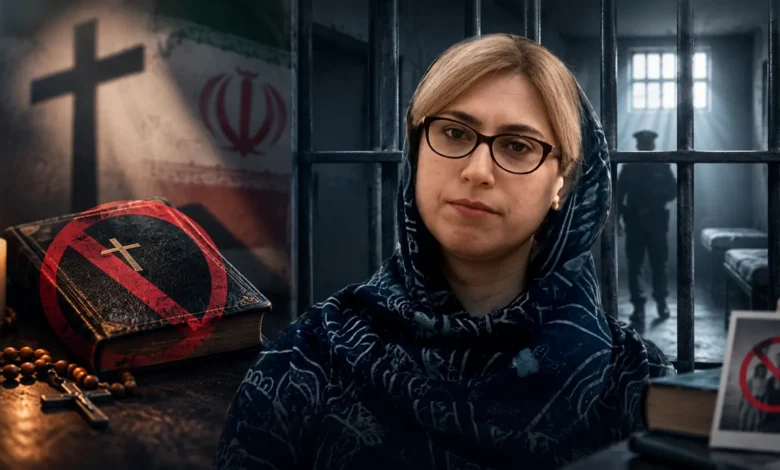
Ghazal Marzbān, a Catholic Christian citizen detained in Evin Prison, has been on a dry hunger strike since September 19 in protest of being denied access to the Bible and Catholic prayers, amid threats of an apostasy verdict and continued prohibition of family visits. According to sources close to her, prison officials have even opposed her request for access to the Bible—a development that has renewed concerns about restrictions on religious freedom and pressure on Christians in Iran.
According to reports published on social media, Ghazal Marzbān had submitted multiple written requests seeking access to the Bible and Catholic prayers so she could use them for spiritual comfort during her imprisonment. One informed source stated that prison officials responded by claiming that only those who are “Christian-born” are permitted to have a Bible in prison.
This source also claimed that even a request to bring a Bible for a female British citizen prisoner who is Christian-born was rejected. The claim of a “secret regulation” prohibiting the delivery of Bibles to Christian citizens who are Muslim-born has not yet been independently published or confirmed by judicial authorities or the prison organization.
Nevertheless, if accurate, the principle of restricting Christian citizens’ access to religious texts and practices extends beyond an administrative prison issue and directly relates to freedom of religion and conscience.
One of the most serious allegations raised regarding Marzbān’s case is the threat of issuing an “apostasy verdict.” According to an informed source, Judge “Hosseini,” responsible for implementing sentences, informed Ghazal Marzbān that her apostasy case remains open and, if she does not sign a recantation letter, there is a risk of issuing an “apostasy verdict.”
This claim is made as Marzbān has previously been in conflict with the Islamic Republic’s judicial system due to her religious activities and beliefs. Human rights sources have reported that in her recent case at Branch 26 of Tehran’s Revolutionary Court, she was sentenced to 9 years and 8 months in prison; the announced charges included “propaganda against the system” and “assembly and conspiracy against national security.”
According to a report released today, Ghazal Marzbān began her dry hunger strike on Saturday, September 19; she is abstaining not only from food but also from water and liquids. She has formally notified prison officials of her protest in writing, but according to the informed source’s report, officials said they would not forward her letter to relevant authorities.
Dry hunger strike is extremely dangerous from a physical standpoint, and continuing it can severely and rapidly deteriorate a person’s health condition. For this reason, Marzbān’s situation requires immediate attention from her family, lawyers, and organizations defending human rights and religious freedom.
This is not the first time she has resorted to hunger strike to protest her situation. Christian and human rights sources have reported that Marzbān had previously gone on hunger strike in recent months in protest of her heavy sentence. Additionally, in July 2026, it was reported that following her protest against conditions in Evin Prison’s women’s ward, she suffered a broken hand during a violent altercation.
In addition to being denied access to the Bible, Ghazal Marzbān remains prohibited from visiting with her family, and according to released information, nearly three months have passed since her last visit.
The totality of these restrictions, if they continue as reported, presents a picture of multilayered pressure on a single prisoner: lengthy imprisonment, restricted contact with family, restricted access to religious texts, and threats regarding her religious beliefs.
Marzbān’s case is being raised at a time when restrictions against Christians in Iran, particularly citizens who have converted from Muslim families to Christianity, have an extensive history.
The annual “Escape to Goa” report by Article 18 Organization and several other Christian organizations stated that in 2025, at least 254 Christians in Iran were arrested on charges related to religious belief or activity—nearly double the previous year’s figure of 139 persons. Additionally, 57 Christians in 2025 endured periods of imprisonment, exile, or forced labor.
An updated British government report on the situation of Christians in Iran also emphasizes that authorities of the Islamic Republic continue to arrest and imprison Christian citizens, with these pressures particularly targeting leaders, organizers, and some other Christians. The report also points to restrictions on church activities, Persian-language worship, and the presence of citizens who have converted from Islam to Christianity.
The United States Commission on International Religious Freedom has also described the situation of religious freedom in Iran as extremely dire and in its 2026 report noted the systematic targeting of religious minorities, including Christians, Bahá’ís, Jews, and Sunnis.
Before her recent detention, Ghazal Marzbān also had a history of imprisonment due to her activities. Article 18 Organization has also reported that during her January 2026 arrest, authorities confiscated her Bible and other Christian literature, and during interrogation, attempts were made to link these texts to propagandistic activity; Marzbān emphasized that these books were for her personal use.
In such circumstances, the issue is not merely about the fate of a book or a single prisoner. The fundamental question is whether a citizen can retain the right to access the Bible, prayer, and other tools of worship even while imprisoned.
For a Christian, the Bible is not merely an ordinary book; it is part of one’s faith life and the connection between a person and God. Denying a person access to sacred texts, particularly when she is under pressure due to her religious beliefs, can amount to exerting pressure on her conscience and religious identity.
The principle of religious freedom does not simply mean that a person outside prison has the permission to identify as a Christian. Freedom of conscience must also include the ability to pray, study sacred texts, and practice religious observances, even for someone serving time in prison.
The Constitution of the Islamic Republic also contains principles regarding the recognition of religions and the rights of religious minorities, and Article 23 of the Constitution prohibits interference with and investigation into people’s beliefs. The Christian organization CSW also referred to these same principles and legal obligations in its September 2026 report.
However, the account of Ghazal Marzbān’s case demonstrates that the gap between declared rights and the experience of some Christian citizens in prison remains a matter of serious concern.
Ultimately, prison must not become a tool for breaking a person’s faith and conscience. Even under conditions of imprisonment, a prisoner remains human, and dignity, freedom of conscience, and the right to humane and spiritual care are not rights that disappear when a cell door closes.