From Shooting at Porters to Using Them to Circumvent Sanctions: The Islamic Republic’s Contradiction
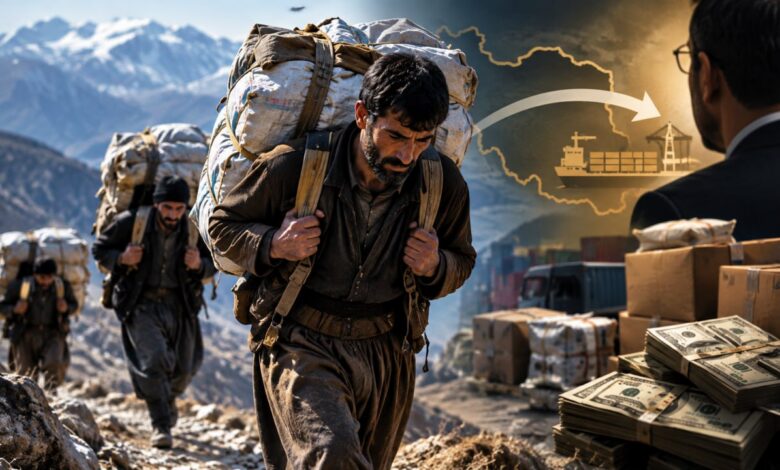
Porters who for years have been targeted by bullets, detained, and had their goods confiscated at Iran’s western borders have now, according to an Islamic Republic official, become part of a commodity supply route and a means to circumvent trade restrictions. Reza Mousazadeh, director general of the Economic Affairs Office of the Anti-Smuggling Headquarters, has announced that the value of imports through porters and sailors reaches approximately 7 billion dollars annually. This shift in approach raises serious questions about a government that for years considered porterage a crime, but now exploits it to meet its own economic needs.
Reza Mousazadeh, director general of the Economic Affairs Office and Process Improvement of the Anti-Smuggling Headquarters, stated that the value of goods imported through porters and sailors has reached approximately 7 billion dollars annually, comprising about 10 percent of Iran’s foreign trade.
He also noted that following the intensification of American economic pressure, the types of goods imported through porters and sailors have shifted from consumer goods toward raw materials, intermediate goods, and production necessities, and as he put it, “porters are bypassing the blockade.”
These statements present a different picture of the porter’s position in the Islamic Republic’s economy—a person who for years in the government’s official narrative has often been labeled with terms such as “smuggler,” but whose activities can now serve to supply raw materials for factories and import goods.
The core issue is precisely this contradiction: if this route now holds billions of dollars in value for the country’s economy, why have the people working these routes faced years of armed and security harassment?
The danger of porterage is not limited merely to the harshness of mountainous routes. Human rights reports in recent years have repeatedly documented direct shooting incidents by border forces against porters.
The HANA Human Rights Organization reported in a report covering the first six months of 1404 (March-August 2025) that at least 37 porters were killed or wounded; 14 people were killed as a result of direct fire by border forces, and 18 others were wounded by gunfire. The organization also emphasized that porterage is not officially recognized as a profession in Iran’s legal system, and porters do not benefit from legal protections in employment and social security.
In Tirmah (June), HANA Human Rights Organization reported that “Rasoul Qlandari,” a 21-year-old porter and father of two children, was killed after being shot by border guard forces in the Qatur region. According to the report, local sources stated that border forces fired on a group of porters without prior warning.
In Mordadmah (August), the Kurdistan Human Rights Network reported that “Hassan Mostafazadeh,” a 49-year-old porter, was wounded as a result of fire from border forces at Honge-Zhale Baneh, and announced that two other porters named “Goran Khodri” and “Bakhtiar Amini” were also injured in the same area due to gunfire and mine explosions.
Therefore, the issue has not been limited to the age, family status, or amount of cargo a porter carries; multiple reports show that porters over the years, in various circumstances, have been exposed to shooting and other border dangers.
In recent years, the Islamic Republic has attempted to bring the activities of porters and sailors under official oversight through the Border Trade Regulation Law.
The Border Trade Regulation and Supervision Law, approved in 1402 (2023-2024) and promulgated in 1403 (2024-2025), has permitted imports through porterage and sailing under specified conditions for a five-year period. The stated objective of this law is economic development of border regions, transparency, and strengthening the livelihoods of border residents.
But the difference today from the past extends beyond merely changing regulations. Now an official of the Islamic Republic directly speaks of the role of porters in supplying goods and countering external pressures. This change in tone raises a serious question: has the government’s view of the porter changed, or has only the government’s need for the porter changed?
In many border areas, porterage is not the result of choosing among several equal jobs. Human rights reports have repeatedly pointed to unemployment, economic deprivation, and the absence of sustainable job opportunities in border regions as factors driving the expansion of porterage.
The Kurdistan Human Rights Network, in its reports, has documented porters who turned to this work due to lack of job opportunities and the difficult economic conditions of border regions. In one case, regarding “Zaniyar,” a 23-year-old porter from Sardasht who was killed in Tirmah 1405 (June 2026) by fire from border forces, a local source said unemployment and the difficult economic and security conditions of the region had driven him to porterage.
In such circumstances, rather than creating sustainable and safe job opportunities, the government now uses this deprived labor force to move goods through routes that the state itself has introduced as part of a new border trade mechanism.
If the figure announced by the Islamic Republic official is accurate, this is no longer a marginal activity in a few border villages.
Seven billion dollars a year means a network that once existed on the margins of the formal economy has now, according to a government official, acquired a significant role in foreign trade. This is while a large portion of the risk remains on the porter’s shoulders: crossing elevations, mines, falls, freezing, gunfire, and the possibility of detention.
In other words, the profit and economic function of this network can be calculated at the national and industrial level, but the physical and mortal danger remains borne by the individual carrying the load.
Human rights reports over recent years have shown that shooting at porters has not been an occasional issue. Human Rights Watch has also examined examples of gunfire by border forces and cases in which officials involved in shooting porters have faced various judicial decisions in a report on the massacre of porters.
In one case, a porter who was shot in 2017 and injured in the eye area provided documents from his case to Human Rights Watch. The organization also reported a case in which more than a hundred bullets were fired at porters.
Now, however, the same border routes and the same human network, from the perspective of an official, can be an instrument for moving goods past trade restrictions.
This contradiction raises a question beyond economics: if the porter is so important to the Islamic Republic’s economy that he can move billions of dollars in goods, why has the security, dignity, and life of that same porter never held equal importance?
Porters, before being a “trade route” or a “tool for circumventing sanctions,” are human beings living in border regions who have turned to dangerous work to make a living.
Converting porterage into part of the formal trade mechanism could, if genuinely implemented, create opportunities for organization and risk reduction; but merely changing the legal title of the activity does not eliminate the danger of shooting, mines, falls, and harsh working conditions.
If the government truly acknowledges the economic role of porters, the fundamental question is why their security and rights should remain a second priority?
A porter cannot be a “smuggler” and target of armed force one day for the government, and on another day, when the government’s economy needs his routes, become a “solution to circumvent the blockade.”
The core issue is not merely the goods crossing the border, but the lives of people who for years have paid the price of economic inefficiency, deprivation of border regions, and the security policies of the Islamic Republic.
From the perspective of human dignity and Christian ethics as well, the value of a human being should not depend on the profit he generates for an economy or government. A person who yesterday was targeted by bullets in the mountains today possesses the same dignity and right to life; even if the government has suddenly found a need for his labor to supply factories and weather economic pressures.