From Inflation and Poverty to the Hijab Case: Where Are the Islamic Republic’s Priorities?
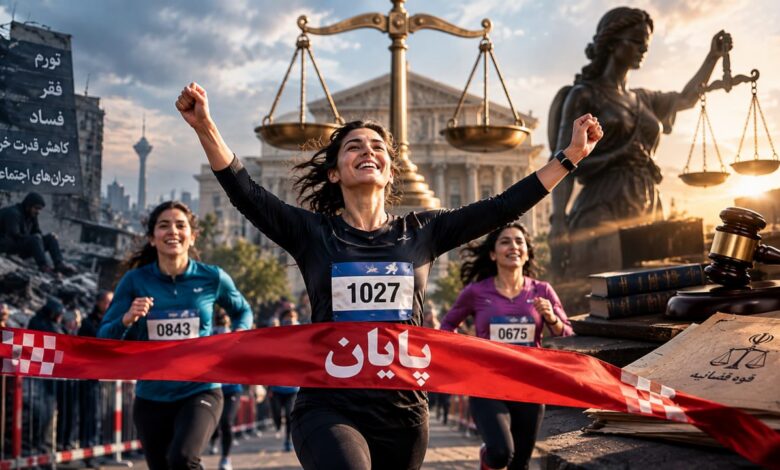
While Iran’s economy faces mounting pressure from inflation, poverty, corruption, declining purchasing power, and social crises, the Tehran Prosecutor’s Office has opened a legal case against the organizers of a 10-kilometer race because women participated without mandatory hijab. The race had been officially authorized, and sports officials claim they had obtained commitments from participants; nevertheless, the Islamic Republic has once again demonstrated that controlling women’s dress remains a priority for the judiciary, even as the livelihood problems of millions of Iranians worsen daily.
The Tehran 10-kilometer race took place yesterday morning, Friday, September 27, in Velayat Park; a sporting event in which the women’s and men’s sections were held at separate times. Images released from the race showed that several women participated without headscarves.
One day later (Saturday, September 28), the Tehran Prosecutor’s Office announced that a legal case had been opened against the organizers and those responsible for holding the race, citing what it called “failure to comply with legal and religious standards.” However, judicial authorities have yet to clarify which individuals are specifically being prosecuted and what the exact charges and legal basis are.
This incident is not merely another legal case; rather, it reflects the government’s priorities in Iran today: in a country where many families struggle to meet basic living expenses, the judiciary continues to intervene over women’s headscarves.
The contradiction becomes even clearer when we learn that the race had been officially authorized. The organizers had even obtained permission from the government.
Habib Setoudeh-Nejad, the general director of sports and youth for Tehran Province, stated that the event had been approved by the Security Council and that organizers had obtained commitments from participants before the race to comply with technical, ethical, and “Islamic standards.”
According to sports authorities, executive and security personnel were present along the route and had warned some women or prevented certain individuals from participating. It was also stated that headscarves had been provided for women. Despite all these measures, the judicial system intervened.
In fact, even compliance with regulations set by the government itself did not prevent the case from being opened; a matter that raises questions about the limits of organizers’ responsibility and the extent of judicial interference in social and sporting events in Iran. The Dadban legal group has also stated that the general phrase “failure to comply with religious and legal standards” is not in itself a specific criminal charge, and the prosecutor’s office has yet to explain what criminal conduct was attributed to the organizers. This case was opened at a time when Iran’s economy faces one of its most severe periods of crisis.
The British House of Commons Library reported in a report on Iran that the annual inflation rate reached 84 percent in August 2026, and the value of the rial has fallen to its lowest historical level. The report also emphasizes that Iran’s economic problems before the 2026 war included high inflation, weak job creation, energy problems, water scarcity, and sanctions pressure.
Other economic reports also indicate a sharp decline in people’s purchasing power. Euronews, in interviews with drivers, workers, and small business owners, reported that many families can no longer afford to purchase certain food items and basic goods, and the economic crisis has severely affected people’s daily lives.
The World Bank has also warned Iran about severe disruption to economic activity, pressure from sanctions and war, rising costs, and risks related to food security and access to essential goods. Yet in such circumstances, the issue that prompted the prosecutor’s office to act is the dress of a few women in a sporting event.
The problems facing Iranians are not limited to inflation and rising prices. Economic and social reports speak of the spread of poverty, declining purchasing power, unemployment, energy crisis, and weak public services. An analytical report on Iran’s situation also cites corruption, structural inefficiency, and budgetary crisis as factors that have reduced the government’s capacity to address economic and social problems.
In the field of addiction, research published in 2026 shows that the issue of drug use in Iran remains a serious public health challenge, and harm reduction programs face implementation problems and significant changes in access and individuals’ recourse.
In such circumstances, families exist that struggle with housing costs, food, healthcare, education, and unemployment; yet the government continues to devote a significant portion of its judicial and security capacity to controlling women’s dress.
Four years after Zhina (Mahsa Amini) was killed in custody of the Guidance Patrol, mandatory hijab remains one of the primary axes of the government’s approach to women.
An Associated Press report on the eve of the fourth anniversary of Mahsa Amini’s death shows that the presence of women without hijabs in public spaces in Iran has become far more widespread, while parts of the government still seek to enforce stricter control over women’s dress. The news agency states that economic pressures, war, and concerns about causing further unrest have also affected how hijab regulations are enforced.
Nevertheless, the 10-kilometer race case shows that even if enforcement of mandatory hijab has decreased in some areas, the principle of government intervention in women’s clothing choices remains intact. A woman walking down the street without a headscarf or running in a sporting event may still face warnings, discrimination, disciplinary action, or legal proceedings.
Now there are two images of Iran:
The first image is of Iran’s families struggling with rising prices, inflation, unemployment, and declining purchasing power; an economy that, according to the British House of Commons Library report, faced 84 percent annual inflation in August 2026.
The second image is of Iran’s institutions that intervene to control women’s dress and even, after holding an officially authorized race, open legal cases against its organizers.
These two images alongside each other raise a serious question: when people’s tables grow emptier each day, why does the government’s priority remain controlling women’s headscarves? Why is there not the same speed and seriousness in dealing with inflation and poverty, unemployment and addiction, corruption and inefficiency, as is shown for mandatory hijab?
Sports is one of the simplest domains of social life; a place for health, joy, competition, and human connection.
But in Iran, even such a domain can become subject to surveillance and judicial action.
Images of women without hijabs at the Tehran race showed that a part of Iranian society is no longer willing to completely surrender the choice of their dress to the government. This can be seen, regardless of individuals’ political stance, as a sign of a gap between official regulations and part of Iran’s social reality.
In response, the government’s judicial reaction shows that this gap is still managed through the tools of law, police, and the judicial system.
The issue is not merely about the headscarf; it is about human choice. And the problem of this case is not simply about a few women in a race; the problem is whether the government should interfere so extensively in the dress, lifestyle, and personal choices of its citizens.
From the perspective of human dignity, the Iranian woman, before being the subject of government regulations, is a free human being with conscience and agency. Religious belief also makes sense only when a person’s choice of faith and way of life is not coerced.
The Islamic Republic, facing widespread economic, social, and political crises, continues to devote energy and judicial capacity to controlling the appearance of women.
Perhaps the real problem is this very contradiction: a government that should guarantee people’s security, welfare, justice, and future is still preoccupied with whether women should wear headscarves while running, and in the meantime, families’ tables grow smaller, purchasing power decreases, and social crises deepen, while the government pays no attention.