Amanaj Mohammadpour, Journalist from Bukane, Arrested and Transferred to Unknown Location
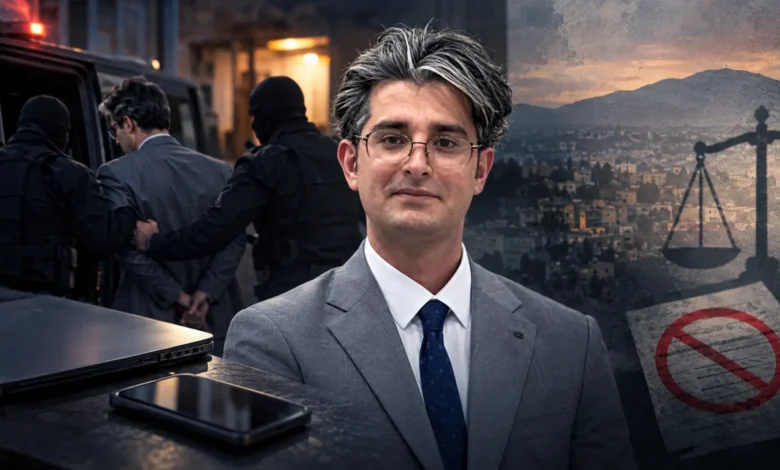
Amanaj Mohammadpour, a 33-year-old journalist and civil activist from Bukane, was arrested on the evening of September 20 during a raid by the Information Ministry forces on his family home and transferred to an unknown location. According to human rights reports, security forces arrested him without presenting a court warrant and used violence, while also confiscating his mobile phone and laptop. To date, the reason for his arrest, potential charges, and his place of detention have not been disclosed, and the family’s efforts to obtain information have been unsuccessful.
According to Hengaw Organization’s report, Information Ministry forces raided the family home of Amanaj Mohammadpour in Bukane around 11 p.m. on Sunday, September 20, 2026, corresponding to Shahrivar 29, and arrested the journalist and civil activist.
Reports indicate that officers used violence during the arrest and entered the house without presenting a court warrant. Following the arrest, the house was searched and Mohammadpour’s mobile phone and laptop were confiscated.
The Hana Human Rights Organization has also confirmed the fact of the arrest, stating that Mohammadpour has been transferred to an unknown location and no information has yet been released regarding the charges or reason for his arrest.
At the time of publishing this report, no information is available regarding his place of detention and the charges against Amanaj Mohammadpour. His family has also made inquiries to learn his fate and place of detention, but these efforts have so far been unsuccessful.
Lack of information about the condition of a detained person, especially when his place of detention and charges are not disclosed, raises serious concerns about the respect for his basic rights.
Amanaj Mohammadpour is not merely a detained citizen; he is a journalist and civil activist. His arrest comes at a time when in recent years, journalists, civil activists, and citizens engaged in activities concerning social and political issues have repeatedly faced summons, detention, and the opening of security files against them.
In such an environment, a nighttime raid on a journalist’s home, confiscation of his work tools, and his subsequent transfer to an unknown location raise serious questions about the limits of the authority of security agencies and citizens’ access to their legal rights.
Even if charges are subsequently brought against a person, the principle should be that the charge must be clearly explained to him and access to a lawyer and contact with family should be provided in accordance with the law.
One of the main concerns in Mohammadpour’s case is not only the arrest itself, but the absence of information about his condition. When a family does not know where their loved one is being held, what the reason for the arrest is, and when they will be able to make contact or visit, the atmosphere of uncertainty can become a tool of pressure.
This issue becomes more sensitive in Kurdish-populated areas of Iran; areas that have repeatedly witnessed the detention of civil activists, journalists, and citizens on security charges in recent years.
The duty of a journalist and civil activist is to address societal issues and reflect the voice of the people. Security treatment of journalists without clear charges and without a transparent judicial process not only affects the life of one individual, but also impacts the public atmosphere of society.
Amanaj Mohammadpour’s case is still in its initial stages and independent information about potential charges against him has not been released. Therefore, it is not possible to judge the actual reason for his arrest. However, this very absence of information makes the need for immediate clarification about his condition even more urgent.
The family of this journalist is now in a situation where they do not know which detention facility he is in and what charges he faces. The minimum expectation from the Islamic Republic’s judicial system is to inform the family of his place of detention, legal status, and potential charges, and to provide him access to a lawyer and contact with his family.
The arrest of a journalist should not turn into his disappearance from the reach of his family and society. If there are charges, they must be examined in a transparent and fair judicial process, and if there are no charges, the continued uncertainty and detention would have no justification.
Finally, what is most concerning in Amanaj Mohammadpour’s case is the transformation of an arrest into a state of limbo and uncertainty; a condition that leaves his family in distress and society in darkness about the fate of a journalist and civil activist.