Police, a Source of Insecurity! Judiciary Describes Police Assault on a Teenager as “Inappropriate Conduct”
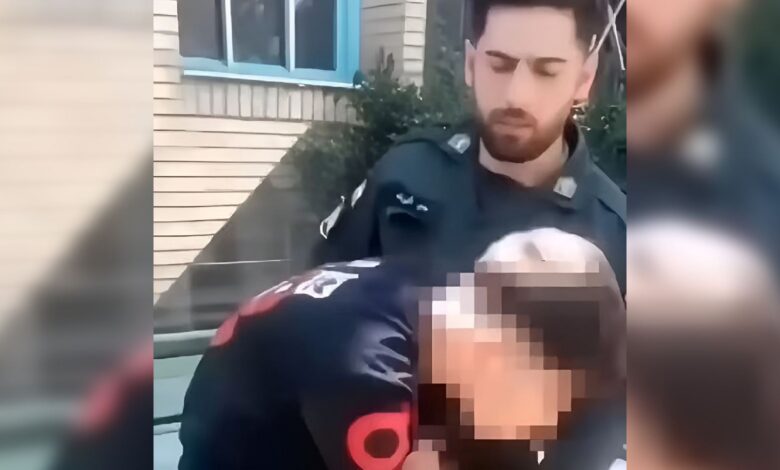
In Tabriz, a video was released showing a teenager being beaten and sexually humiliated by police officers; an incident that, following widespread public outcry, led to the opening of a case against six officers. However, in the indictment issued by the Judiciary of the Islamic Republic, sexual assault was conspicuously omitted from the charges, and the incident was described as “inappropriate conduct toward an individual.” This case raises once again the crucial question: when a police officer, who is supposed to be the protector and guarantor of citizens’ security, becomes a source of fear and humiliation, where can the victim turn to seek justice?
In any society, a police officer represents the law on the streets. When a citizen sees a police officer, they should feel that someone is there to protect their life, property, and dignity; not fear that the same officer might beat them, humiliate them, or assault them.
In a video released in the last week of Shahrivar, several police officers assault and humiliate a teenager. In parts of the footage, one officer, after pulling down the teenager’s clothes, engages in sexual and humiliating conduct toward him, and another officer threatens him with rape at the police station.
Video insertion
This is no longer merely “inappropriate conduct”; the issue concerns the dignity of a human being and, particularly, the dignity of a child in the face of armed law enforcement officers—dignity that even the Judiciary refuses to name as assault.
Following the widespread distribution of these images, the judicial organization of the armed forces announced that a case had been opened against the officers and that they had been detained. Now, in the indictment phase, the Judiciary has named six defendants and listed their charges as “violation of citizens’ rights,” “creating distrust toward the armed forces,” and “intentional bodily harm.”
But here is the shocking point: in the list of charges announced, there is no mention whatsoever of sexual assault against the teenager. The Judiciary’s media outlet even referred to the victim as “an individual,” making no mention of his being a minor.
This type of language raises serious questions: Is the sexual humiliation of a teenager in custody merely “inappropriate conduct”? If the same act had been committed by an ordinary citizen, would the judicial system describe it with such terminology?
A crime cannot be minimized by changing words. Changing the language does not alter the reality of what is seen in the footage. If an officer beats someone, they are accountable. If they humiliate a detained teenager, their accountability is heavier, and if sexual assault or violence occurred during detention, the matter is no longer merely “administrative misconduct” or “inappropriate conduct.”
The Judiciary must clarify why the charges related to sexual assault have not been raised in the issued indictment and whether this aspect of the officers’ conduct was actually investigated at all.
Justice is not achieved by removing unpleasant words from the indictment text. This time, the camera was on, and one of the most significant differences in this case compared to many others is the existence of a video documenting part of the officers’ conduct.
The images show multiple officers present at the scene, and the teenager in a situation where he has no means to defend himself. The distribution of these very images prompted widespread social reaction and prompted judicial and police authorities to respond.
But an even more critical question remains: if there had been no camera, what would have happened to this teenager?
And more importantly, in thousands of detentions where no camera exists in interrogation rooms, vehicles, detention facilities, or prisons, what guarantee exists for protecting the dignity and security of individuals?
What was witnessed on the street increases concerns about what happens behind closed detention facility doors. While one should not claim without evidence that every detainee has been assaulted, concerns about torture and sexual violence in Islamic Republic detention facilities are not merely rumors or scattered claims.
Amnesty International, in 2023, following investigation into the “Woman, Life, Freedom” protests, documented testimonies from 45 people regarding sexual assault and other forms of sexual violence. These cases involved women, men, and children and occurred in several Iranian provinces. The organization stated that no government official had been prosecuted for the documented cases of sexual assault and violence.
Amnesty International also reported on detained children, stating that security forces of the Islamic Republic have used beatings, flogging, electric shock, sexual assault, threats of assault, and other forms of sexual violence against children.
Therefore, society’s concerns about what may occur behind closed detention facility doors are based on documented history.
Four years ago, the death of Jina Mahsa Amini following her arrest by the Guidance Patrol became one of the Islamic Republic’s largest human rights crises. But the issue is not merely one officer or one police unit.
Amnesty International, in its recent report on the suppression of the 1401 protests, stated that Islamic Republic authorities have committed crimes against humanity and identified 87 officials for criminal investigation regarding their role in this suppression. The organization emphasized that in the past four years, no independent and effective criminal investigations have been conducted into government forces’ crimes during the protests.
This is the point where the Tabriz case gains heightened significance. If the offending officer is not punished, the message is clear: power can transcend the law.
If action against the officer only begins after a video is released and public anger is aroused, another question emerges: what happens to incidents where no camera has recorded them?
Amnesty International, in its 2023 report, stated that the intelligence and security forces of the Islamic Republic used sexual assault and other forms of sexual violence during the 1401 protests as means of torture, punishment, humiliation, and instilling fear among protesters.
The organization documented 45 cases, including those against children aged 14, 16, and 17. It also reported that some victims’ complaints were ignored and, in certain cases, judicial authorities helped cover up the matter rather than investigating.
Amnesty International explicitly stated in its report that there is systematic impunity for these crimes. For this reason, when today a teenager faces violence and sexual humiliation by officers before a camera, society has the right to ask whether this time justice will truly be served or whether this case too will eventually be forgotten.
This issue holds particular importance for the Islamic Republic because a significant portion of the country’s security structure over the past four years has been deployed not merely to maintain order, but to suppress political and social protests.
In such circumstances, the line between “law enforcement” and “repression” must be controlled through independent monitoring and accountability mechanisms, rather than allowing security and military institutions themselves to decide on their own forces’ conduct.
The humiliation and assault of a teenager from Tabriz is not merely a case file; this teenager has now become a symbol of a larger question: Can a citizen in Iran feel secure when encountering police?
This question cannot be answered merely by issuing an indictment. The answer comes when actual charges are presented without erasure or distortion, when the victim receives support and justice, when the accused are tried in a fair process, and when the case outcome is transparent to the public.
The Tabriz case is now a test for the Islamic Republic’s Judiciary. Not only for the six officers, but to determine whether the law is applied with equal seriousness against a law enforcement officer as it is against an ordinary citizen. Police should be a place where citizens feel secure upon seeing an officer; not a place where they fear for their future.