Islamic Republic Launches Military Training for Children Under “Janfada” Campaign
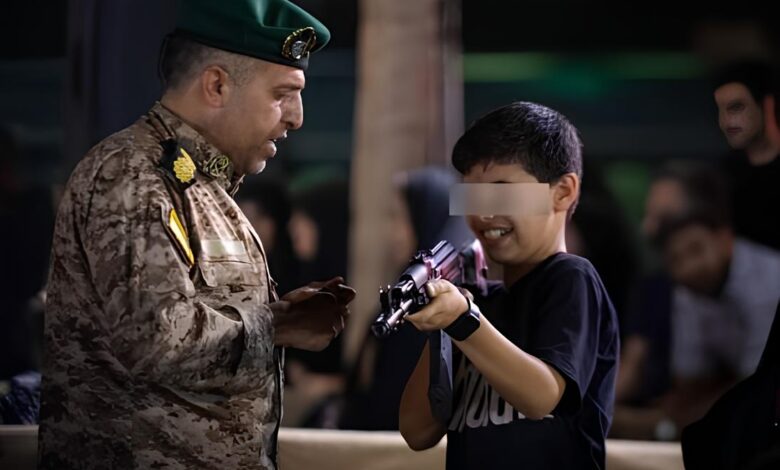
In continuation of mobilization and Revolutionary Guard Corps recruitment plans, the Islamic Republic is expanding military training for boys aged 12 to 15 under the “Janfada” campaign; a program that includes drone piloting instruction, intelligence operations, local security, and even familiarity with shoulder-fired weapons. This move comes as Amnesty International and Human Rights Watch have previously warned about the presence of armed children at checkpoints and militia patrols.
The government campaign “Janfada,” promoted with the slogan “We have one life and we give it for Iran,” has now entered a phase in which military training of adolescents is part of the program.
Sasan Zarei, spokesperson for the campaign, stated in an interview with ILNA news agency that training for individuals aged 15 and above has begun, and due to what he called “high demand,” age-appropriate training will also be provided for children under 15. According to published reports, these programs are to begin in Tehran and then expand to other provinces.
According to officials of this program, the training is not limited to relief or non-military activities, but includes combat readiness, local security provision, observation and identification, intelligence operations, and guidance of small drones. Familiarity with shoulder-fired weapons has also been announced as part of the training program.
In this way, the boundary between “civic education” and military training for children becomes increasingly blurred. This is not the first time; previously, the recruitment age had reached 12 years. The issue of recruiting children into Iran’s security structures has been raised for months.
In March 2026, Rahim Nadeali from officials of the Revolutionary Guard Corps Muhammad Rasul-Allah organization in Greater Tehran announced that the “Defenders of the Homeland Fighters” program recruits individuals aged 12 and above for activities related to mobilization structures.
Human Rights Watch reported at that time that this program, in addition to activities such as support, equipment distribution, and aid provision, also includes tasks such as presence at checkpoints, operational and intelligence patrols, and accompanying in vehicle convoys.
Amnesty International, after reviewing 16 images and videos, announced that children in Tehran, Mashhad, and Kermanshah were seen alongside Revolutionary Guard and militia forces at checkpoints and patrols, and some of them were carrying Kalashnikov-type weapons.
One of the most shocking examples is the death of 11-year-old Alireza Jafari in Tehran. Amnesty International reported that on March 29, 2026, this child was present alongside his father, a militia member, at a Tehran checkpoint, where he was killed in a drone strike. Islamic Republic officials also confirmed that he was “on duty” at the checkpoint.
Alireza’s mother told the Hamshahri newspaper that the father had taken his sons with him due to “staff shortages” at checkpoints. According to Amnesty International’s report, Alireza’s 9-year-old brother was also present with his father and brother that night.
This incident demonstrated that the presence of children in military and security structures is not merely a propaganda matter; these children are actually placed in locations that can become targets of attacks.
Amnesty International has deemed the recruitment of 12-year-old children in Iran’s military structures a serious violation of children’s rights and, if legal conditions are met, the recruitment and use of individuals under 15 in armed conflicts as a war crime. The organization has called on the Islamic Republic to stop recruiting individuals under 18 in armed forces.
Human Rights Watch has also stated that military use of children under 15 could constitute a war crime and has called for the cancellation of this program. Bill Van Esveld, director of the children’s rights section of the organization, warned that Islamic Republic officials apparently are willing to endanger children’s lives to secure more personnel.
Iran is a signatory to the Convention on the Rights of the Child. According to data from the International Committee of the Red Cross, Iran in 2012 acceded to the Optional Protocol to the Convention on the Rights of the Child on the involvement of children in armed conflict.
Nevertheless, international customary law makes it binding for Iran that recruitment or use of children under 15 in armed conflicts can constitute a war crime.
On the other hand, even without reaching the stage of direct participation in warfare, placing children at checkpoints, security patrols, or military facilities exposes them to direct danger of violence and military attacks.
The use of children in military structures is not a new phenomenon for the Islamic Republic. During the Iran-Iraq War, thousands of children and adolescents were deployed to war through mobilization structures and government-affiliated forces. Amnesty International, citing official statistics from the Islamic Republic, reported that more than 550,000 children were sent to war and at least 36,000 of them were killed.
Hossein Fahmideh also became one of the most famous propaganda symbols of the Islamic Republic regarding the “martyrdom” of children; a pattern that has been reproduced in textbooks, cultural programs, and government camps over the past decades.
Now it appears that the same culture, with newer military tools, is being reproduced for another generation.
Childhood should be defined by school, play, family, education, and future—not by checkpoints, weapons, and intelligence operations.
When the government conducts drone piloting courses and weapons familiarization for adolescents, one can no longer describe this process merely as a cultural activity or general education in national defense.
Even if Islamic Republic officials insist that training will be “age-appropriate,” the presence of weapons, security training, and preparation for wartime conditions demonstrate that the issue extends far beyond a recreational or humanitarian program.
Sasan Zarei has also claimed that millions of people have registered in the “Janfada” campaign, and a significant portion of them have expressed readiness for military and security activities.
However, these figures cannot be independently verified. IranWire has also noted regarding some reported figures for campaign registrations that they lack independent verification capability.
Therefore, these numbers cannot be considered as definitive evidence of public support from Iranian society for such a program.
The main concern is that in conditions of war and increased security pressures, instead of keeping children away from military fields, the government is drawing them ever closer to security structures. A child should not be a tool for the government’s survival. A child standing armed at a checkpoint or participating in weapon and drone training courses not only endangers his own life but is exposed from his formative years to the normalization of violence and death.
From a Christian perspective, every child possesses inherent dignity; a child is not a means for political propaganda, provision of military personnel, or proof of loyalty to a government. No political ideal and no state ideology can turn a child’s future into a tool for its own survival.
A 12-year-old boy should sit behind a school desk, not behind a checkpoint; he should build dreams of his future, not be asked to endanger his life for a political structure.
What the Islamic Republic calls “Janfada” raises a far more fundamental question from the perspective of children’s rights: why does a government claiming to defend the next generation send children to fields of danger?