Assassination of Sunni Cleric in Zahedan; Escalating Violence in Southeast Iran
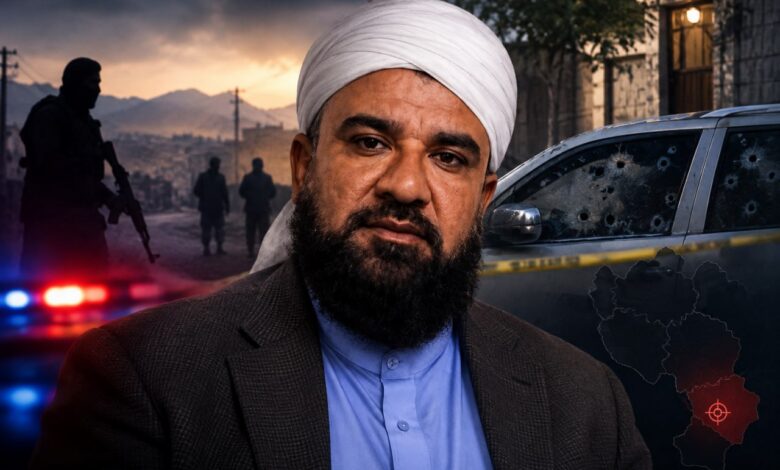
“Maulawi Yousuf Gorgij,” Imam of the Sunni congregation in Zahedan and a cleric close to the Islamic Republic, was shot and killed in front of his home by unknown armed individuals. This incident occurred two days after a deadly clash between security forces and armed men in Saravan, a confrontation in which the IRGC reported the deaths of three of its personnel. Simultaneously, several armed incidents have been reported in Sistan and Baluchestan Province.
A video recently released by Tousi TV, referring to a series of armed incidents in Sistan and Baluchestan Province, claims that “the Islamic Republic is losing control of southeast Iran.” In this video, the killing of a Sunni cleric in Zahedan and, days earlier, a deadly clash between IRGC forces and armed men in Saravan are presented as signs of escalating attacks against government-affiliated forces. However, the claim presented in the Tousi TV video that the Islamic Republic is “losing control of southeast Iran” has not been independently verified to date.
A review of official reports, Iranian media, local sources, and independent analytical reports shows that the two main incidents mentioned in the video did occur, but the video’s analytical section regarding the Islamic Republic’s loss of control cannot be published as an established fact.
Maulawi Yousuf Gorgij, Imam of the “Muhammad Rasul Allah” mosque in Zahedan, on Monday, September 14, 2026, corresponding to September 23, 1405 in the Islamic calendar, was shot by unknown armed individuals in front of his residence and died from the severity of his injuries.
Zahedan police announced that an investigation has begun to identify the perpetrator or perpetrators of this attack. No group has formally claimed responsibility for this killing to date.
Iran’s state media introduced Gorgij as a Sunni cleric close to the government. Tasnim News Agency reported that he had actively participated in government ceremonies and events commemorating the Islamic Republic’s casualties and had spoken at gatherings related to the recent war.
Baluch sources and opposition groups also described him as a figure close to security and government structures. This aspect of his background is noteworthy, particularly given the official presence of Islamic Republic officials at ceremonies following his death; the commander of the Quds Force and the governor of Sistan and Baluchestan Province referred to him in their statements as the Imam of the Sunni congregation and an active individual in a government-supported path.
However, the identity of the attackers and their motives remain unclear. Some local media outlets attributed the attack to Baluch armed groups, but at the time this report was prepared, no group had formally claimed responsibility.
Just two days before Gorgij’s killing, on September 12, a severe clash occurred between the Islamic Republic’s security forces and armed men in the Bakshan area of Saravan county.
The Quds Force of the IRGC Ground Forces announced that during this operation, three security personnel and four armed men were killed. Tasnim also released the same figures and stated that this operation was carried out jointly with the presence of the IRGC, the Ministry of Intelligence, and law enforcement.
However, reports from local sources and the human rights group “Haalosh” indicated a longer clash and higher casualties. Iran International, citing Haalosh, reported that the clash lasted for hours and several military vehicles were targeted; however, the higher casualty figures have not been independently confirmed.
Therefore, the deaths of at least three security personnel in Saravan is an established and confirmed fact reported by the IRGC itself, but there are significant discrepancies among sources regarding the exact number of casualties and the extent of damage.
In the days following these two incidents, other armed incidents were also reported. On September 18, an armed clash occurred in Zahedan in which, according to an Iran Wire report, at least one police officer was killed. State-affiliated media also reported the killing of two armed individuals and the detention of another, while Baluch sources identified the two killed as Baluch citizens. Therefore, there are differing narratives regarding the details and identity of the parties involved in the clash.
On the other hand, the killing of Maulawi Yousuf Gorgij is not the first incident of this kind in the current year. “Maulawi Mohammad Anwar Rigi,” the Friday Imam of the Sunni congregation in Mirjaveh, was also killed by unknown armed men on July 20, 2026. Reuters confirmed this incident and reported that the perpetrators were not identified at the time of publication.
This series of incidents demonstrates that armed violence in Sistan and Baluchestan remains a serious security issue, and several deadly incidents have occurred in the period under review. This province has been facing the activities of Baluch armed groups, smugglers, and security confrontations for years, and this problem is not confined to recent days.
This is the crucial point in fact-checking the video. Tousi TV uses the phrase “Islamic Republic is losing its grip on southeastern Iran” in the video under review and treats the series of recent incidents as a sign of the weakening of government control.
However, this phrase is a political assessment and interpretation, not a report that can be directly inferred from existing statistics. In contrast, available data shows that the Islamic Republic’s security forces continue to conduct operations in Saravan, Zahedan, and other parts of the province, and in some cases have reported the killing of armed individuals and the detention of some attackers.
For example, on September 18, Tasnim reported the alleged killing of two members of Jeish al-Adl and the detention of another person in Zahedan. On the other hand, the occurrence of prolonged clashes, attacks on security forces, and the killing of officials and figures close to the government demonstrate that armed groups’ ability to create insecurity in parts of the province remains significant.
Therefore, a more accurate description is that a wave of violence and armed clashes have occurred in southeast Iran in recent days, and the capability of armed groups to target security forces and some government-affiliated figures has been demonstrated; however, the available evidence alone does not prove that the Islamic Republic has lost control of the region.