Netanyahu at UN: Iranian People Will Be Free; Islamic Republic Will Fall
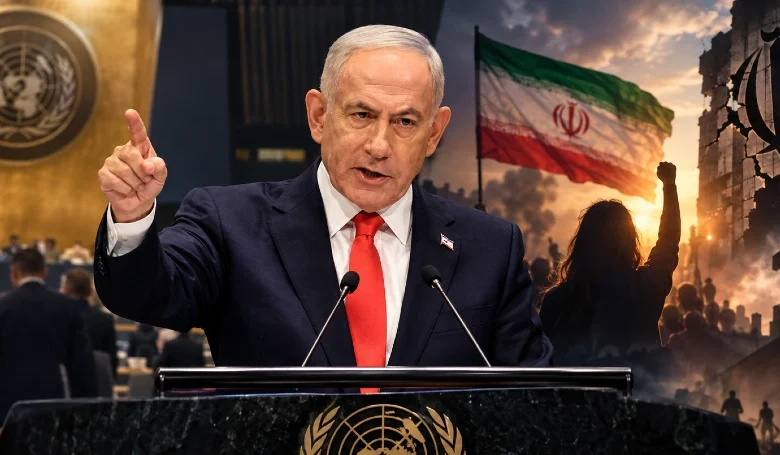
Benjamin Netanyahu, Prime Minister of Israel, said Thursday, September 23, in his speech to the UN General Assembly that the power of the Iranian people will ultimately prevail over the rulers of the Islamic Republic and that Iranians will be free. He also accused delegations that left the hall before his speech of hypocrisy regarding human rights, and referring to the suppression of protesters and Christians in Iran, said everyone will celebrate the day the Islamic Republic falls.
Netanyahu devoted a significant portion of his speech to Iran, saying the Islamic Republic fears its own people more than anything else—people who, according to him, have paid a high price for freedom over the years.
Addressing opponents of the Islamic Republic, he said: “The power of the people will overcome those in power” and added that Iranian people’s freedom may not be far away. The Israeli Prime Minister went on to describe the Islamic Republic as a “murderous” and “evil” regime, saying it will fall due to “lies, corruption, and cruelty.”
Before his speech began, dozens of diplomatic delegations left the General Assembly hall. Netanyahu, addressing those who remained, said: “If there are other moral cowards in this room, they can leave now.” News reports indicated the presence of delegations from several countries among those who walked out.
He then, referring to the suppression of protesters in Iran, asked why these same countries have not protested the killing and wounding of thousands of Iranians and why they have remained silent about the persecution of Christians in Iran. Netanyahu stated that those who present themselves as human rights defenders under such circumstances are, according to him, “fake human rights protesters.”
In another section of his speech, Netanyahu defended Israel’s military operations against Iran and the Islamic Republic’s proxy groups, saying Israel has defended not only itself but also other countries through these actions.
He also held up a pager and, referring to the operation that detonated Hezbollah’s pagers, said: “This action dealt a heavy blow to this group.” Netanyahu claimed a large portion of Hezbollah’s missile arsenal has been destroyed and senior leaders of the group have been killed.
He also listed the names of “Ayatollah Khamenei,” “Muhammad Deif,” “Yahya Sinwar,” “Ismail Haniyeh,” and “Hassan Nasrallah” among leaders and commanders who, according to him, no longer exist.
In the section regarding Iran, Netanyahu also displayed a Starlink device and said the Islamic Republic fears people’s access to information and free communication. He considered this device a symbol of Iranians’ potential access to information, choice, and freedom of speech, and announced he would hand it to the President of the General Assembly to be delivered to the Iranian delegation, a statement that received mixed reactions.
Netanyahu also sharply criticized Zohran Mamdani, the Muslim Mayor of New York, claiming that many Jews in New York no longer feel safe. He accused Mamdani of anti-Israel positions and connections with people who have supported Hamas, and said Jews around the world should know that Israel is ready to defend them.
Netanyahu concluded by referring to growing concerns about antisemitism, saying: “The era of defenseless Jews is over” and emphasized that now “there is a country” and “an army” to defend them.
Netanyahu’s remarks about Iranian freedom came at a time when the Islamic Republic continues to face widespread allegations of suppressing protesters, restricting freedom of speech, and pressuring religious minorities, including Christians.
For Iran’s Christian community, true freedom is not limited to a change of government; freedom of conscience, the ability to worship without fear, equal protection under the law, and respect for the dignity of every human being, regardless of religion and belief, are inseparable parts of a free society.
Ultimately, the political future of Iran will be determined by its people; but what cannot be overlooked is their right to live without fear, freedom of conscience, and enjoyment of fundamental human rights.