Mojtaba Khamenei Claims Islamic Republic’s Victory in War and Status as World’s First Power
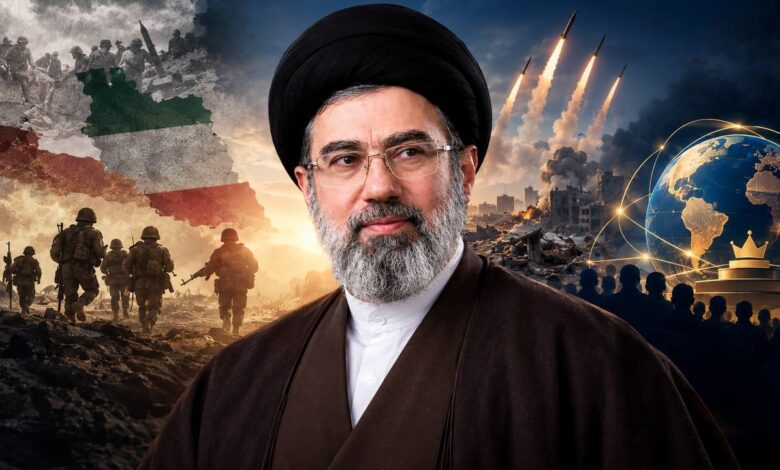
Mojtaba Khamenei, leader of the Islamic Republic, in a message marking the anniversary of the start of the Iran-Iraq War, described the recent conflict with the United States and Israel as a continuation of that historical confrontation and claimed that the Islamic Republic emerged victorious from this battle. In his message, he spoke of increased government power, American withdrawal, and even Iran’s positioning as a “world’s first power,” though significant portions of these claims were not accompanied by any independent data or verifiable documentation.
In his message, Mojtaba Khamenei referred to the Iran-Iraq War as the “first imposed war” and claimed that Western powers have also attempted, since the Islamic Revolution, to return Iran to pre-revolution conditions. He characterized recent wars as a continuation of that same confrontation, stating that the Islamic Republic succeeded in forcing “invading hegemons” to withdraw in the recent conflict.
This narrative is being presented at a time when the current war began on February 28, 2026 with attacks by the United States and Israel on Iran, during which Ali Khamenei, the Islamic Republic’s previous leader, was killed. Mojtaba Khamenei subsequently took over the leadership and was himself severely wounded during those attacks. Reuters reported that in the following months, the war left thousands dead and caused extensive damage to Iran’s military and economic infrastructure.
Despite these realities, the Islamic Republic’s leader presented a completely triumphant picture of the war in his new message. He claimed that the opposing side sought shelter in the face of the Islamic Republic’s attacks and “pleaded” for an end to the war—a claim not accompanied by military details or independent evidence in his message.
One of the most notable sections of this message is his claim regarding Iran’s global standing. Mojtaba Khamenei wrote that some, “based on worldly calculations,” consider Iran the “fourth superpower in the world,” but the Islamic Republic, based on religious beliefs, has described Iran as the “world’s first power.” This statement is more an element of the Islamic Republic leader’s ideological narrative about Iran’s global position than a measurable assessment based on military, economic, or political indicators.
The Strait of Hormuz also occupied another section of Mojtaba Khamenei’s message. He claimed that American forces and their allies cannot advance beyond the Arabian Sea due to the Islamic Republic’s attacks, stating: “It is only a matter of time before the Arabian Sea itself is emptied of them.”
However, the situation in the Strait of Hormuz remains one of the war’s principal points of tension. Reuters reports show that maritime traffic through the waterway has been severely reduced, and in recent weeks Tehran has stated that it is prepared to reopen the strait in a short timeframe if American military pressure is reduced and the blockade of Iranian ports is lifted.
In another section of his message, Mojtaba Khamenei attempted to present an image of broad social support for the Islamic Republic. He claimed that over the past seven months, people have continuously been present in the streets, and more than 30 million Iranians have declared themselves “willing to sacrifice their lives.” He also stated that following the announcement of a call for some form of organization, registration capacity for more than 500,000 people was filled in just 100 minutes.
No independent documentation or data was provided in the message to support these figures and claims. Therefore, these statistics cannot be considered an independent measurement of the level of public support for the government and should be reported solely as claims made by the Islamic Republic’s leader.
These claims are being presented at a time when independent reports on Iran’s domestic situation present a more complex picture than what was offered in the Islamic Republic leader’s message. Reuters reported in a piece on six months of war that while Iran has not surrendered, the war has become a war of attrition, maritime traffic through the Strait of Hormuz has been severely disrupted, and simultaneously economic pressure on the government has increased.
On the other hand, in recent weeks, Islamic Republic officials have repeatedly spoken about economic difficulties, reduced oil revenues, currency shortages, energy problems, and pressures arising from the war. Reuters also reported in September that Iran’s government, while continuing the war and facing economic pressures, has placed efforts to address domestic problems on its agenda.
Mojtaba Khamenei’s new message in fact places two different narratives about the Islamic Republic’s situation side by side: an official narrative that speaks of victory, increased power, and the support of tens of millions of Iranians, and on the other side, a reality accompanying ongoing war, disruption to trade and shipping, economic pressure, and diplomatic efforts to end the conflict as shown in independent reports.
Meanwhile, the emphasis on “certain victory” and portraying an expensive conflict as a sign of “being the world’s first power” is more an indication of a narrative that the Islamic Republic’s leader is attempting to present regarding the government’s position following one of the most severe military crises in the Islamic Republic’s history, rather than an answer to questions about the costs of war and people’s living conditions. Judging the degree of success or failure of either side requires examining a range of military, political, economic, and humanitarian indicators, and mere claims by the parties involved cannot alone substantiate such a conclusion.