Three Isfahan Judicial Officials Accused of Issuing Death Sentences Against Protesters
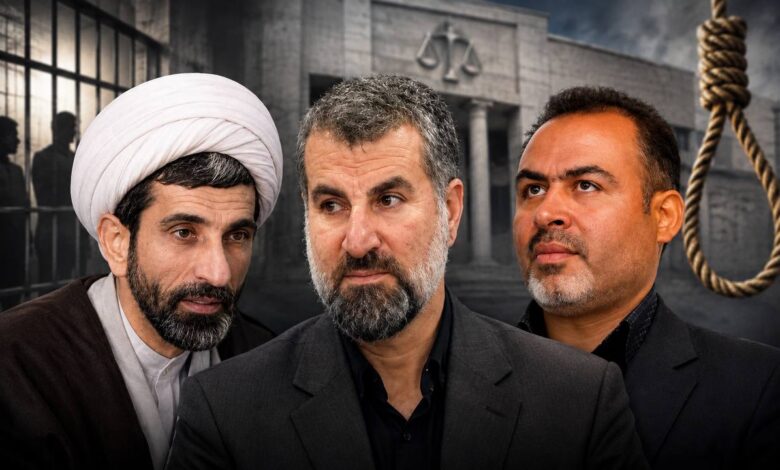
Iran International has revealed the direct role of Mohammad Reza Toukali, Morteza Barati, and Asadollah Jafari in handling cases of detainees from December 2024 protests and issuing death sentences against them. According to reports, two judges of the Isfahan Revolutionary Court have issued death sentences in dozens of cases related to the protests, and the chief justice of the province has also played a role in the review process and issuance of these sentences; while a number of the convicted, including two 20-year-old youth, have already been executed.
Based on a report published by Iran International, Mohammad Reza Toukali, judge of the first branch of the Isfahan Revolutionary Court, and Morteza Barati, advisor to that branch, were among the main judicial officials in the case known as “Alikhani Square.” An informed source told this media outlet that these two judges issued death sentences in dozens of cases related to detainees from the December protests in Isfahan.
The same source claimed that Asadollah Jafari, chief justice of Isfahan Province, also directly intervened in the process of reviewing these cases and issuing death sentences. According to this source, Morteza Barati visited the prison to follow up on the process of issuing sentences and was stationed there.
The Alikhani Square case relates to the December 2024 protests in Isfahan and the events of December 18. During this case, approximately 60 people were arrested, and ultimately death sentences for 12 people were confirmed. Two of the convicted, Amirhossein Maleki and Amirhossein Ebrahimi, were both 20 years old and were executed on Tuesday morning, November 3, at Dastgerd Prison in Isfahan.
Previously, seven others named Alireza Raisi, Alireza Sepahi, Erfan Esfandiari, Golmohammad Mohammadi, Abolfazl Sepahi, Amirhossein Safari Hassanabadi, and Ghaem Hosseini were executed between July 19 and October 4, 2026. This brings the number of those executed in this case to 9, while three other convicts still face the risk of execution.
These executions took place under circumstances where human rights reports regarding the review process in the Alikhani Square case reveal serious concerns about the protection of the accused’s rights. Iran International previously reported, citing a lawyer, that the accused were denied access to independent lawyers during the review phase, and defense lawyers also did not have access to the complete case file. There have also been reports of torture and extraction of forced confessions. The Islamic Republic’s judiciary must provide clear and documented answers to these accusations.
Asadollah Jafari previously announced that by June 2026, thousands of cases related to protests had been filed in Isfahan Province and hundreds of indictments issued. According to him, the issued sentences ranged from acquittal and fines to lengthy imprisonment and, in some cases, execution. This statistic demonstrates the extent of the judicial crackdown on detainees from the protests in this province.
The role of these three judicial officials is not limited to recent cases. The names of Mohammad Reza Toukali, Morteza Barati, and Asadollah Jafari have been mentioned in connection with other cases that resulted in severe sentences and executions of protesters; including the cases of Saleh Mirhashemi, Majid Kazemi, and Saeid Yaqoubi, who were executed in May 2023, and the case of Mostafa Salehi. These officials’ names have also been mentioned in connection with the cases of Tomaj Salehi and Amir Nasrazadeh.
According to Iran International’s report, all three officials have been sanctioned by the European Union for human rights violations. Britain and Canada have also placed Morteza Barati and Asadollah Jafari on their sanction lists. In official European Union documents regarding Asadollah Jafari, reference is made to his role in dealing with protesters during the Isfahan water shortage protests in November 2021 and his previous judicial responsibilities.
This record raises serious questions about the accountability of officials responsible in the Islamic Republic’s judicial system for handling political and security cases. A judge and judicial official must be the guarantor of legal compliance, right to defense, and fair trial, not turn the judicial process into a path for issuing death sentences against protesters.
When young people around 20 years old are sentenced to death after being arrested during protests, and reports emerge of torture, forced confessions, and deprivation of independent legal representation in their cases, the responsibility of the officials involved in this process cannot be considered concluded by a formal announcement of the sentence. Every death sentence raises questions about evidence, quality of trial, and the responsibility of those who issued or confirmed it.
The Islamic Republic continues to take the lives of protesters, and its judicial system must be accountable for its role in this cycle. The families of victims have the right to know on what evidence their loved ones were convicted, whether they had a real opportunity to defend themselves, and why reports of torture and forced confessions were not independently investigated. Silence in the face of these questions is neither justice nor accountability.