“Mai Sato”: Islamic Republic Has Responded to Only One of Eight Correspondences Regarding Christians
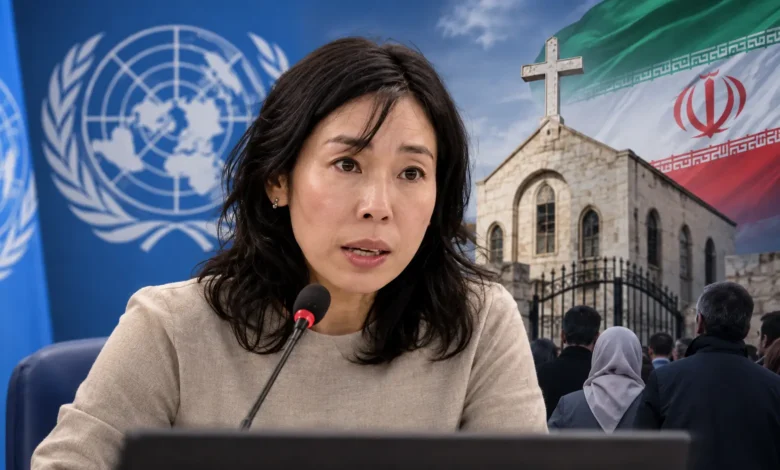
Mai Sato, UN Special Rapporteur on human rights in Iran, stated that officials of the Islamic Republic have responded to only one of eight formal correspondences from UN experts regarding the situation of Christians since 2011; a response in which Persian-speaking Christian citizens who have changed their religion have been introduced as a “threat to national security.” Sato also considered the confiscation of St. Peter’s Evangelical Church in Tehran and the eviction of Armenian and Assyrian residents as part of a broader process of restricting religious freedom in Iran.
Mai Sato, UN Special Rapporteur on human rights in the Islamic Republic of Iran, discussed various dimensions of pressure on Iran’s Christian community, the limitations of her mandate, and the security-oriented approach to religious activities in an interview with human rights organization “Article 18.” This conversation depicts the gap between Iran’s international commitments and the performance of government agencies regarding freedom of religion and belief.
According to Sato, eight formal correspondences from UN experts regarding the situation of Christians in Iran have been recorded in the UN database since 2011. Seven correspondences pertained to the arrest and prosecution of Christians, mainly Persian-speaking converted citizens, while the eighth correspondence concerned the confiscation of St. Peter’s Evangelical Church in Tehran and the eviction of Armenian and Assyrian residents.
Sato emphasized that officials of the Islamic Republic have only responded to the 2020 correspondence. In that response, the government attempted to justify its treatment of Christians not due to their beliefs and religious activities, but under the guise of security charges and propaganda against the government. According to the special rapporteur, in this response, Persian-speaking Christian citizens were introduced as a threat to national security.
According to Sato, this response exemplifies an approach in which ordinary religious activities, including gatherings in homes for worship, Bible study, and distribution of Christian texts, are framed as security charges. She explained that in some cases, behaviors that are religious in nature are pursued under labels such as “propaganda against the system” or crimes related to national security.
Another part of the conversation focuses on the confiscation of St. Peter’s Evangelical Church in Tehran; a historic site that, in addition to the church building, included residential houses, two schools, and offices related to Christian activities.
According to a report by UN experts, 27 members of Armenian and Assyrian Christian communities residing in this complex were evicted from their homes. Approximately 20 families, many of whom had lived in this complex for years, were given only two weeks to vacate their homes. UN experts also stated that church leaders faced the threat of arrest if they did not comply with the evacuation order.
This complex was transferred to the “Execution Headquarters of the Imam’s Decree” in July 2026 in implementation of a ruling by the Revolutionary Court in 1998. UN Special Rapporteurs Mai Sato and Nazila Ghanea called for the return of the complex and enabling the return of residents and church members in response to this action.
Sato considered this case distinct because, unlike most previous correspondences about converted Christian citizens, this time members of two Christian communities officially recognized in the constitution were affected by the consequences of a government action. Thus, even the official recognition of Armenians and Assyrians has not prevented their deprivation of homes and places of worship.
One of the important points raised in this conversation is the difference in the government’s treatment of historic Christian communities and Persian-speaking Christian citizens. Officials of the Islamic Republic generally recognize Armenians and Assyrians as official religious minorities; however, the activities of Persian-language churches and Christian gatherings face restrictions and security-oriented treatment.
Referring to cases mentioned in UN correspondences, Sato stated that in some instances, activities such as participating in home church meetings or distributing Bibles have been introduced in legal cases as behaviors related to national security. She also pointed to examples where traveling abroad to participate in church activities has served as a pretext for espionage charges against an individual.
UN experts in their July 15, 2026 statement regarding St. Peter’s Church also declared that freedom of religion and belief is not limited to personal belief alone; but includes the right to collective worship, conducting ceremonies in one’s own language, and preserving religious sites. They considered the confiscation of the church and eviction of its residents incompatible with Iran’s human rights obligations.
Mai Sato, in explaining the limitations of her mandate, stated that officials of the Islamic Republic do not recognize the legitimacy of the UN Special Rapporteur’s mandate on human rights in Iran, and since the revival of this mandate in 2011, access for special rapporteurs in this field to Iran has not been provided. For this reason, she must gather necessary information through contact with civil society, human rights organizations, families of victims, and meetings with Iranians in other countries.
She identified four main tools of her mandate as preparing periodic reports, sending formal correspondences to governments, issuing public statements, and documenting cases of human rights violations. Sato emphasized, however, that this mandate does not have executive authority or power to compel governments to change their behavior.
According to her, the value of this documentation lies in recording the narratives of victims and their families alongside the government’s official narrative and preserving evidence for accountability mechanisms in the future. Sato also stated that given wars, protests, and waves of executions, much of her attention in recent months has been directed toward the right to life and the situation of political prisoners facing execution, but religious freedom is also an inseparable part of human rights.
The statements of the UN Special Rapporteur once again highlight the gap between the formal recognition of religious minorities in the laws of the Islamic Republic and the actual possibility of their enjoyment of freedom of religion and belief. When conducting worship in homes, studying the Bible, activities of Persian-language churches, or preserving a historic religious site are accompanied by security charges, arrest, confiscation, and eviction, one cannot speak of the existence of genuine religious freedom.
Restricting religious activities to government-approved frameworks, depriving citizens of worship in their mother tongue, and prosecuting peaceful gatherings not only target the rights of Christian citizens, but the very principle of freedom of conscience and belief. The confiscation of St. Peter’s Church also demonstrates that even officially recognized religious communities are not immune from the consequences of these policies.
The failure to respond to seven out of eight UN formal correspondences, combined with the 2020 response that justified Christian activities under the label of national security threat, poses a serious question to officials of the Islamic Republic: If worship, Bible study, and peaceful gatherings are not security crimes, why does the government pursue them in the guise of security cases instead of guaranteeing the freedom of these activities?
Freedom of religion and belief is not a privilege that governments grant to or withhold from citizens at their discretion; it is a fundamental right that must be guaranteed for all, regardless of family background, language, and type of belief.