Arrest of Reza Mostafaei, Disabled Citizen, on Charges of Slogan Writing and Support for Families of Protest Victims
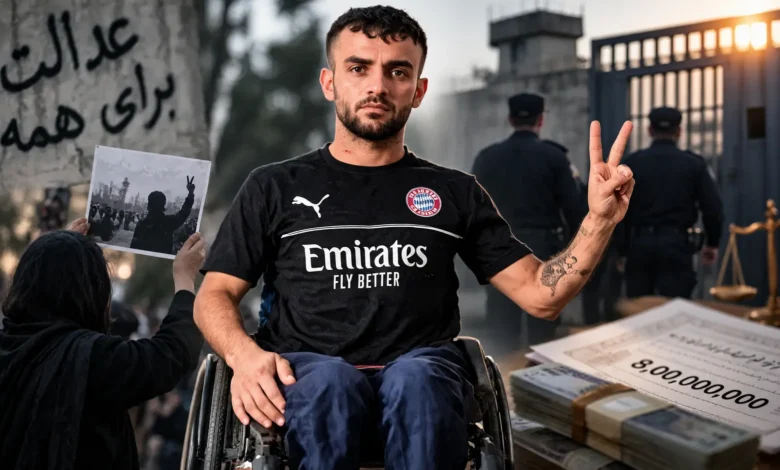
Reza Mostafaei, a 26-year-old Lur citizen with severe physical-motor disability and spinal cord injury, was arrested after appearing at the Dahdashte Prosecutor’s Office and transferred to the central prison of the city. According to human rights sources, the arrest followed the imposition of a heavy bail of eight billion tomans, which the family was unable to pay. The charges against him relate to “slogan writing” and support for families of those killed in the December 2025 protests.
According to reports by Hengaw and Hrana, Mostafaei was arrested on Saturday, October 3, 2026 (11 Mehr 1405), after appearing at the Sixth Branch of the General and Revolutionary Prosecutor’s Office of Kohgiluyeh County in Dahdashte. He had previously been summoned, and after being informed of the charges, a bail of eight billion tomans was set for his temporary release. However, due to his inability to provide this sum, he was sent to prison.
According to the Human Rights in Iran report, the charge attributed to Reza Mostafaei is titled “propaganda activity against the system,” with the judicial authorities specifying that this includes slogan writing and support for families of those killed in the protests. In such circumstances, serious questions arise about the proportionality of the bail and the necessity of continued detention. In particular, the defendant’s financial inability to pay the bail can effectively become a factor perpetuating his deprivation of liberty.
However, the more concerning aspect of the case is the physical condition of this 26-year-old young man. Human rights sources state that Mostafaei suffers from severe physical-motor disability and spinal cord problems, and his transfer to prison has heightened concerns among his family and loved ones about his access to necessary care and his ability to withstand prison conditions.
Additionally, according to sources close to the case, the prosecutor of the branch, an individual with the surname “Paydar,” made derogatory remarks toward Mostafaei during an interrogation session, referring to his physical condition and disability. This claim has been raised by human rights sources and family members, and no official clarification from the relevant judicial authorities has been released regarding it.
Reza Mostafaei has previously had a history of being summoned and facing judicial action, and his mobile phone had been confiscated. Now once again, support for families of protest victims and activities such as slogan writing have become the basis for opening a case that has resulted, immediately, in the arrest and transfer to prison of this disabled citizen.
Mostafaei’s arrest occurs as judicial pressure on protesters and families seeking justice for the December protests has continued in recent months. In various cases, activities such as supporting families of the deceased, expressing protest views, and civic activities have faced security and political charges. Human rights organizations view this as an instance of restricting freedom of expression and suppressing protest activities.
In Reza Mostafaei’s case, the issue is not merely a judicial detention. A young disabled citizen with spinal cord problems is now in prison due to his inability to pay an eight billion toman bail, and the charges against him relate to activities such as slogan writing and support for families of protest victims. This case raises again the question: where is the line between judicial proceedings and the punishment of protest activities and expressions of sympathy with families of victims in the Islamic Republic?
While December protesters are faced one after another with arrest, trial, imprisonment, and even death sentences, the case of Reza Mostafaei is another example of the continuation of judicial pressure on the body of the protest movement; this time against a young man who, due to physical disability and spinal cord injury, needs appropriate conditions and medical care more than many others. The continuation of his detention without sufficient consideration of his physical condition has intensified concerns about his health and human rights.