Chaos in Iran's environment
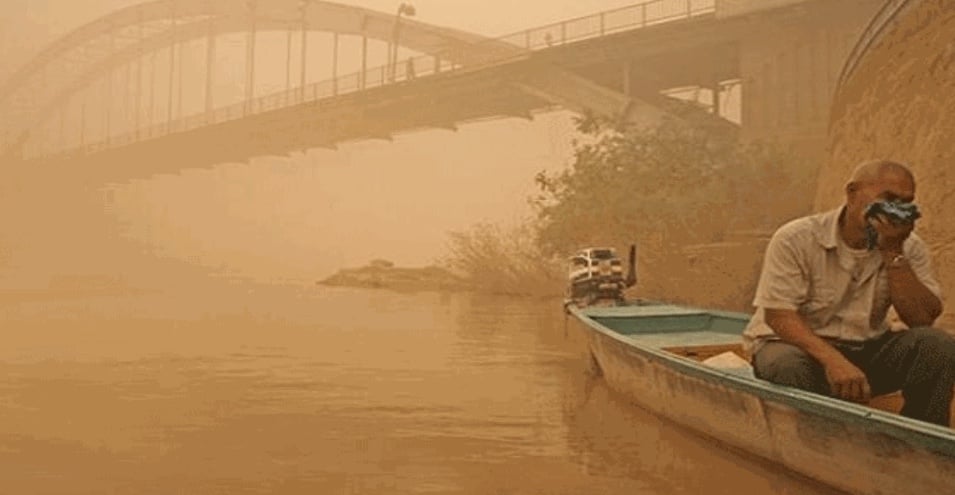
Ahvaz, the capital of Khuzestan Province, was the most polluted city in Iran and among the most polluted in the world on Monday.
According to local news agencies and the Global Air Quality Index project website, on Monday, the level of pollution caused by dust particles in the city of Ahvaz reached dangerous levels, as a result of which more than 430 Ahvaz citizens were hospitalized with acute respiratory problems.
Last week, dust in Tehran made it the most polluted city in the world.
Nik Ahang Kowsar, a geologist and water journalist, said in an exclusive interview with a Voice of America reporter about this environmental problem: "A significant portion of this dust is caused by the drying of the land surface in neighboring countries and also in the central plateau of Iran."
He considered the drying of the Hor al-Azim wetland to be one of the reasons for the rise of dust in Khuzestan province and western regions of Iran, adding: "The reduction in soil moisture and water shortage in Iran's neighboring countries due to Turkish policies and the construction of dams on the branches of the Tigris and Euphrates rivers has led to the destruction of agriculture and the migration of farmers in Iraq and Syria, which is the same factor that has caused the dust phenomenon and created many problems for the Iranian people in the past few decades."
At the same time, First Deputy Prime Minister Ebrahim Raisi said at a meeting of the National Headquarters for Coordination and Management of the country's wetlands: "All people should use wetlands, but now the country's wetlands are at risk of drying up, and if the necessary measures are not taken to preserve, restore, and develop them, we must be accountable to God and the people."
This comes at a time when Interior Minister Ebrahim Raisi broke ground earlier this year on a petrochemical complex near the Miankaleh wetland, a project that has become a point of contention between environmental activists and supporters, mostly from the government, of the construction of this complex.
Meanwhile, the Tabnak website, close to Mohsen Rezaei, the deputy head of the government for economic affairs, also announced that the Shilat wetland in the city of Astara is on the verge of destruction. According to the report, the influx of domestic sewage and various types of waste, as well as invasive plants, has put the existence of the only inner-city wetland in the north of the country at risk.