Iranian petroglyphs may be among the oldest relics of humanity.
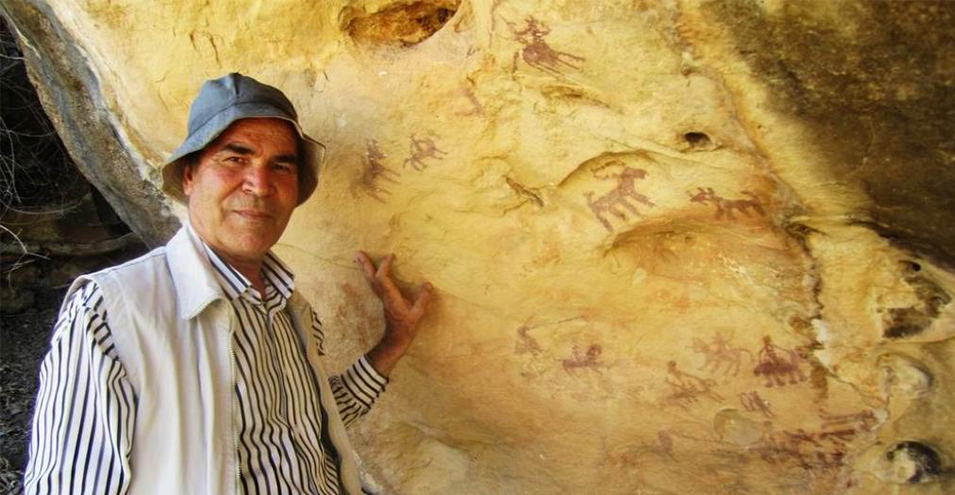
Most of the petroglyphs in central Iran are several thousand years old. But some discoveries by Iranian archaeologist Mohammad Naserifard may date back as far as forty thousand years. In that case, some of these paintings, hidden from public view among the mountains and rocks, could be among the oldest human relics on Earth.
Dr. Mohammad Naseri Fard, who has been exploring and exploring the mountains and hills of central Iran for years, took an AFP reporter to Khomein County to show him a number of petroglyphs, most of which depict antelopes.
In 2008, Nasseri Fard guided a Dutch couple fascinated by archaeology to the same area. The two Dutch experts concluded with disbelief that some of the rock paintings were possibly up to forty thousand years old.
But determining the age of the petroglyphs is not an easy task and requires advanced tools and techniques. “The sanctions have deprived us of technology,” says Nasseri Fard. However, he hopes that “as the situation improves,” new techniques and tools can be brought to the site to obtain more, more accurate, and more reliable scientific information.
Global experts' attention to Iranian petroglyphs
The AFP adds that in Iran, petroglyphs have not received much attention and, in general, not enough research has been done in the field of prehistory.
Dr. Mohammad Nasseri is an exception. He tirelessly traverses the mountains and deserts of Iran, and with this method, over the years, he has discovered nearly 50,000 rock carvings in Iran.
He says he first became seriously interested in this type of research in 2002, when he found a role in Khomein County. “I was so excited, it was like I had found a treasure,” he says.
Since then, Dr. Nasseri Fard's discoveries have been classified and catalogued by the Bradshaw Foundation in Switzerland. This foundation, which operates in the fields of archaeology and anthropology, has been able to attract the attention of many experts around the world to Nasseri Fard's research.
The common heritage of humanity
It is possible that the petroglyphs discovered by Mohammad Naseri Fard date back to the earliest era when humans were gradually leaving their original homeland, Africa.
Geneviève von Petzinger, an expert on prehistoric caves, says of the importance of Nasseri Fard's findings: "With the help of these findings, we can gradually draw a map that is full of dark and ambiguous spots with more precision."
According to Ms. Petsinger, the Iranian discoveries reinforce the assumption that humans had art before they left Africa. Otherwise, how can we explain the striking similarity between some petroglyphs in Iran, South Africa, Spain or California?
According to this Canadian expert, Iran could be “a very important piece of a global puzzle” because this land “has strategic importance and people have always passed through it to migrate west or east.”
To accurately date Mohammad Nasseri Fard's discoveries, uranium technology must be used, which is more accurate than carbon-14 technology, but much more expensive. According to Genevieve von Petzinger, "Nasseri Fard must have access to large foreign laboratories, and we hope to help him in this."
Source: RFI