Unemployment rate for Iranian university graduates is “twice that of illiterates”
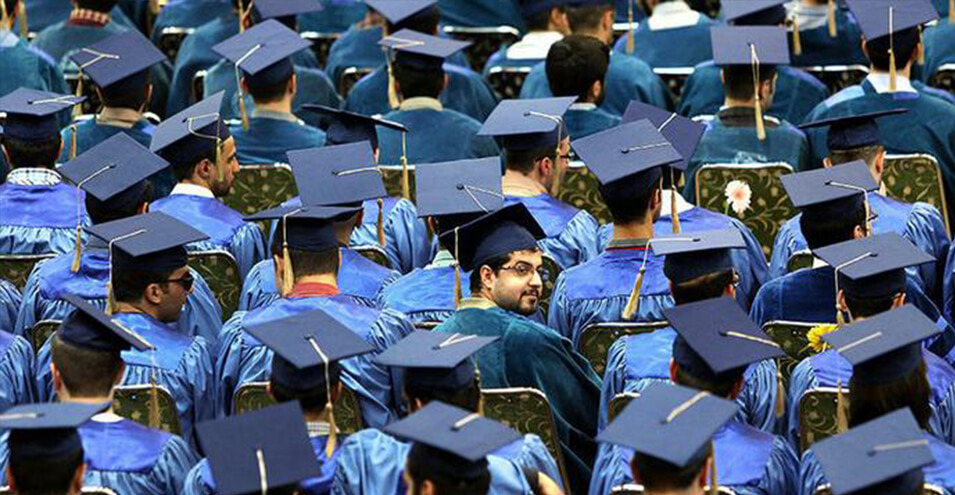
A Labor Ministry official reported that the unemployment rate among Iranian university graduates is twice that of illiterate people. According to the official, “at least 70 percent” of the jobs available in the Iranian labor market do not require a university education.
Alireza Hatemzadeh, deputy director of education for the Technical and Vocational Education Organization of Iran, said that “40 percent” of those who visit this organization affiliated with the Ministry of Cooperatives, Labor and Social Affairs are “unemployed graduates,” adding: “At least 70 percent of jobs in the labor market do not require a university education.”
The deputy education minister of Iran's Technical and Vocational Education Organization told Tasnim News Agency on Monday, October 28, referring to "one million and 340 thousand unemployed graduates in the country," adding: "The unemployment rate among university graduates is twice that of illiterate people."
The official affiliated with the Iranian Ministry of Labor added: "If you look at the jobs around you one day on your way to work, you will easily realize that a large part of the jobs do not require a university education. But the wrong culture that exists in the country prioritizes certificates over skills. That is, instead of making a person wait for 4 years for a bachelor's degree and 2 years for a doctorate, we can quickly enter the job market with skills training."
According to Tasnim, currently, "passenger transportation by private car, motorbike, and driving in taxi agencies, freelance and brokerage jobs, setting up grocery stores and supermarkets, father's work and continuing the father's job, and other such options are available for unemployed graduates" of Iranian universities.
In another part of his speech, Alireza Hatemzadeh criticized the lack of a "career perspective" in university curricula and pointed to the shortage of skilled workers among graduates, saying: "We train individuals but are not in charge of jobs, but large groups come to us, make demands on us, and ask us for skilled workers."
60% of cardboard sleepers have "additional education"
Meanwhile, even Ali Sadeghi, deputy director of "Social Support at the Tehran Municipality's Welfare, Services and Social Partnerships Organization," has reported on the university education of "some of the cardboard sleepers," who, according to him, "became cardboard sleepers as a result of being rejected by their family environment."
According to ISNA, this Tehran municipality official said: "About 60 percent of Iran's homeless people have advanced education or specialized skills, but due to struggles with addiction or poverty, they have been driven out of society and abandoned on the streets."
In an interview with Tasnim, the deputy director of education for the Technical and Vocational Education Organization of Iran stated that the number of unemployed graduates in the country is "about 1.34 million" and said that, according to statistics from 2018, about 40 percent of technical and vocational trainees are university graduates, and that those who referred to this organization affiliated with the Ministry of Labor "even had doctoral degrees."
Alireza Hatemzadeh, noting that "skills poverty causes 40 percent of university graduates to seek vocational training," also states that after completing the vocational training course, only "42 percent of them succeed in entering the job market."
Graduates lacking "job skills"
Domestic media reports on the phenomenon of “unemployed PhD engineers” in Iran. According to experts, due to the “barrier between higher education and the job market” and the inability of universities to train a “specialized and appropriate” workforce, most Iranian university graduates lack “up-to-date job skills,” and the number of this group of unemployed is increasing every day.
According to the latest reports from the Statistics Center and the Strategic Information Center of the Iranian Ministry of Labor, currently about 1.12 million people are studying as students in 22 university majors, of which about 6.4 million are men and 5.7 million are women.
In the main academic fields in Iran, the highest unemployment rates are related to the computer science groups (with 41.4 percent), environmental protection (with 37.6 percent), art (28 percent), and physics and natural sciences (27.8 percent), and the lowest unemployment rate is related to the veterinary medicine group (with 8.7 percent).
Among the official statistics of "one million and 340 thousand" unemployed graduates in Iran, engineering graduates account for the highest share of unemployed with "more than 301 thousand people", followed by commerce and administrative affairs with "266 thousand" and architecture with "163 thousand" unemployed.
Of the total population of university graduates or students in higher education in Iran, 52.6 percent are men and 47.4 percent are women. Among the active people in this population, 14.14 percent of men and 31.1 percent of women are registered as unemployed. The highest unemployment rates among this population are in the provinces of Kermanshah (34.9 percent), Kurdistan (29.4 percent), and Chaharmahal and Bakhtiari (28.7 percent), respectively, and the lowest unemployment rate is in Markazi Province (12.5 percent).
According to the Statistical Center of Iran, the largest number of employed people in Iran (5.38 million) are those with “diploma and pre-university degrees.” In contrast, the smallest number of employed people in Iran (100,704) are those with a doctorate degree. According to statistics published in May 2018, the unemployment rate in Iran in 2016 was 13.1 percent among literate people and 6.4 percent among illiterate people.
Many experts, however, estimate the real unemployment rate in Iran to be much higher than official statistics, and one of the reasons for this is the definition of people employed in official institutions. According to them, the definition of the “employed population” in Iran differs fundamentally from developed standards. Some analysts believe that unemployment of more than a quarter of young people, which is also confirmed by official statistics, indicates the critical situation of the labor and employment market in Iran; a market in which unemployment is growing faster than employment growth.
Source: DW