Coronavirus in Iran: From Eid al-Fitr prayers to MP's comments on the vaccination black market
According to official statistics from the Iranian Ministry of Health, from May 19 to 20, 18,408 new cases of COVID-19 were confirmed in Iran. 351 people also lost their lives due to COVID-19.
Many are skeptical about the accuracy of official statistics, and even the Research Center of the Islamic Consultative Assembly announced that the actual number of infections and deaths is many times higher than the official figures.
Is the fourth wave over in Iran?
While a few days ago, Iranian Health Minister Saeed Namaki claimed that the fourth wave had ended, noting that the epidemic had begun to decline in most provinces, Saud Mardani, a member of the Coronavirus Task Force Committee, does not consider the claim of "passing the fourth wave of Corona" to be logical.
Mr. Mardani says that a number of cities are at the beginning of the "fourth peak" and some are facing "the establishment of this wave."
Meanwhile, following the announcement by the National Task Force to Combat Corona on Saturday, a number of businesses resumed their activities after weeks of closure.
This comes at a time when many businessmen are protesting the government's lack of support for businesses during the coronavirus pandemic and the forced closures, and in the past few days, reports have been circulating online that a number of shops have been spontaneously closing their shutters in some parts of the country.
Determining the fate of final exams
After a period of disagreement between the Ministry of Education and the Ministry of Health over holding in-person exams, the National Coronavirus Task Force finally decided to hold the exams in-person.
Khosrow Saki, head of the Center for Measuring and Monitoring the Quality of Education, said in this regard: "The National Task Force for Combating Corona emphasizes three issues: first, that traffic routes be short, second, that gatherings be reduced as much as possible, and this issue should be observed both when students enter and exit and in the examination area, and the third issue is related to having proper ventilation in the examination areas."
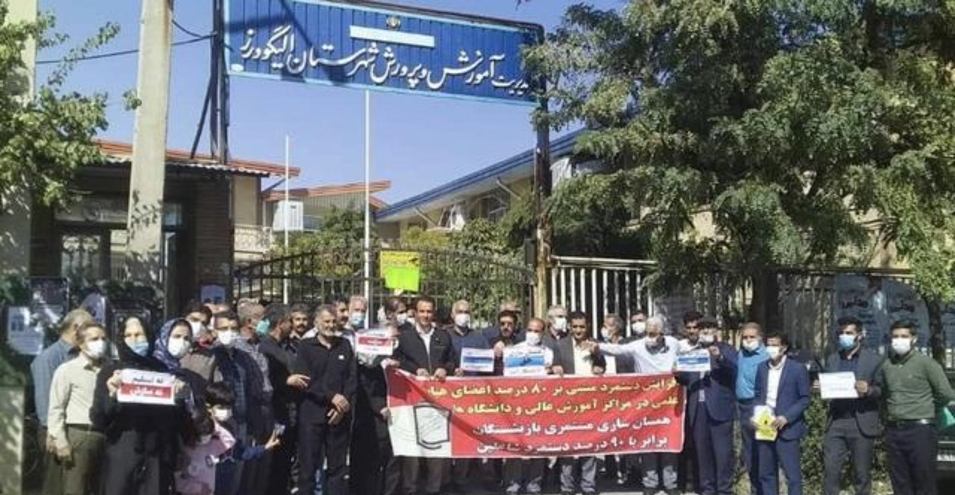
In recent weeks, students in various cities have gathered to protest the holding of their final exams in person despite the outbreak and spread of the coronavirus, chanting slogans such as "We don't want in-person exams, we don't want them" and "In-person exams are not possible with the coronavirus."
Restrictions on movement and holding Eid al-Fitr prayers
While "interprovincial" travel restrictions have been imposed for the Eid al-Fitr holiday, Eid al-Fitr prayers will be held.
Hossein Ghasemi, Secretary of the Security, Social, and Disciplinary Committee of the National Headquarters for Corona Management, announced that there will be no restrictions during the Eid al-Fitr holidays, but rather a ban on "inter-provincial" travel will be imposed.
Meanwhile, Mehdi Hajian, spokesman for the National Anti-Corruption Agency, told IRNA that a fine of one million tomans would be imposed on vehicles driving in "red" (high-risk) cities.
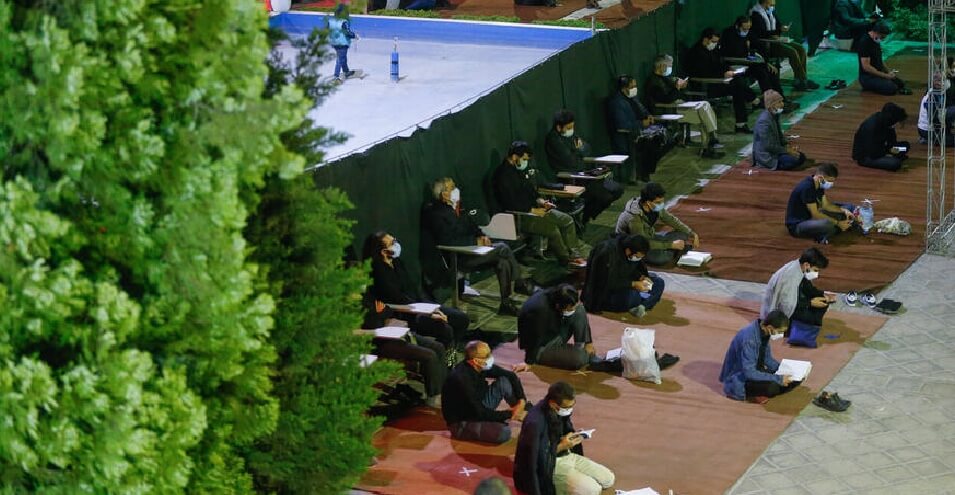
On the other hand, Ali Nouri, deputy organizer of the Friday Imams Policy Council, said that Eid al-Fitr prayers will be held outdoors in red and orange cities, with “strict adherence to health guidelines,” and in yellow and blue cities, based on a “smart management plan,” in prayer rooms and mosques. Details of this smart plan have not been released.
Mr. Nouri urged people with underlying illnesses or symptoms of illness not to attend the prayers.
The vaccination black market is in the news again
Media outlets within Iran reflected the statements of Masoumeh Pashaei Bahram, representative of Marand and Jolfa, regarding violations in the vaccination process.
The MP pointed out that a number of vaccines are being sold on the black market for "huge sums of money" outside the official distribution chain, saying: "Each AstraZeneca vaccine is sold on the black market for up to 25 million tomans, while the price of this vaccine is a maximum of 300,000 tomans."
The representative of Marand and Jolfa said that more than 50 percent of vaccine IDs are not registered in the "Titec system", which increases the possibility of injecting counterfeit vaccines. He considered the solution to prevent violations to be using the monitoring capacity of the "Titec" system.
With the start of public vaccination in Iran, disagreements between authorities over the use of vaccine distribution through two systems for tracking, tracing, and controlling the authenticity of health-related items, "Titec" belonging to the Food and Drug Administration and the "SIB" integrated health system belonging to the Deputy Ministry of Health, also began and continue.
Source: Voice of America