54 Writers and Artists Inside and Outside the Country Protest Prison Sentences for Three Writers
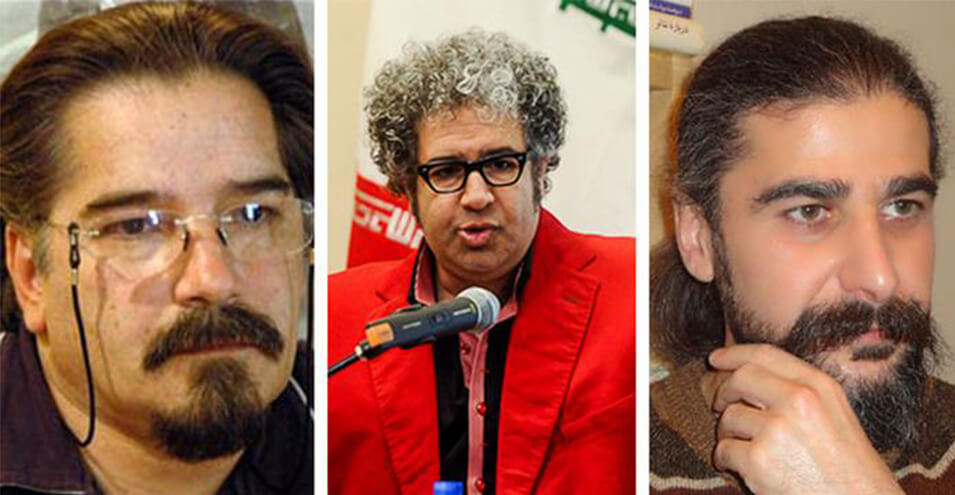
More than 50 writers and artists from inside and outside the country have protested the issuance of prison sentences for three Iranian writers. Reza Khandan (Mahabadi), Kiyan Bajen, and Baktash Abtin, members of the Iranian Writers Association, have been collectively sentenced to 18 years in prison.
In continuation of protests against the 18-year collective prison sentence for Reza Khandan (Mahabadi), Baktash Abtin, and Kiyan Bajen, 54 writers and artists from inside and outside the country have jointly protested this verdict, and while condemning “security-related approaches” toward writers, have called for the annulment of the prison sentences for these three members of the Iranian Writers Association.
The Iranian Writers Association also published this statement on its Telegram channel and provided a web address for people to visit and sign a protest petition.
Reza Khandan (Mahabadi), Kiyan Bajen, and Baktash Abtin are three writers who have each been sentenced to six years in prison. The verdict issued by Branch 28 of Tehran’s Revolutionary Court against these three writers was notified to their lawyers, Naser Zarafshan and Razieh Zayedi, on the 25th of Ordibehesht (April 14).
“Another Sign of Increased Threats and Pressure”
In the statement of 54 writers and artists, which was published today, Wednesday, the 9th of Mordad (July 31), on the Telegram channel of the Iranian Writers Association, regarding these sentences, it stated: “Although the issuance and implementation of such sentences is not unprecedented, examining the reasons for this new case is another sign of increased threats and pressure on writers.”
The statement’s authors added: “If publishing a journal and authoring a book and visiting the graves of writers and artists are considered security crimes, as has been done in the case of these three writers, then at the discretion of security and judicial authorities, a ‘criminal’ will be discovered in every independent writer.”
The protest statement further considers the “securitization of the field of literature and art” as destructive to the security of activists in this field and damaging to the “meager remaining capacity” of this field, and continues: “If this is not important to those in power, it is important to us writers and readers of free literature; it is important that we do not have the Sword of Damocles hanging over our heads in the form of prison sentences, detention, and exile; it is important that the creators of literature and art be people endowed with freedom of expression; because creativity flourishes in the realm of freedom.”
The 54 writers and artists residing inside and outside the country finally, “together with these three writers and members of the Iranian Writers Association protesting the court verdict,” while condemning “security-related approaches” toward writers, have called for the annulment of the sentences issued for Baktash Abtin, Kiyan Bajen, and Reza Khandan (Mahabadi).
Babak Ahmadi, Hassan Asghari, Ali Babachahi, Parviz Babayi, Mohammad Reza Botani, Rakhshan Bani Etemad, Bahram Beyzaei, Khosrow Parsa, Jafar Panahi, Ahmad Puri, Alireza Jabari, Shapur Jourkesh, Amir Hasan Chehelthan, Farkhondeh Haji Zadeh, Hassan Hassam, Mohsen Hakimi, Nasim Khaksaar, Ismail Khoyi, Khashayar Dihimi, Mohammad Rasoulof, Qasem Rabin, Fariborz Raisdana, Naser Zarafshan, Farshte Sari, Mohammad Ali Sejadi, Jalal Sarfaraz, Faraj Sarkohhi, Enayat Samiei, Seyyed Ali Salehi, Farzaneh Taheri, Abdolali Azimi, Mehdi Gharaei, Murad Farhad Pour, Mohammad Qaed, Azita Qahraman, Iraj Kaboli, Mehrangiz Kar, Yourik Karim Massihi, Leili Golestan, Shahla Lahiji, Shams Langaroudi, Javad Mojabi, Mohammad Mohammad Ali, Abbas Mokhber, Akbar Masoumbeigi, Shahab Moghrabin, Esfandiar Manfarzadeh, Hafez Mousavi, Nemat Mirzazadeh (M. Azarm), Jamal Mirsadeghie, Mojtaba Mirzatahmasebi, Manizhe Najm Iraqi, Mohsen Yalfani, and Saeid Yousefi are the signatories of this protest statement.
Wave of Protests
Shortly after the 18-year collective prison sentence for these three writers was notified, a large group consisting of 894 Iranian writers, poets, critics, and journalists sent a letter to the officials of Iran’s executive and judicial authorities, expressing their “explicit protest” against the “unfair procedures of the judicial system and security-related approaches toward writers and literati,” and called for the annulment of the “unjust and freedom-suppressing” verdicts against the three members of the Iranian Writers Association.
PEN International also expressed concern on the 13th of Ordibehesht (April 3), before the court verdict was issued, by publishing a statement about the trial of these three members of the Iranian Writers Association. The international organization considered the trial of these writers to have “political motivations” and described it as “a blatant violation of their right to freedom of expression.”
Reza Khandan (Mahabadi), Kiyan Bajen, and Baktash Abtin have each been sentenced to one year in prison on the charge of “propaganda against the system” and five years on the charge of “assembly and conspiracy with the intention of acting against the country’s security.” However, this is a first-instance court verdict, and the defendants have filed appeals and requests for retrial against the issued sentences.
On the 26th of Ordibehesht, Reza Khandan (Mahabadi) told DW Persian that the verdicts issued by Judge Mohammad Moghisseh, head of Branch 28 of Tehran’s Revolutionary Court, were “even violations of Iran’s own laws” and attributed the issuance of such sentences to the “disgust and fear” of government officials regarding independent organizations. According to Khandan, the purpose of issuing these sentences is to “create intimidation and fear and frighten others” and to “counter protests and organizations” in Iran.
This writer also stated that the examples cited by the court regarding the charge of “propaganda against the system” included the publication of various statements by the Iranian Writers Association throughout its existence and the very limited publication of a book titled “50 Years of the Iranian Writers Association,” of which only 30 copies were printed for internal use within the association.
According to Reza Khandan, the example cited regarding “assembly and conspiracy with the intention of acting against the country’s security” was nothing more than participation in ceremonies such as the commemoration of Ahmad Shamloo’s death or the commemoration of the assassination of Mohammad Mokhtari and Mohammad Jafar Pouyandeh, two victims of political killings.
Messrs. Khandan and Bajen appeared in Branch 7 of Evin Prosecutor’s Office in Mordad of the previous year (2018) and were informed of the charge of “propaganda against the system.” These two writers were summoned at that time along with Baktash Abtin in connection with a file that the Ministry of Intelligence had opened for them in 2015. Subsequently, in November of the previous year, the charge of “assembly and conspiracy with the intention of acting against the country’s security” was added to the previous charge.
The prosecutor handling the case of these three writers increased the bail for Messrs. Khandan, Bajen, and Abtin from 50 million tomans to 100 million tomans on the 12th of November at Branch 7 of Evin Prosecutor’s Office, and these three were released pending trial after providing bail.
On the 2nd of Bahman, however, Judge Moghisseh, while rejecting their request to have their chosen lawyer present at the trial, changed the bail from 100 million tomans to a 1 billion toman bail for each of them. As a result, these three members of the Iranian Writers Association were detained and transferred to Evin due to their inability to provide the bail. Eventually, however, Reza Khandan, Baktash Abtin, and Kiyan Bajen were released from Evin on the 6th, 8th, and 10th of Bahman, respectively, by posting 1 billion toman bail pending the completion of legal proceedings.
Source: DW