Arash Sadeghi in First Interview After Release: Human Rights Compliance Should Be a Condition for Lifting Sanctions Against Islamic Republic
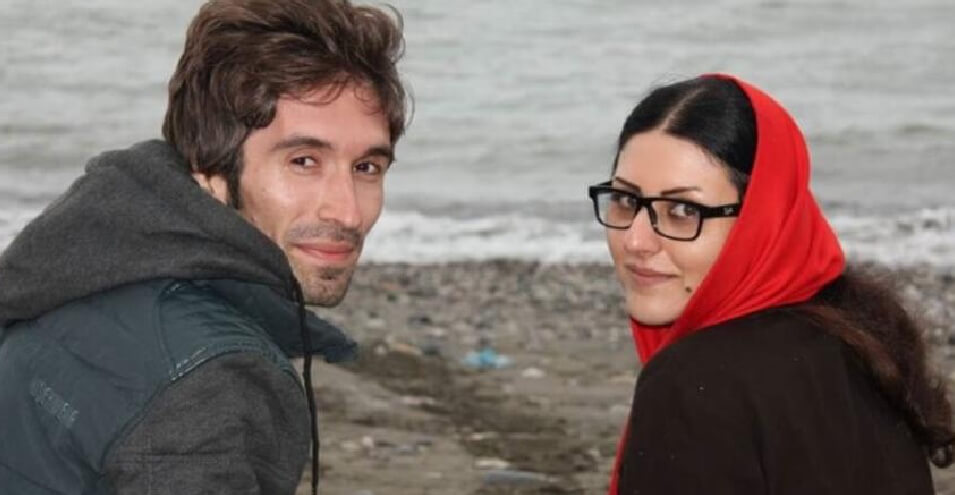
Arash Sadeghi, a former political prisoner who was recently released from Rajaei Shahr Prison, discussed his first meeting with his wife after months of visitation ban in his first interview following his release from Rajaei Shahr Prison, and called for lifting sanctions against the Islamic Republic of Iran to be conditional on respecting human rights.
Arash Sadeghi told Voice of America that on Monday, the 27th of Ordibehesht month, after one year and seven months of communication and visitation ban with his wife Golrokh Iraei, he was able to meet with her for the first time in the presence of the prison warden and the women’s ward supervisor at Aml prison.
Mr. Sadeghi, who says he was deprived of contact and visitation with his wife for more than a year, added that Amin Vaziri, the prosecutor’s representative, without providing any specific reason, deprived them of in-person visits and phone calls during this period.
Rights which, according to this political activist, are among the minimum basic rights of a prisoner and is mentioned in the law that “when two members of a family are imprisoned in any way, they should have visits at least weekly or once every two weeks”.
According to him, Golrokh Iraei is serving her sentence in this prison alongside prisoners convicted of ordinary crimes such as murder and theft.
This human rights activist continued his conversation with Voice of America by describing the conditions of Aml Women’s Prison according to Golrokh Iraei’s account: “Approximately 50 people are held in two rooms that do not have suitable sanitary and food conditions, there is no shop or library, and for months the prisoners have been effectively deprived of their right to yard time, which according to her is ‘every prisoner’s right,’ under the pretext of repairs.”
Arash Sadeghi, referring to Ms. Iraei’s recent and renewed conviction, said that the two-year and one-month prison sentence of this civil activist, who was convicted in a joint case with Atena Daemi for holding memorial ceremonies for Zaniyar and Loghman Moradi and Ramin Hossein Panahi, was about to end in the current year’s Shahrivar month when they opened a new case against her again.
He added: “They specifically did not indicate what the actual reason for opening this case was. She was tried in absentia in Branch 26 of the Revolutionary Court under the presidency of Iman Afshari, to the extent that they did not inform her of the court date and she practically did not have a lawyer who could be present at least in the branch.”
Previously, Voice of America had reported that Golrokh Iraei, in a case opened against her while in Qarchak Prison, was sentenced in absentia by Tehran’s Revolutionary Court on charges of propaganda against the system to one year in prison, two-year ban on leaving the country, and two-year ban on membership in political parties.
A conviction that was met with widespread reaction from human rights organizations, and the United States Commission on International Religious Freedom also issued a statement at the time condemning the issuance of a doubled sentence for Golrokh Ebrahimi Iraei, a civil activist and imprisoned writer.
Arash Sadeghi, who contracted chondrosarcoma (a type of malignant bone cancer) in prison in Farvardin of 1397, regarding his physical condition and treatment process during his imprisonment, said: “In prison, after surgery I underwent approximately 90 sessions of radiotherapy and two months after my last radiotherapy session I was released from prison, and during this time I was following up on my treatment condition to determine the status of the tumors that were initially in the arm area and then spread to the shoulder and two bones above the chest.”
This human rights activist and former political prisoner also referred to negotiations between the Islamic Republic and European countries on ending Iran’s sanctions in his conversation with Voice of America and said: “Currently, discussions on negotiating with the Islamic Republic and lifting sanctions are underway, and I ask the European countries that in some way claim to support human rights to include the issue of human rights compliance and the conditions of political prisoners in their negotiations.”
Mr. Sadeghi, who believes that since Ibrahim Raisi took office as head of the judiciary, the situation of political prisoners has worsened compared to the past, added: “Widespread exiles, sentences and new case fabrications are taking place, which are signs of human rights violations, and I, as a human rights activist who spent five and a half years in prison, ask countries claiming to support human rights to make lifting sanctions conditional on respecting human rights in their negotiations.”
Arash Sadeghi was sentenced in the Revolutionary Court on charges of gathering and conspiracy against internal security, insulting the leader and the founder of the Islamic Republic, spreading false information and propaganda against the system to 15 years in prison, and the court judge implemented a four-year suspended sentence for this prisoner at that time. Thus Arash Sadeghi, 32 years old, began serving his 19-year prison sentence for peaceful human rights activities.
This human rights activist and political prisoner in Iran was finally released on Saturday, the 11th of Ordibehesht month, from Rajaei Shahr Prison in Karaj after enduring five years and six months of imprisonment.
The United States has repeatedly condemned violent clashes and widespread suppression of protesters and civil activists, as well as repeated and continuous violations of the rights of Iranian citizens by the Islamic Republic on various occasions.
Source: Voice of America