Azerbaijan Railway Workers’ Protest Gathering
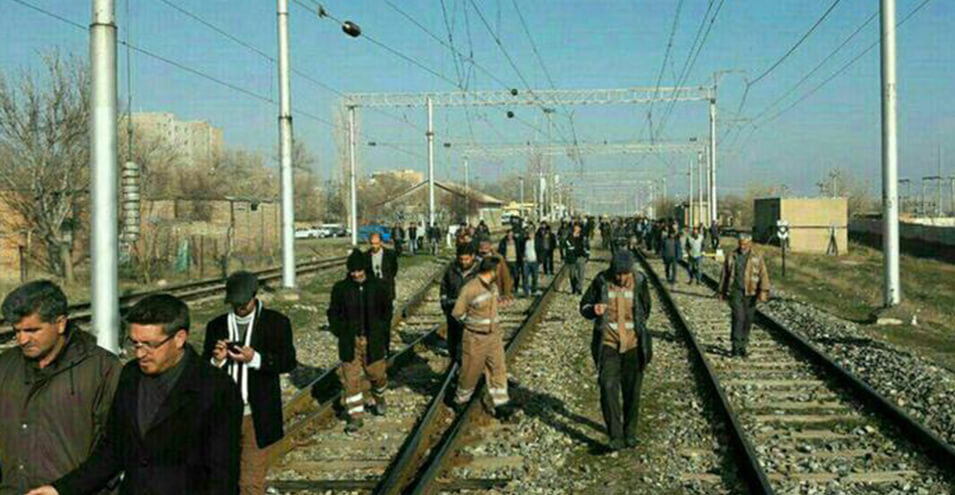
In continuation of their new round of protests, Azerbaijan railway workers gathered to press their wage demands. Yesterday, Tabriz railway workers also blocked the railway line movement. Iran has witnessed dozens of protest gatherings in recent days.
Azerbaijan railway workers continued their protests on Wednesday, the 15th of Esfand (March 6th), striking and gathering in protest of their wage demands.
Hrana news agency announced on Twitter that a number of workers from Azerbaijan’s technical infrastructure lines gathered at Ajabeshr Station “in protest of management’s performance in paying their wage claims.”
The news agency also tweeted that a group of workers from the technical infrastructure lines “in the railway areas of Hormozgan and Azerbaijan” went on strike and gathered over their wage demands.
Tabriz Workers Block Train Routes
According to domestic news agencies, yesterday, staff from Tabriz’s railway transport sector gathered on railway tracks to block train movement in protest of not receiving their two-month salaries. Blocking the railway lines by Tabriz railway staff came after several days of protests and strikes by them along with other staff from Iran’s railway lines.
The director general of Azerbaijan Railways confirmed this news to the state news agency IRNA, saying the reason for workers’ protests and blocking railway lines was the failure to pay two months of accumulated wage arrears. Shapour Aslani had reminded that officials are pursuing this to obtain money from the government to pay workers’ salaries.
However, some sources, citing Tabriz railway workers, said they have not received four months of their salaries and bonuses and can no longer afford their living expenses. Azerbaijan Railway is one of Iran’s nineteen railway regions, with railway lines reaching approximately 1,100 kilometers.
Yesterday, in addition to gatherings in Azerbaijan, reports were also published of protest gatherings of railway workers in Hormozgan, Lorestan, Zagros, Mashhad, and Andimeshk. These gatherings disrupted the movement of numerous trains and the transportation of passengers.
“At Least Three Months of Wage Arrears”
Railway workers’ protests and gatherings are not new, but taking action to gather on railway tracks and block train movement, which rarely happens, indicates a severe livelihood crisis and intense pressure on them. Last Sunday, reports were also published about blocking the Mashhad-Ahvaz passenger train route by maintenance and technical infrastructure line workers of the Railway Company in Andimeshk. Last May, workers at the Hepco factory in Arak blocked Iran’s nationwide railway from north to south in protest of their livelihood problems.
This is not the first protest action by railway workers in Iran in the current year (1397). Last September, workers on several railway lines also gathered in protests to receive their wage claims. Before that, a large number of technical infrastructure line workers, including in the areas of Sirjan, Khorasan, Bandar Turkmen, Sarakh, Shahroud, Damghan, Semnan, Nishapur Station, Sabzevar, Kashmar, and Atar, workers on Zanjan railway infrastructure lines and Hormozgan railway areas, Islamshahr Tehran, Karaj, Lorestan, Azerbaijan, Zagros, Shahroud, Damghan, Semnan, Ahmadbad Hormozgan, and several other stations had engaged in widespread trade union protests.
The new round of protests by technical infrastructure line workers in the railway areas of Hormozgan, Lorestan, Zagros, Mashhad, Andimeshk, and Azerbaijan began on the 11th of Esfand.
EILNA news agency on Monday, referring to the protest gathering of workers in their workplace due to not receiving “at least three months of wage arrears along with several years of seniority from the employer,” wrote citing railway workers: “Every so often we resort to trade union protests to receive our wage arrears, but in each period the employer deposits part of our claims to end the workers’ protest.” The news agency asked “officials” to “find solutions.”
The number of maintenance line and infrastructure workers of the Islamic Republic Railway Company reaches approximately 6,500 people, who are mainly employed through contracting companies and with temporary contracts in this company.
In recent days, Iran has witnessed many gatherings and protest movements among different segments of society. The gathering of a group of workers from the United Company Housing Cooperative in front of the Labor Ministry building in Tehran, a number of retirees from Ahvaz and Isfahan Steel, a group of employees working in equity share offices in Tehran, a number of Mehran Municipality workers, as well as the three-day nationwide sit-in of teachers, were among the recent protest movements centered on livelihood problems.
Source: DW