Azita Rafiee-Zadeh, an Instructor at the Bahai Institute of Higher Education, Released from Evin Prison After Completing Her Sentence
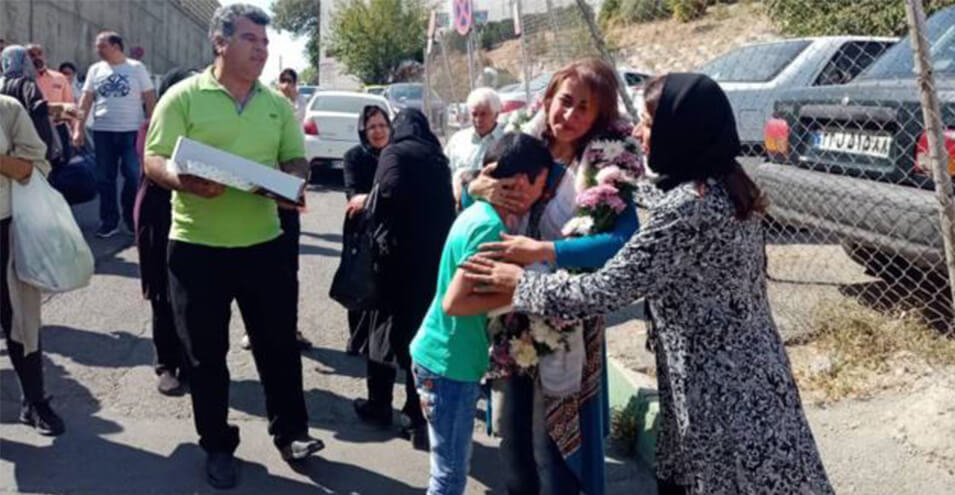
Azita Rafiee-Zadeh, a Bahai citizen and instructor at the Bahai Institute of Higher Education who was imprisoned four years ago on charges of “actions against national security,” has been released from Evin Prison after completing her sentence.
According to a report by the Campaign to Defend Political and Civil Prisoners, Azita Rafiee-Zadeh, who was sentenced to four years in prison on charges of “actions against national security” through what was described as illegal activities at the Bahai Institute of Higher Education, was released from Evin Prison on Wednesday, October 8, after completing her sentence.
This Bahai citizen was arrested in early June 2011 along with her husband, “Peiman Koushk-Baghee,” when security forces visited their home. At the time of their arrest, security forces confiscated a number of personal items including books, handouts, CDs, laptops, and computer hard drives after searching their residence.
According to published reports, Ms. Rafiee-Zadeh and her husband were temporarily released after some time upon giving a commitment to discontinue cooperation with the Bahai Institute of Higher Education and posting a bail of 50 million tomans until the completion of the investigation.
Azita Rafiee-Zadeh’s court hearing was held in June 2014 in Branch 28 of the Revolutionary Court presided over by Judge Moghisseh, and this Bahai citizen was sentenced to four years in prison for the charge of “membership in an illegal Bahai organization with the purpose of actions against national security through illegal activities in an educational institution (BIHE).”
According to the Campaign to Defend Political and Civil Prisoners, Azita Rafiee-Zadeh, who obtained her master’s degree in computer engineering from the Bahai Institute of Higher Education (BIHE), began her work as a computer science instructor at the institution in 2002.
Based on available information, the Bahai Institute of Higher Education is an unofficial university in Iran that was established in 1987 by the Iranian Bahai community. The purpose of this non-residential educational institution is to educate young Bahai students who have been deprived of education in Iranian universities solely because of their religious beliefs. Currently, Bahai citizens can continue their studies in 38 fields of study at the associate, bachelor’s, and master’s degree levels at this university.
The Bahai Institute of Higher Education continues its activities in Iran while the Islamic Republic has labeled it illegal. According to the U.S. State Department’s annual report on religious freedom, Bahai are prohibited from having their own educational institutions, and Bahai students are banned from studying at universities. If their religion is discovered after they have completed their education, they are expelled from the university.
Based on reports published in human rights media, this year a number of Bahai citizens who have passed university entrance exams have been deprived of university admission for various reasons, such as “incomplete files,” contrary to the Islamic Republic of Iran’s regulations, just as in previous years.
Last year, at least 58 Bahai students accepted in the national university entrance exam encountered the phrase “incomplete file” when attempting to register. In fact, Bahai are, except for certain periods, deprived of continuing their education at universities unless they hide or deny their adherence to the Bahai faith.
Some time ago, Mohsen Haji-Mirzaei, the Minister of Education, said on the sidelines of a cabinet session that if students declare that they are followers of religions other than the official religions of the country and if this action of theirs is considered a kind of propaganda, their education in schools is prohibited.
In a section of the Universal Declaration of Human Rights, which the Iranian government is also obliged to follow, regarding the right to education; in part of Article 26 of this declaration, it is written that access to higher education should be equally available to all individuals based on their individual merits.
International human rights organizations and the U.S. State Department have repeatedly condemned the Islamic Republic government’s treatment of Bahai and violations of their civil rights.
In the Iran section of the annual report of the U.S. State Department on religious freedom in the world, it states that in Iran, Bahai are prohibited from having their own educational institutions, and Bahai students are banned from studying at universities, and if their religion is discovered after they have completed their education, they are expelled from the university.
Source: Voice of America