Death Sentence Issued for Leila Abolhasani on “Moharebeh” Charge: A Case with Unclear Documentation

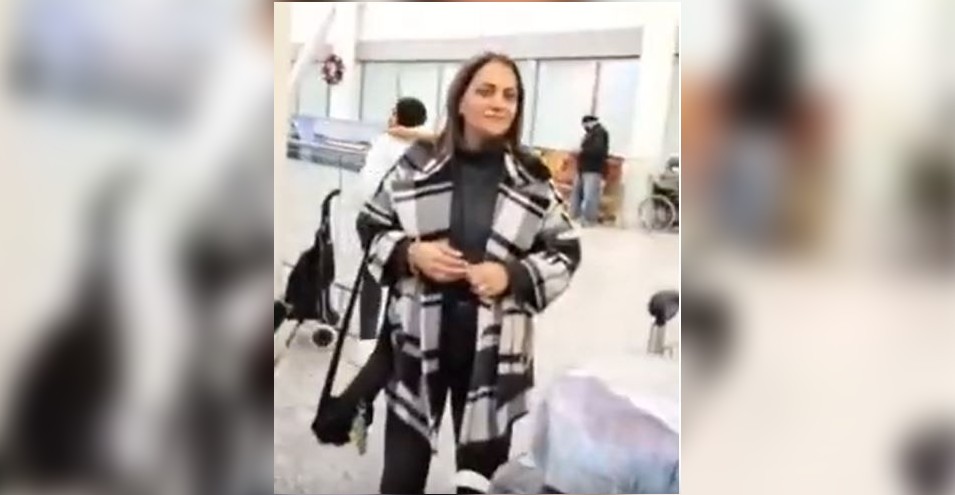
Leila Abolhasani, a 43-year-old mother of two teenage daughters and one of those detained during the December protests in Shahin Shahr, has been sentenced to death on charges of “moharebeh” (enmity against God) after more than seven months in detention at Dowlatabad Prison in Isfahan. She was arrested on December 18 while filming a fire at an Ufq Kourosh store branch. Her relatives say she played no role in setting the fire, and the court documents regarding this charge have not been made public to date.
Leila Abolhasani, a 43-year-old citizen and mother of two teenage daughters, was arrested during the December 2025 protests in Shahin Shahr, Isfahan, and is now facing a death sentence.
According to published reports, the Fifth Branch of the Isfahan Revolutionary Court, presided over by Judge Vahid Hemmat-Nezhad, sentenced her to death on charges of “moharebeh” in Ordibehesht 1405 (April-May 2026). This first-instance verdict was sent to the Supreme Court following an appeal and cassation petition, and the case is still under review.
Therefore, the issued sentence is not yet final and enforceable, and the ultimate fate of the case depends on the decision of the Supreme Court of Iran.
Based on information released by human rights sources, the Islamic Republic’s judicial apparatus has accused her of participating in setting fire to one of the branches of the Ufq Kourosh chain store—an accusation that ultimately became the basis for issuing the death sentence under the charge of “moharebeh.”
However, the account given by Abolhasani’s relatives differs. They say she was merely filming the scene at the time the fire occurred and was arrested while filming. This account has also been reflected in reports by Hana, Hrana, and Iran Wire.
To date, the full text of the court verdict and the evidence upon which the court based its determination of her participation in setting the fire have not been publicly released. For this reason, the details of the case’s evidence remain unclear to the public and media.
Following her arrest, Abolhasani was transferred to Dowlatabad Prison in Isfahan, where she has been held for over seven months.
Human rights reports have identified her as a hairdresser and in some sources as a nail technician. At the time of her arrest, she had two teenage daughters, and her continued detention and the threat of execution of her death sentence have heightened concerns about her family’s situation.
Her case is currently in the cassation stage, and the Supreme Court’s final decision regarding the confirmation or annulment of the sentence has not yet been released.
The charge of “moharebeh” has been one of the criminal charges used in cases related to protests in Iran. Death sentences issued under such charges in cases involving protesters have consistently been accompanied by concerns from human rights organizations about the proportionality of punishment, the fairness of trial proceedings, and the quality of evidence presented in courts.
In Leila Abolhasani’s case, the fundamental question is what evidence has been presented to prove her participation in setting the store fire—a question to which, at the time of the available reports, no documented answer has been made accessible to the public.
This matter is of particular importance because the punishment contemplated by the court—the deprivation of life—is irreversible, and its issuance must be based on a transparent judicial process and evaluable evidence.
Leila Abolhasani’s case is not merely a legal proceeding; behind it lies the life of a 43-year-old woman and two teenage daughters who have endured their mother’s imprisonment for over seven months and now face the threat of her execution.
While the Supreme Court has not yet made a final decision on the issued sentence, this detainee’s situation has once again drawn attention to the use of capital punishment in cases related to Iran’s protests.
For Abolhasani’s family, her fate now hinges on the review process of her case in Iran’s highest judicial authority—a case in which serious ambiguities persist regarding the evidence and documentation for the most serious charge leveled against her: participation in setting fire to the store.