Demonstrations by Iranians in Washington: Structural Error, Not Personal Mistake
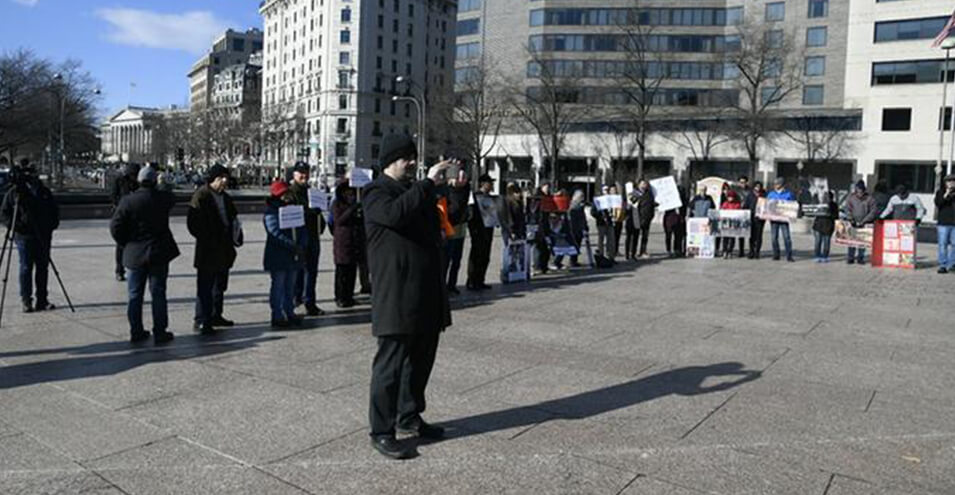
A group of Iranian republicans gathered in Washington to express sympathy with survivors of the victims of the Ukrainian airliner downing. Speakers at this gathering referred to the airplane downing as another sign of a structural problem in Iran’s government.
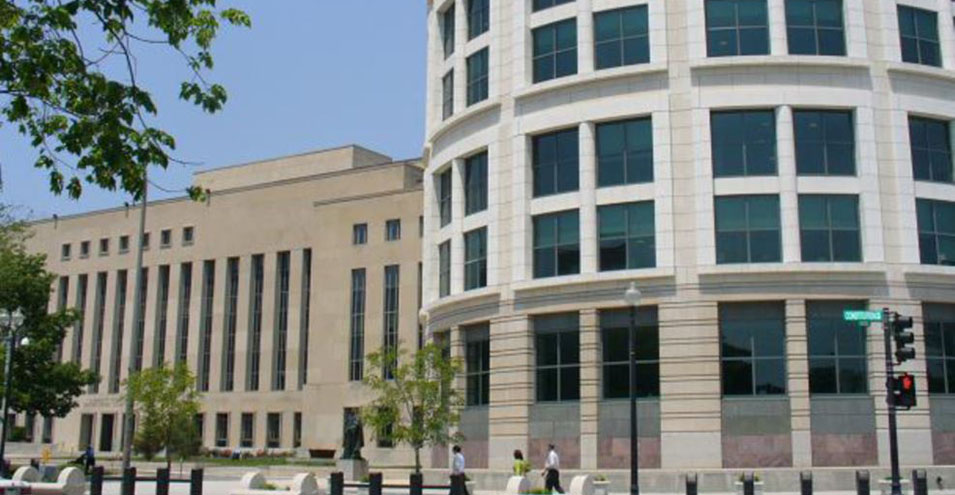
On the afternoon of December 29th, a number of Iranians residing in Washington and its surroundings gathered to pay respects to those killed in the crash of a Ukrainian passenger plane in Iran. This gathering, organized at the invitation of the Society of Iranian Republicans in Washington, D.C., started in front of the Freedom Building in the city and continued after a short march by participants to the front of the U.S. Congress building.
After the performance of the national anthem “Ey Iran” at the beginning of the program, American civil activist Maria Rohelli, in her remarks, recalled the developments that have occurred over many years in the slogans and demands of the Iranian people’s protests, emphasizing that today the people’s desire is for fundamental changes in the structure of government. She cited as an example the change in the slogan “Don’t be afraid, don’t be afraid, we are all together” to “Be afraid, be afraid, we are all together” and considered it a sign of direct confrontation with oppressors. According to Ms. Rohelli, the decline in the slogan “Allahu Akbar” is another manifestation of fundamental changes in protest thinking. She recalled that in 2009, religious slogans were part of the main protest chants, but today these slogans have been marginalized. Ms. Rohelli also considered direct slogans against the Supreme Leader of the Islamic Republic to be an important development in the direction of protests.
She also emphasized in another part of her remarks that what exists in Iran under the claim of the Islamic government is not actually a state, but rather a mafia gang and criminal organization that bears no sign of the reality of a responsible government. According to her, the high percentage of young people who have become addicted or are unemployed, the fact that the economic structure has been corrupted, or the severe destruction of the environment in Iran and water scarcity and air pollution becoming part of people’s daily routine, are signs that this mafia group is incapable of managing the country, because according to Ms. Rohelli, the first duty of any government is to manage the country and resolve these problems, while Iran’s rulers lack such capability. Ms. Rohelli continued that for this reason, essentially there is no government in Iran and only a mafia governs it. She considered the crash of the passenger plane another sign of this inability to govern, because it reveals its structural incapacity. Ms. Rohelli, while reiterating the absence of government in Iran, added that this issue causes only tools of repression to be used in response to people’s protests, and the killing of protesters or their imprisonment and torture is the only response of this gang to the people.
“The Importance of Winning Public Opinion”
At the end of her remarks, she discussed the difference in how the “ruling gang” in Iran dealt with the November protests and recent protests, and attributed the widespread suppression in November to the voice of the Iranian people not being heard abroad and the failure to attract media and public attention to it. According to her, this difference shows how important it is to win public attention, because Iran’s rulers do not have the possibility of widespread suppression under international scrutiny.
Following Ms. Rohelli’s remarks, those gathered chanted slogans in opposition to Iran’s government. Among these slogans were calls for the destruction of the Islamic Republic and the establishment of democracy in Iran. They chanted: “No to theocracy, yes to democracy” as well as “The Islamic Republic must be destroyed,” “Political prisoners must be freed,” “Women’s rights are human rights,” “Equal rights for all women,” and “Free press for Iran.”
Continuing the ceremony, Ms. Fariba Rad, representative of the Society of Iranian Republicans in Washington, D.C., read the statement of this group. Part of this statement read: “The Iranian government once again committed a major crime by firing a Revolutionary Guard missile at a passenger plane, adding to its long list of crimes. According to their usual practice, they tried to deceive people and the world through lies and concealment, but this time the entry of officials from other countries and people’s alertness on social networks deprived them of this opportunity.” In another section of this statement, referring to people’s protests in November and protests following the plane crash, it was emphasized: “This time, people’s slogans directly targeted the institution of Wilayat al-Faqih and Khamenei along with his instrument of oppression, the Islamic Revolutionary Guard Corps. People once again loudly cried out that they are tired of both factions of the government, both reformists and hardliners, and are seeking a bright future in the shadow of democracy, justice, and freedom.” At the end of this statement, it also said: “We, the Society of Iranian Republicans – Washington D.C. – while expressing condolences to the families of those who died in the passenger plane crash, declare that we stand with the Iranian nation and loudly say: the path to prosperity and happiness of the Iranian nation is summed up in one demand: the Islamic Republic must go.”
After the reading of the Society of Iranian Republicans’ statement, Jalil Azadkhah, an independent Kurdish political activist, took the podium and at the beginning of his remarks expressed sympathy with the Baloch people who have been facing numerous problems these days due to flooding in the region, and some of whom have lost their lives. He also expressed sympathy with the families and survivors of those killed in the Ukrainian passenger plane. Mr. Azadkhah stressed that these people were actually murdered and assassinated, but the government labeled this act as human error.
Referring to the living conditions of people in Iran who face new problems and crises every day and have no possibility of living in peace, and are waiting every day for a new crime or massacre, he added that this situation has existed for a large segment of the population since the very beginning of the Islamic Revolution and the establishment of the Islamic Republic and is not a new event. Mr. Azadkhah emphasized that the withdrawal of a few people within the government is not a solution for Iran; rather, everything related to this government, from political and legal structures to economic and cultural ones, must be completely changed to provide the possibility of prosperity for the people. According to Mr. Azadkhah, the Islamic Republic government always lives in crisis and its survival depends on crisis, which is why these crises will continue in the future. He considered smuggling, corruption, discrimination, and killing as inseparable parts of the identity of Iran’s government and at the same time expressed hope that Iran’s government has lost a large portion of its supporters and consequently its social capital. Mr. Azadkhah called for establishing a secular democratic government based on universal standards of human rights in Iran and emphasized that the departure of the Islamic Republic would be beneficial to all nations living in Iran, including Kurds, Turks, Arabs, Persians, and Baloch, and every day that this government remains is greater harm to the people. Mr. Azadkhah also considered it the duty of Iranians outside the country to be the voice of people inside for change and to never forget this duty for a moment.
“The Connection of the Iranian and Lebanese Peoples”
Following these remarks, those gathered once again chanted slogans in protest against Iran’s government. Among some of the slogans of people inside Iran, “We didn’t shed blood to compromise, I won’t praise a murderous leader,” and “Khamenei, shame on your deception, blood drips from your colorless face,” as well as the slogan “Bread, work, freedom,” were chanted several times.
Then the crowd that had gathered in front of the Freedom Building in Washington moved toward the U.S. Congress building. In the cold weather of Washington, the slogans of those present, the placards they were holding, and the crowd moving along the sidewalk toward Congress also attracted the attention of passersby, and some citizens asked those at the program about the reason for the gathering and the meaning of the Farsi slogans.
It was around 2:30 in the afternoon when those gathered reached the front of the U.S. Congress. There, those present observed one minute of silence in honor of the lives lost in the downing of the passenger plane, and then slogans were chanted. After that, Nizar Zakka, an American-Lebanese citizen who had been imprisoned in Iran for several years, spoke to those gathered. In his brief remarks, Mr. Zakka, referring to the long four-year period during which he was imprisoned by the Islamic Republic without any guilt, said he is concerned about those who remain imprisoned and forgotten. He reported on people who have no crime and, according to Mr. Zakka, are cultured, educated individuals and among the best members of this society. While expressing renewed concern about the fate of those still remaining in Iranian prisons, he expressed hope that the United Nations will follow up on their rights. Because according to Mr. Zakka, these people are not just citizens of one country but world citizens. In another part of his remarks, he referred to the historical proximity of the two nations of Iran and Lebanon and said that the desire of both peoples is one.
“The File of Wise and Savior and Charismatic Leaders in Iran”
Continuing the ceremony, a message from Ms. Ghazaleh Hashemi, representative of the people in the Virginia State Senate, was read. In her message, Ms. Hashemi sent her deepest condolences to the families and survivors of this great tragedy. Referring to the diverse nationalities among the victims of the disaster, she emphasized that families have the right to receive clear answers about this and the causes of the incident. She added, let us remember the memory of these people, their names, their voices, and their faces, and assure their families that what they have lost is the same thing we have lost.
At the end of this program, Ali Afshari, a member of the Society of Iranian Republicans, said in his remarks that today we have gathered to mourn innocent passengers who were lost due to the tragic error of the government. He emphasized that this tragic disaster is not a human error but a systematic government error by an autocratic, corrupt, and incompetent government that in four decades of its existence has committed major crimes directly and indirectly. Mr. Afshari added that in addition to this disaster, our protest is against the setting that has created the disaster, and this defective structure will continue to cause disasters. Afshari stressed that in a deeper view, what causes such disasters is the lack of respect for humans and humanity in the intellectual and practical structure of the Islamic Republic, and the way of dealing with this issue shows how worthless human life is from the perspective of Iran’s rulers, because no one in any part of the government was willing to accept responsibility.
Afshari also said that the “autocratic leader” of the Islamic Republic in his speech “with utmost audacity” made this very painful event seem trivial and tried to show his anger at why public protests over concealment and cover-up of truth led to the marginalization of the government’s power maneuver in the funeral of Qasem Soleimani “the commander of despotic guardianship.” Afshari considered this treatment another sign of the government’s disregard for human lives. He also said that those who ordered and carried out the downing of the plane “which might even have been intentional” should be tried according to standards of justice. According to him, this is not only a national demand but also an international one.
Mr. Afshari, in another part of his remarks, emphasized that those gathered in this meeting, like many people in Iran, seek a non-violent transition to democracy. According to him, the Iranian people are a united people who must resist together so that the structure of oppression is dismantled and surrenders to the will of the nation. Mr. Afshari stressed that what preserves the unity of the people is not “traditional institutions from outdated periods belonging to past eras,” but rather agreement and consent among the members of Iranian society, which is the bond of national solidarity. He considered the current Iranian society to be composed of people in which there is no place for “supermen” and the legitimacy of its government is not somewhere in the sky or outside the will of the people, and in this society average humans have gathered who have equal civil rights. According to him, the Iranian people, despite all their social, cultural, religious, and ethnic diversity, have reached a level of development in the twenty-first century where, relying on themselves, they can solve their problems and have no need for a savior. Mr. Afshari expressed hope that the file of wise and savior and charismatic leaders in Iran will be closed.
Source: DW