Details of the Assassination of ‘Mogaddasi’ and ‘Razini’, Judges of Injustice and Suppressors of Minorities
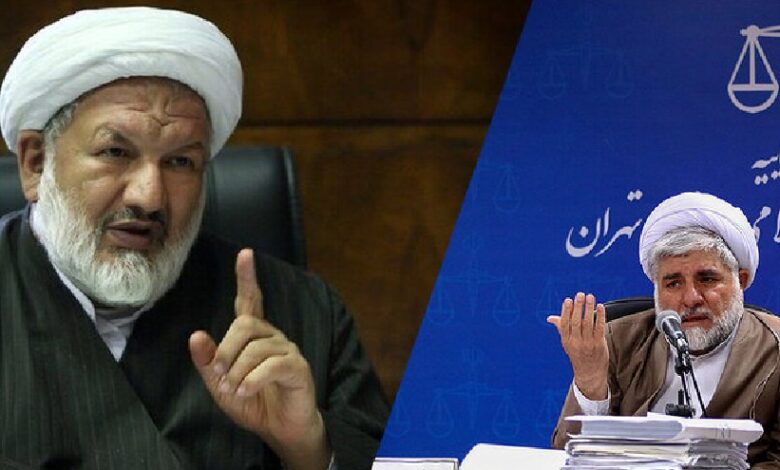
Various media outlets reported details of the assassination of Mogaddasi and Razini, judges of injustice and suppressors of minorities.
Judge “Mohammad Mogaddasi” and “Ali Razini” were shot and killed on Saturday, the 29th of Dey 1403. Some news agencies reported their deaths occurred at their office, while others reported that their assassination took place in front of the Supreme Court building.
Mohammad Mogaddasi was an Iranian judge, head of a division and judge at the Supreme Court of the country, and was a staunch and brutal supporter of the suppression of minorities, the massacre of political prisoners, and a pursuer of executions of prisoners from the 1980s, particularly in the summer of 1988.
Ali Razini was also a cleric, judge, and head of Division 41 of the Supreme Court who was appointed as the prosecutor of the Islamic Revolution in Tehran after “Assadollah Lajevardi” was removed from office. He also served as head of the judicial organization of the armed forces and head of the Administrative Court of Justice. He was one of those who participated in the trials of the summer 1988 executions and stated that he carried them out on the direct orders of Ayatollah Khomeini. In addition, he issued all death sentences for women political prisoners in 1980 in Mashhad.
The assassination of these two brutal judges and human rights violators on Saturday revived memories of the crimes and nightmares of political citizens and religious minorities that had been inflicted upon them. In recent decades, they played a significant role in issuing death sentences, long-term imprisonments, and systematic torture against detainees and their families, to the extent that Mohammad Mogaddasi was placed on the human rights sanctions list by the European Union and the United States for widespread human rights violations.
Mohammad Mogaddasi and Ali Razini were known to the Iranian people and various countries as “death judges” who played a principal role in the execution of political prisoners in the summer of 1988. The sentences issued by them in 1988 were recognized by the UN Human Rights Council’s Special Rapporteur on Iran as “crimes against humanity” and were classified among the gravest international crimes.
According to statements from close associates of Reverend “Hossein Sudmend” in Mashhad, when he was tried in the Special Court for the Clergy in Mashhad and executed in 1990 on charges of apostasy, Ali Razini was Ayatollah Khomeini’s and Ali Khamenei’s trusted judge who became head of the Special Court for the Clergy by Khomeini’s order. Reverend Sudmend was also the pastor of the Evangelical Church at that time and was sentenced to death by this judge on charges of apostasy.
Mohammad Mogaddasi also issued sentences of nearly 100 years imprisonment against Christians in at least 4 cases and caused harassment and persecution of their families. He was known for issuing heavy sentences against religious minorities and, by using methods such as rejecting assigned lawyers and imposing heavy bail amounts, transformed the court into a field of psychological pressure and threats.
The U.S. Treasury Department also issued a statement in 2019, while sanctioning Mohammad Mogaddasi and Judge Salwati as human rights violators, writing about them: “Abolghasem Salwati and Mohammad Mogaddasi are the architects of injustice in the regime’s show trials, where journalists, lawyers, political activists, and members of religious and ethnic minorities have been sentenced to long-term imprisonment, flogging, and even execution for exercising their right to free speech and assembly.”
Now Mohammad Mogaddasi and Ali Razini, the death judges, were killed on Saturday, the 29th of Dey, by gunshots from an individual whom some media outlets identified as a service staff employee and water carrier at the judiciary building. According to the head of the Supreme Court, the shooter was an infiltrating agent who acted according to a pre-planned operation.
“Mohammad Jafar Montazeri”, the head of the Supreme Court, appeared on Monday, the first of Bahman, as an eyewitness on the Islamic Republic’s news network, and while reconstructing the scene of the attack on these two judges, told a reporter that the shooter had prepared the weapon illegally and in advance. He also announced that the shooter had no criminal record and no cases or rulings in the court.
In his statement during an interview with a reporter, he added: “I was in the building on the day of the incident, and when I left my office for some work and went downstairs, I saw Mogaddasi who had been shot in the corridor, and after two movements in his hands he died. I was told there that Razini had also been shot, and when I entered Razini’s office, I saw him fallen from his chair with much blood coming from his body and he was dead.”
According to his statement, the shooter first went directly to Razini and then shot at Mogaddasi who was in the same office, and after that ended his own life by shooting himself in the heart. Now, two days after their murder, no organization or group has yet claimed responsibility for their assassination.
The killing of these two judges in Tehran, whose rulings affected many lives and cast a shadow of fear and hatred on the families of their victims, prompted many former political prisoners, civil activists, students, and women to write about their court memories with these two judges known as death judges, and many also commemorated the victims of nationwide protests, some of whom were sentenced to death by Ali Razini.