Discovery of First Roman Stone Sarcophagus in Diyarbakır, Turkey
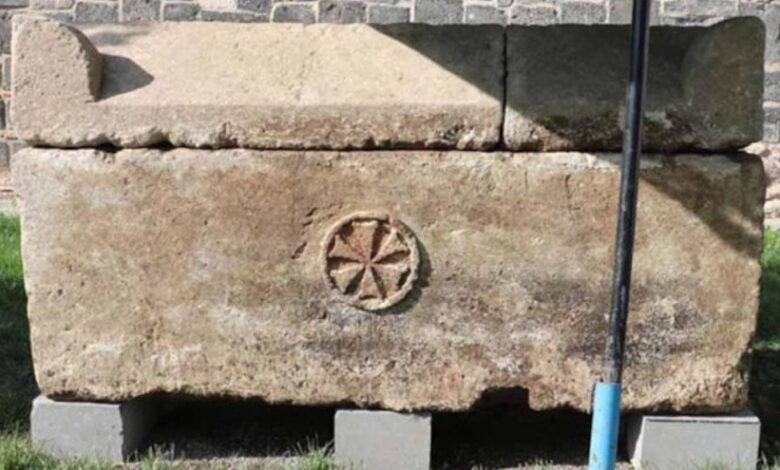
The online magazine “Archaeologist” reported the discovery of a Roman stone sarcophagus among the ancient walls of Diyarbakır, on which a Maltese cross was engraved.
According to a report by the online magazine Archaeologist, when archaeologists were conducting excavations in the ancient city of Diyarbakır, they made an exciting and unprecedented discovery. While digging in a section of a watchtower in the famous defensive walls of the city and the Church of Saint George, they discovered a sarcophagus from the Roman period.
This sarcophagus, which contained the remains of an unknown person, dates to the time of the Roman Empire in Diyarbakır and holds great historical significance. On the outer wall of this stone sarcophagus, a Maltese cross is engraved, which has remained completely intact. This religious symbol is associated with Christianity of the Middle Ages and the Crusades; however, this cross, called special, is unique because it has six sides, whereas most versions of the Maltese cross have eight or four sides.
The discovery of this large sarcophagus took place at a depth of 4.5 meters underground, requiring considerable effort. The discovery was made during restoration work to preserve the ancient walls that surround the oldest part of the city. The aforementioned sarcophagus, which is more than two meters long and 82 centimeters high, is carved from limestone and has two heavy lids placed together. Its unique construction style allowed researchers to identify it as a product of a Roman-era craftsman.
The sarcophagus was found near the historic Church of Saint George and was added to the collection of archaeological discoveries. Researchers suggested that this area must have been the church’s cemetery. Jamil Koch, director of the Diyarbakır survey, told Anadolu News Agency: “Excavations are continuing and similar findings may be uncovered.”
The skeletal remains of the person placed in the sarcophagus will be subjected to radiocarbon dating to help researchers determine the age, gender, and time of life and death of this individual. The discovery of this sarcophagus has allowed archaeologists to expand their underground excavation and see whether they can discover other surprises from this structure, which according to their statements is very likely a church.