Dry Riverbed of Shiraz Takes on the Color of Water
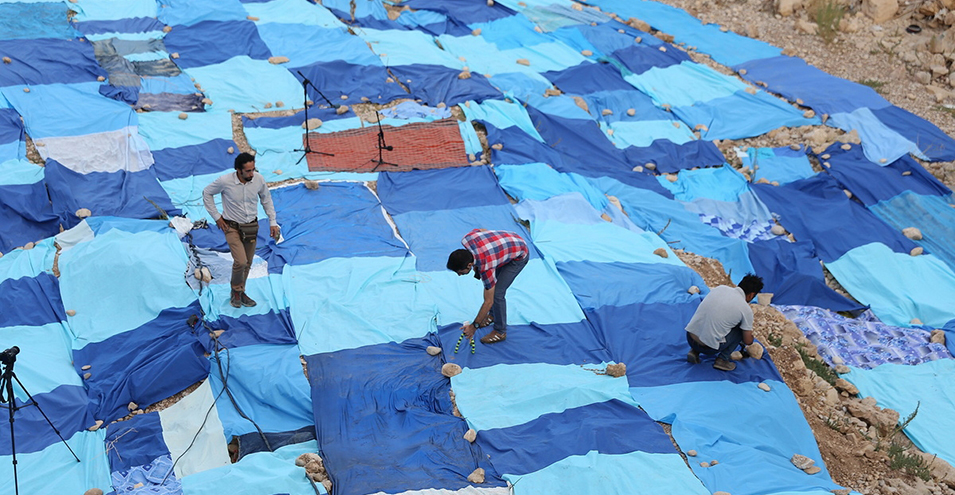
Shiraz- IRNA- The dry riverbed of Shiraz, which has not had flowing water for years, has taken on the color of water through the initiative of a group of artists concerned about the water crisis, using blue-colored fabrics.
According to IRNA’s report, on Tuesday, this group of artists from Fars Province spread blue-colored fabric pieces, which people sent over the course of one year to carry out this project and which took one month to sew together, across 2,500 meters of the dry riverbed of Shiraz between the Bagh-e Safa and Neshat bridges.
This work was carried out with the efforts of the General Department of Culture and Islamic Guidance of Fars Province. This group of young artists, led by Seyed Jalal Hashemi, named this artistic initiative environmental art titled “Blue Without Water” and used the “performance” method to carry out this work.
Performance is a combination of visual arts, theater, and music.
Hashemi, in an interview with IRNA regarding this initiative, stated: “Our message from this purposeful artistic action is to remind people of the water crisis, and this warning that we should fear the time when news and events related to the drying of rivers and lakes become normal for society and the importance and sensitivity of this issue diminishes.”
He stated: “Another message from implementing this artistic work is to spread the culture of optimal water consumption in practice and in each sector of society.”
Hashemi expressed: “By carrying out this work, we convey a message to people, who themselves have a significant role in organizing this artistic initiative, to take the water crisis seriously and to come together to promote a culture of optimal water consumption.”
This young artist, regarding the reason for choosing the performance format to carry out this work, said: “Implementing this artistic format to convey the message requires the participation of different sectors of society, and this matter is an inseparable element of this art form.”
Hashemi said: “To collect these blue fabrics, starting one year ago, we informed people through social media and requested their participation in this work by sending blue fabrics they no longer needed, and this is the first step of public participation in this work. At least 250 people participated in organizing this artistic program, which aims to warn society, by sending blue fabrics.”
He said: “The work of covering the dry riverbed of Shiraz with sewn blue fabrics will end at 7 p.m. today (Tuesday), and this program will be concluded with the performance of traditional Iranian music that will be performed live.”
Hashemi said: “After the performance ‘Blue Without Water’ remains in the dry Shiraz riverbed for three days, it will be transferred to Parishan Lake in Kazerun City, and then it will be extended to the Zayandeh River bed in Isfahan Province and subsequently to Lake Urmia in northwestern Iran.”
He added: “Implementation of this environmental art will continue by attracting audience participation in different water-scarce and water-deprived areas.”
The dry Shiraz riverbed is a seasonal river that is formed by the joining of water from two canals, Nahr-e Azam and Chinar Sukhte. After passing through the city of Shiraz, it flows toward the southeastern part of its basin and empties into Lake Maharloo, 10 kilometers southeast of Shiraz.
This river passes diagonally through the middle of the city of Shiraz and seems to divide the city into two halves.
To cross this river in Shiraz, numerous bridges have been built over it, the most important of which are Bagh-e Safa Bridge, Namazi Bridge, Zargari Bridge, Ali ibn Hamza Bridge, Moaali Abad Bridge, Pirnia Bridge, and Parking Bridge.
Source: IRNA