Economy Under Ceasefire; From Destruction of Livelihoods to Nighttime Extortion of Merchants
Economy under ceasefire in people’s accounts: “Businesses have been destroyed, widespread unemployment and organized pressure on us merchants has increased to the point where they have resorted to nighttime extortion and threats.”
While a temporary ceasefire and reduction in attacks is seen by many as a sign of calm, narratives emerging from cities paint a completely different picture; a picture of gradual economic collapse, business closures, and mounting pressure on productive sectors of society.
Limited internet access has meant that only groups of citizens can publish their accounts at great expense; accounts that have moved beyond unemployment and, as some describe it, reached “complete economic destruction.”
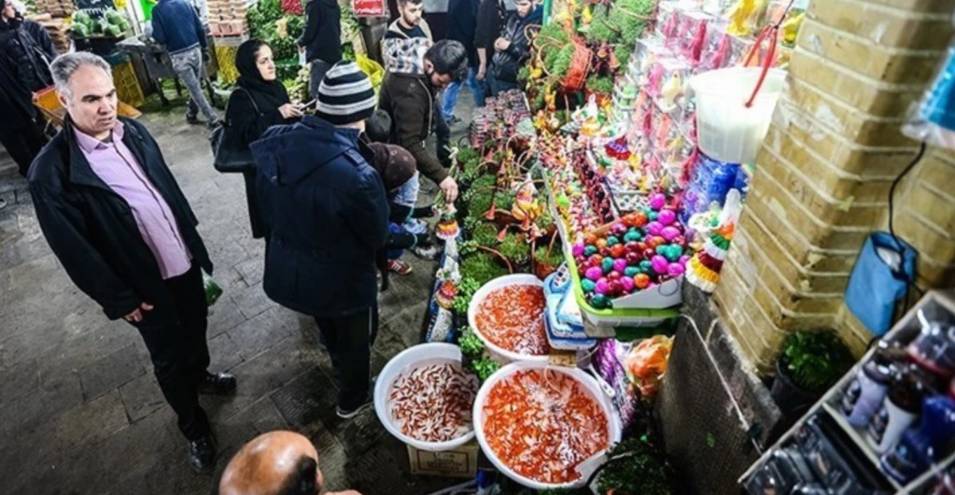
One less-discussed dimension of these days is the mounting pressure on local merchants. “Siavash,” a livestock herder living in one of the cities of Tehran Province, speaks of the changed atmosphere on streets after the ceasefire: “They organize processions chanting ‘Haidar, Haidar’ and ‘War, War until victory’ through neighborhoods and demand that merchants feed the people who bring them darkness.”
He explains that gatherings have now become more widespread and longer: “They existed before too. But in any case, bombardment and airstrikes meant they gathered in specific places for some recitations and commotion, breaking up around 11 pm. Now, however, they come every night starting at six or seven in the evening until dawn on the street.”
According to him, providing food for these gatherings is effectively imposed on merchants. He says: “For example, they told me I must provide a hundred kilos of milk because they want to serve people chocolate milk. They tell the butcher to provide meat. Restaurants must provide food, cafes coffee and tea. If anyone objects, they’re threatened with closure and asset seizure.”
He described this situation as a form of extortion and added: “They’re parasitically feeding off us. They’re using force to extort from business owners, and any slight objection is met with threats.”
In industrial areas, conditions are reported to be even more critical. “Farshad,” a worker at one of the petrochemical plants, describes the situation this way: “I bought two gigabytes of internet for two million tomans, just to say that what we’re witnessing in Bandar Imam and Mahshahr is not unemployment, it’s destruction.”
According to him, damage to vital infrastructure has created a chain of unemployment: “Tens of thousands of workers have been laid off following the targeting of Fajr One and Two complexes, and hundreds of workers are on the layoff list.”
He also mentions workers who lost their lives and wants their names to be seen: “In this attack, six workers from Fajr Petrochemical were killed. Hossein Hashempour, Ali Emami, Mehdi Visibiar, Abozar Reihani, Ali Mombini, and Mohammad Torabi. Please mention their names, do not let their names be forgotten in this commotion.”
Concerns are not limited to the unemployed; even permanent employees speak of their uncertain future: “Right now, there’s no talk of returning to work. Then they go on television for interviews saying that in six more months everything will be back to normal.”
In various cities, small businesses, which are normally the most vulnerable part of the economy, are collapsing at an accelerating rate.
“Master Hossein,” an experienced painter in Tabriz, speaks of his efforts to help people during crisis days, but emphasizes that he cannot continue this process: “My income wasn’t enough to support even two apprentices. I had to tell one of them not to come.”
He speaks of customers for whom the car is their means of livelihood: “One is a courier, one works for Snapp. People’s cars were buried under rubble or damaged.”
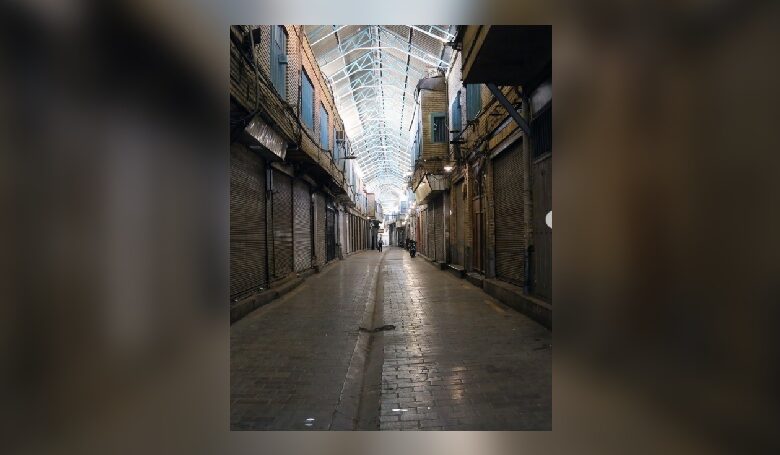
In Tehran, markets like Laleh Zar that once thrived now face severe recession. “Ali,” owner of a chandelier shop, says: “I’ve put everything on sale but still no one is buying.”
He has decided to change his profession: “My only hope for sales was on New Year’s Eve. This year nothing. Even now that I’ve put more than 60 percent discount on most items, no one is buying. The supermarket always covers its costs. You can’t avoid buying food.”
Financial pressures from banks have also fueled this crisis: “My bank, without considering circumstances, sends me threatening messages every day saying we will take legal action. Where are we supposed to get it from?”
What emerges from the totality of these narratives is a picture of an economy that is not only directly impacted by war, but is also eroding due to its indirect consequences; from supply chain disruptions and reduced demand to social and structural pressures on businesses.
Economic experts in similar circumstances emphasize that during post-war periods or fragile ceasefires, small businesses and wage laborers suffer the most; groups with limited financial reserves who drop out of the economic cycle faster than others.
In such circumstances, a phrase that “Master Hossein” says at the end may be a summary of the current situation for many of Iran’s people: “Even if one had Croesus’s wealth, if there’s no market, it’s finished. How long can you survive on savings? Please pray for us Iranians.”