Employment Discrimination by IRIB Against Women, Persons with Disabilities, and Non-Muslims
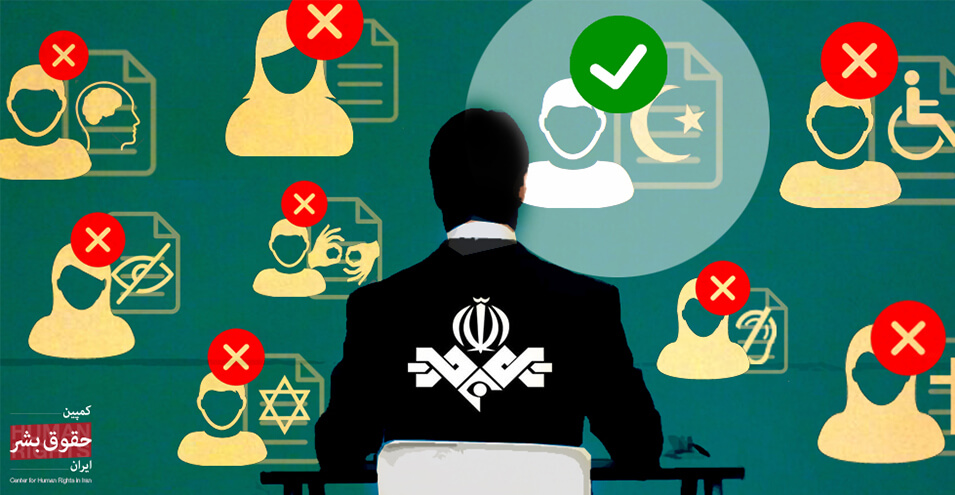
In its latest employment announcement published on June 26, 2019, the Islamic Republic of Iran Broadcasting (IRIB) declared “complete health and absence of physical disability” and “belief in and practical commitment to Islam and Wilayat al-Faqih” as employment conditions in all cities, and “being male” in all provincial centers except Tehran as hiring requirements for the organization. This means only healthy Muslim men without disabilities can be employed at IRIB.
This announcement mandates discrimination based on disability, gender, and religion, and constitutes ideological scrutiny. Additionally, according to the announcement, employment contracts in provincial centers outside Tehran are contingent upon signing “a ten-year notarized commitment to not change occupation and not request workplace relocation.” However, this limitation violates the right to freedom of employment and choice of residence, which are stipulated in the Constitution, the International Covenant on Civil and Political Rights, and the International Covenant on Economic, Social and Cultural Rights.
A lawyer from Tehran who spoke with the Iran Human Rights Campaign on condition of anonymity, responding to the employment announcement, stated: “IRIB has proven it does not care about enforcing the law and has no regard for women’s rights, religious minorities, and even persons with disabilities. If the Administrative Justice Court becomes involved, it would likely find a violation of law, but court proceedings are usually very slow, and we don’t have active organizations in Iran to follow up such cases. It is illegal for someone to commit that they cannot change their job or workplace for ten years, and it constitutes a form of forced labor, as it deprives the person of the right to choose their occupation and place of residence for an extended period.”
Violation of Domestic and International Commitments to Ensure Equal Employment for Persons with Disabilities
In its employment announcement for recruiting specialists in electrical, mechanical, and computer engineering fields, IRIB declared “complete health” and “absence of physical disability” as general and primary employment conditions. This action directly violates the Convention on the Rights of Persons with Disabilities, according to which member states, including Iran, are obligated to take all necessary measures to ensure equal access and non-discriminatory opportunity for persons with disabilities to employment opportunities. Article 27, paragraph 1, of this Convention explicitly prohibits any discrimination based on disability in employment conditions. Furthermore, according to Article 15 of the Law for the Protection of the Rights of Persons with Disabilities, approved by Parliament in February 2018, “the government is obligated to allocate at least three percent of formal, contractual, and labor employment permits of government and public agencies, including ministries, organizations, institutions, companies, public and revolutionary bodies, and other agencies using the public budget, to qualified persons with disabilities.”
However, recruitment examinations have repeatedly violated the rights of persons with disabilities in recent years, preventing them from taking these examinations. For example, in the guidebook for the fifth centralized civil service recruitment examination published in April 2018, the medical conditions section for teacher applicants set minimum requirements for vision and hearing levels, effectively barring blind, low-vision, deaf, and hard-of-hearing individuals from access to this profession, which offers the most employment opportunities for persons with disabilities. Following this incident, a group of persons with disabilities issued an open letter to the President demanding a halt to the examination and guaranteeing the actual implementation of the three percent quota for persons with disabilities in government employment. Despite this request, the fifth civil service recruitment examination proceeded as scheduled. However, raising the issue of non-implementation of the three percent quota law at the social level led to multiple follow-ups and statements. Among the outcomes of these efforts was the issuance of a mandatory circular by the Civil Service and Administrative Employment Organization in September 2018 requiring the presence of welfare representatives during employment interviews for persons with disabilities.
IRIB’s action in listing the absence of physical disability as an employment requirement has prompted multiple reactions among persons with disabilities and activists in this field.
Mohammad Kamali, former dean of the Faculty of Social Welfare and Rehabilitation and a longtime activist in promoting the rights of persons with disabilities, tweeted: “The gentlemen at #IRIB have once again trampled the law and violated section (a) of Article 7 of the comprehensive law on the rights of #persons with disabilities [Article 15 of the current law protecting persons with disabilities]. While the law clearly requires a 3% quota for them. Yet on BBC, they proudly use a presenter missing a hand below the elbow for a children’s program.” The campaign for monitoring the rights of persons with disabilities also tweeted, announcing the exclusion of persons with disabilities from IRIB employment: “IRIB, in addition to producing and broadcasting films and series with negative portrayals of disability, this time in an extremist approach declared ‘complete health and absence of physical disability’ as a general condition for recruitment!”
A user named “Nada,” who identified herself as hard-of-hearing and a member of the campaign for monitoring the rights of persons with disabilities, reacted to this discrimination on Twitter: “Our group, despite studying with great difficulty and even performing much more successfully than healthy people in university, unfortunately the government, instead of supporting us, official hiring under the pretext that people must have complete physical health is denying the three percent employment quota—they should just officially say disabled people go and die.”
Certainly, different occupations require different physical and mental activities that may not be possible for some persons with disabilities, but first, the number of such cases is far more limited than assumed, and in many cases, persons with disabilities can be employed by providing standard workplace accommodations. Second, many persons with physical disabilities who will not be able to participate in IRIB’s recruitment examination due to the condition of “complete health and absence of physical disability” do not even require special accommodations to perform their work. For example, those with physical disabilities due to missing one or more fingers or shortened legs would easily be able to perform the duties of an electrical engineer or computer specialist.
Repeated Discrimination Against Women and Non-Muslims
Beyond persons with disabilities, women and religious minorities have also faced explicit and direct discrimination by IRIB. The employment announcement imposes gender restrictions only in Tehran; in other provinces, according to the explicit text of the announcement, “applicants must be male and native to the relevant province.”
Excluding women from employment in many professions, especially engineering positions, is common in many private and government announcements, where employers without providing reasons state that the applicant must definitely be “male.” Conversely, for administrative and secretarial positions, in many cases employment is limited to women. This practice clearly demonstrates how widespread gender stereotypes are in Iran. This is while any employment discrimination solely based on gender is illegal and violates Article 20 of the Constitution and Article 3 of the International Covenant on Civil and Political Rights and Article 3 of the International Covenant on Economic, Social and Cultural Rights.
Furthermore, the announcement mentions “belief in and practical commitment to Islam and Wilayat al-Faqih” as an employment condition, meaning the exclusion of religious minorities, even those officially recognized in the Constitution. Additionally, the condition of belief in Islam and Wilayat al-Faqih means ideological scrutiny, which the Constitution has declared prohibited.
The lawyer from Tehran who discussed the legal issues of this announcement with the campaign said: “In this matter of whether belief should be a condition or practical commitment, there have been many discussions and some suggested that practical commitment is sufficient, meaning it is enough that the person does not act contrary to Islam and Wilayat al-Faqih in practice, since determining people’s beliefs requires ideological scrutiny, which is unacceptable. But this announcement again speaks of belief and has issued a license for ideological scrutiny.”
He also said regarding the prohibition of hiring non-Muslims: “Unfortunately, the condition of being Muslim in government announcements is very common and is even seen in simple positions like administrative work that have no political or cultural sensitivity, where non-Muslims are excluded for reasons that are not clear.”
Workers’ Commitment to Not Ending Cooperation and Not Requesting Relocation Is an Unnecessary and Illegal Restriction
IRIB’s employment announcement, alongside other discriminatory conditions, makes employment in provincial centers contingent on a commitment signed at a notary public office that applicants will not change their occupation or request workplace relocation for ten years from the start of employment. The apparent reason for this condition is that many people change their occupation or workplace after a short period of work in deprived and remote provinces, depriving the organization of specialized personnel who have enhanced their professional skills after the initial period of work.
However, no interest justifies simultaneously depriving someone of the right to choose their occupation and place of residence for ten years. First, according to Article 21 of the Labor Law, resignation is a worker’s right, and the worker, like the employer, has the right to terminate the employment contract with prior notice and a one-month interval. Yet the notarized commitment mentioned in this announcement means depriving the worker of the right to resign. Regarding the prohibition of requesting workplace relocation, it should be said that if this prohibition were presented alone without depriving the right to resign, it might be justifiable, but the simultaneous imposition of these two prohibitions will place workers in precarious situations.
Articles 6 and 7 of the International Covenant on Economic, Social and Cultural Rights, which are binding on the Iranian government and have the force of law, obligate the state to respect individuals’ freedom in choosing their occupation and, in addition to not creating obstacles to professional development and advancement, to provide necessary facilities in this regard.
Moreover, a ten-year commitment to employment and, consequently, residence in a specific location and not requesting relocation violates individuals’ right to choose their place of residence and prohibits forcing them to reside in a specific place. Only by law and as punishment can a person be forced to reside in a place for ten years and not request relocation. As mentioned, it is understandable that organizations may face a shortage of specialized labor in deprived cities due to people’s tendency to seek employment and residence in large cities and want to counter this trend. But certainly, countering such a trend is not by obtaining formal commitments for ten years that deprive individuals of the freedom to choose their occupation and place of residence. Rather, offering specific and tangible benefits for employment in deprived areas, or stating that the employer has no obligation to approve workplace relocation, can be appropriate solutions to this problem.
Source: Iran Human Rights Campaign