Extension of Temporary Detention of Environmental Activists at Evin Until Fifth of Farvardin: ‘No One is Accountable’
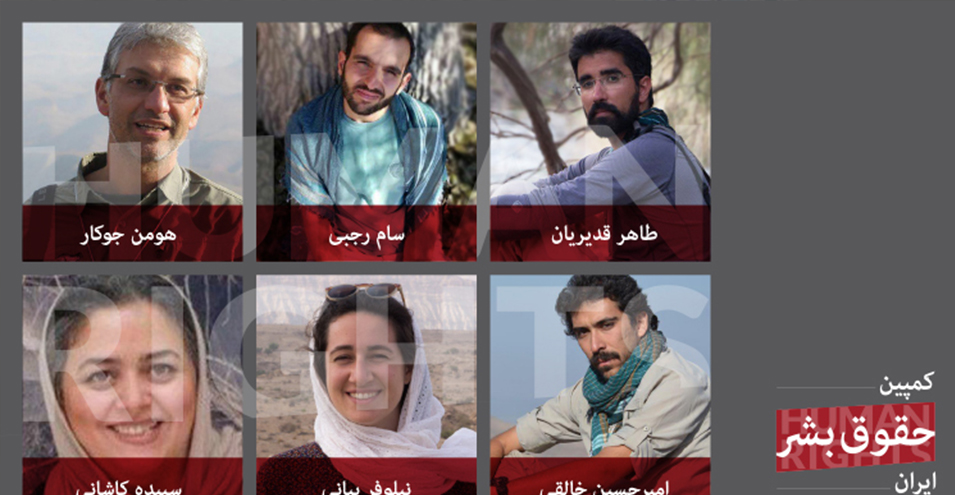
An informed source on the Human Rights Campaign in Iran stated that the temporary detention order for seven detained environmental activists has been extended until the fifth of Farvardin 1397. According to this source, except for Niloufar Bayani, none of the detainees have had any contact with their families since their arrest, and their lawyers have not been allowed to meet with their clients or access their case files.
The source told the campaign: “Niloufar Bayani’s parents were called only once to visit, during which they saw their daughter for a moment from a distance. Niloufar came, waved her hand, and left.”
According to this source, they still have no information about the charges against the detainees: “No one answers the families. The detainees only have the right to occasional phone calls, and even those are just brief check-ins. The families have no recourse.”
The source also said that parliamentary representatives who sought to follow up on the environmental activists’ situation in the early days of their detention have remained silent in recent days and “have seemingly withdrawn.” Referring to recent meetings between families and parliamentary representatives, the source said: “The families went to Mohammad Aref’s parliamentary office two weeks ago. After hearing what they had to say, he only said: we will follow up now. Abdolkarim Hosseinzadeh said they will be out soon. Mohammad Kazemi told the families that these are spies and you don’t know.”
The source continued: “Everyone says something different and no one does anything. We are powerless and our loved ones are in prison in unclear conditions.”
The source close to the detained environmental activists said about the transfer of work vehicles belonging to these individuals and vehicles that belonged to the Wildlife Heritage organization: “Revolutionary Guards officers have also taken the vehicles that these young people were using to search for leopards in the area. Some of them belonged to the Wildlife Heritage office and some were personal vehicles that were either parked in the office parking lot or in the areas. We really don’t know why these vehicles were taken.”
Previously, an informed source, referring to families’ meetings with parliamentary representatives, said that in one of the sessions, university professors and colleagues of the arrested individuals were present and explained to the representatives about the installed cameras in the areas, how they work, and the leopard project.
A few days after the news of Kavous Seyed-Amami’s death was publicized, President Hassan Rouhani formed a four-member committee to investigate his death and the situation of detained environmental activists, but no news of this committee’s findings has been reported. Even Seyed-Amami’s autopsy report has not yet been delivered to his family.
Complete Lack of News About Alireza Farhad-Zadeh
Expressing concern about the situation of Alireza Farhad-Zadeh, a wildlife filmmaker who made the film “Day of the Leopard,” the source told the campaign: “Alireza’s situation is more concerning than the other detainees because there is no news from him since his detention. He hasn’t even had a single phone call.” Alireza Farhad-Zadeh was arrested by Revolutionary Guards officers in Bandar Abbas on the seventh of Esfand 1396.
Weeks of detention of environmental activists continued in media silence until Ramin Seyed-Amami, the son of the late Kavous Seyed-Amami, announced his father’s death in prison on his Twitter and Instagram accounts on the nineteenth of Bahman. After that, the detention of other environmental activists became a media issue.
The names of thirteen detained environmental activists confirmed so far are as follows: Amir-Hossein Khaleghi, Homan Jokar, Taher Qadiri-yan, Sepideh Kashani, Sam Rajabi, Niloufar Bayani, Morad Tahbaz, Morteza Aria-Nejad, Hassan Raagh, Aref Zareh and Hassan Zareh (brother), Abdolreza Koohpayeh, and Alireza Farhad-Zadeh. Kavous Seyed-Amami also died in prison two weeks after his arrest. Judicial authorities claimed he committed suicide in prison.
According to the campaign’s information, environmental activist Morad Tahbaz and colleague of the Parsian Wildlife Heritage Institute was initially arrested, and after some time, on the fourth of Bahman, the late Kavous Seyed-Amami and other former and current colleagues of the institute were separately arrested by Revolutionary Guards officers on the same day in the street, at home, or at the institute’s office. After Kavous Seyed-Amami’s death became public, five environmental activists from Bandar Abbas named Morteza Aria-Nejad, Hassan Raagh, Aref Zareh, Hassan Zareh, and Abdolreza Koohpayeh were arrested, and Alireza Farhad-Zadeh, who had gone to Bandar Abbas to film and was a guest of Abdolreza Koohpayeh, was also arrested.
The Parsian Wildlife Heritage office was also sealed on the fourth of Bahman following the arrest of Kavous Seyed-Amami and his colleagues.
After the news of Kavous Seyed-Amami’s death in Evin prison was published, the Tehran prosecutor brought serious charges such as spying for the CIA and Mossad and collecting classified information against him and the other detainees in the media. However, to date, the judicial authorities have refrained from presenting documents and evidence to prove such claims.
Source: Human Rights Campaign