Financial Action Task Force Gives Iran Until October to Implement Anti-Money Laundering Programs
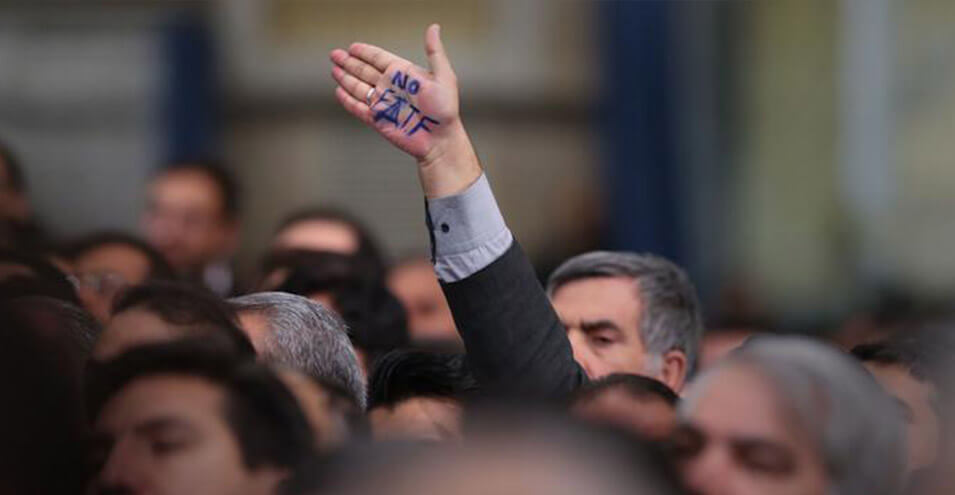
The Financial Action Task Force (FATF) has given Iran until October to implement its programs to combat money laundering and terrorism financing. Otherwise, it will be placed on the blacklist. However, Ali Khamenei opposes this program.
The Financial Action Task Force (FATF) expressed disappointment that the Islamic Republic government has not yet been able to announce a financial action program to combat money laundering and the financing of terrorism (CFT) based on this group’s standards, stating that the Iranian government has until October to implement the necessary measures.
The Financial Action Task Force issued a statement on June 29 (June 8) in Paris, expressing hope that the Iranian government will pass the necessary laws in the coming months to be removed from the blacklist of unsafe countries for foreign investment.
Iran’s accession to the Financial Action Task Force (FATF) provisions would pave the way for international investments in Iran. Ali Khamenei, the leader of the Islamic Republic, expressed his opposition to joining this group and approving laws in accordance with its regulations in statements made about a week ago.
In the statement of the Financial Action Task Force, released after a week of consultations regarding Iran, it stated: “The Financial Action Task Force emphasizes that it expects Iran to move forward on the path of reforms as quickly as possible to ensure that all remaining issues in its action program are addressed through the completion and implementation of necessary reforms, particularly in activating necessary laws.”
The statement continued: “The Financial Action Task Force expects Iran to immediately pursue the reform path rapidly to ensure that all remaining items in this program are resolved… We expect amendments related to combating money laundering and terrorism financing in government laws to be approved by October 2018 in a way that is fully in line with FATF standards. Otherwise, the Financial Action Task Force will make appropriate decisions and take necessary measures.”
Opponents of the Islamic Republic’s accession to this convention and to the Financial Action Task Force (FATF) are concerned that if laws are approved to combat money laundering and terrorism financing, the path of Islamic Republic assistance to movements such as Hezbollah in Lebanon will be blocked. The United States and many countries classify Hezbollah in Lebanon and several other Islamic movements supported by Iran as terrorist organizations.
Ali Khamenei’s Opposition to Iran’s Accession
On Wednesday, June 30, Ali Khamenei said in a meeting with the Speaker of Parliament and several representatives that Parliament should independently pass laws in this area and not follow international conventions designed by Western countries.
According to ILNA news agency, Khamenei said: “As we have said about some recently discussed international conventions in Parliament, the Islamic Consultative Assembly, which is rational, mature and wise, should independently legislate on matters such as fighting terrorism or combating money laundering.”
Last year, Hassan Rouhani’s government submitted to the Islamic Consultative Assembly a bill on Iran’s accession to the Convention on Combating the Financing of Terrorism and Money Laundering. Previously, diplomats from the Islamic Republic’s Foreign Ministry had emphasized the importance of acceding to this convention, as it would enable foreign investments and global trade for Iran.
The “Financial Action Task Force” (FATF) was established in 1989 and has set international standards in the field of combating money laundering and financing of terrorism (CFT).
These money laundering regulations include laws that require individuals and companies to explain to governments how they earn their income. In this way, money obtained through illegal means, such as smuggling, bribery and financial violations, faces greater difficulty in entering financial markets, and the health of the financial and economic system can be better assured.
Only in this way can international companies assess and more cautiously approach the investment risk in “suspicious countries.”
Source: DW