First Month Livelihood Assistance Withdrawn and New Prices Announced
The Market Regulation Headquarters announced the gradual implementation of new prices for oil, poultry, eggs, and dairy products, with final prices for various dairy products now announced. The first month’s livelihood assistance for 23 million Iranian households became available for withdrawal since yesterday evening.
“The Market Regulation Headquarters” announced in a statement that the “livelihood assistance” deposited for the first month became available for withdrawal from Wednesday evening (April 10). Two days before this announcement was issued, it had been reported that “livelihood subsidies” were transferred to citizens’ accounts in packages of 400,000 and 300,000 tomans.
According to domestic media reports, government assistance covers 23 million households, equivalent to 72 million people out of Iran’s 85 million population.
The Ibrahim Raisi government named this measure the “popularization and fair distribution of subsidies” plan and is attempting to overcome economic constraints and price-setting chaos in the market through this approach.
In the “Market Regulation Headquarters” statement, “measures taken” were mentioned, but the government did not provide details of these measures. Furthermore, it was emphasized that there are no problems in supplying essential goods needed by the people, and the prices of bread, fuel, and medicine will not change.
What is set to change under the government’s new plan is the price of oil, poultry, eggs, and dairy products, which will be implemented “gradually” starting today (April 11).
No specific program has been presented in this regard. The statement only emphasized that “price adjustments for goods in each province and monitoring of price compliance” are the responsibility of provincial governors.
Tasnim News Agency on April 11, citing Reza Bakri, secretary of the dairy industry association, announced prices for several types of dairy products: 900ml bagged milk with 1.5% fat at 15,000 tomans, one-liter bottled milk with 1.5% fat at 18,000 tomans, 2.5 kilogram yogurt with 1.5% fat at 49,500 tomans, 400-gram UHT cheese at 37,500 tomans.
Tangible Reality
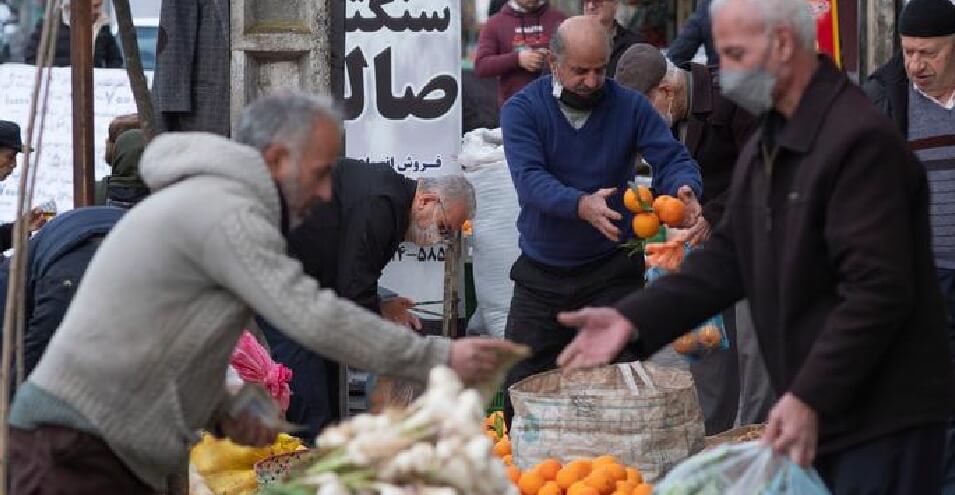
While government officials repeatedly emphasize improvements in conditions and particularly promise people prevention of price increases for essential and everyday goods, society is struggling with continuously rising prices, and experts warn of class divisions and the danger of social explosion.
Domestic media are increasingly reporting public dissatisfaction. Last week, while the government again emphasized preventing price increases for food items and supporting consumers, the IRIB news agency quoted a citizen saying: “A week ago we bought bread for 600 tomans, but now the same bread costs 3,000 tomans, which is a five-fold increase. Pasta was 8,000 tomans, now it’s 28,000 tomans. Sandwich bread we used to buy for 1,200 tomans now costs 3,000 tomans. With this financial situation, what should I do? Should bread go from 600 tomans to 3,000 tomans in one day? When the foundation of my life is bread, can I survive with a five-fold price increase? I humbly ask you to bring our voice to the attention of officials.”
The current chaotic situation most affects workers, who according to domestic media have long been unable to even afford meat. ILNA news agency wrote on April 1 in this regard: “April is not over yet, but these price increases have severely emptied the shopping basket of working-class families. This year wages increased by 57 percent, but in just these two months, the average increase in food items alone has exceeded 200 percent, which means approximately a 150 percent reduction in workers’ real wages.”
The EconomyOnline website wrote on April 11 in its editorial: “Economic policymakers have brought Iranian households to the slaughterhouse of inflation, rising prices, and shortages.”
This economic website, while emphasizing that the government’s intervention has transformed prices into a set of meaningless artificial numbers, wrote: “The constant denial of officials and blaming previous governments is nothing new. Yet all governments have been the same in their understanding of economics and the basis of their economic policymaking. The change in the country’s macro conditions and the increasing vulnerability of people are the result of denying economic realities and the continuous depletion of resources in an artificial price-setting system.”
Source: DW