Head of Nuclear Agency: Talks with Iran Should Resume Within Weeks

The head of the International Atomic Energy Agency says Iran is determined to pursue 20 percent uranium enrichment, and talks with Iran over reviving the JCPOA and allowing international inspectors to continue their work should begin as soon as possible.
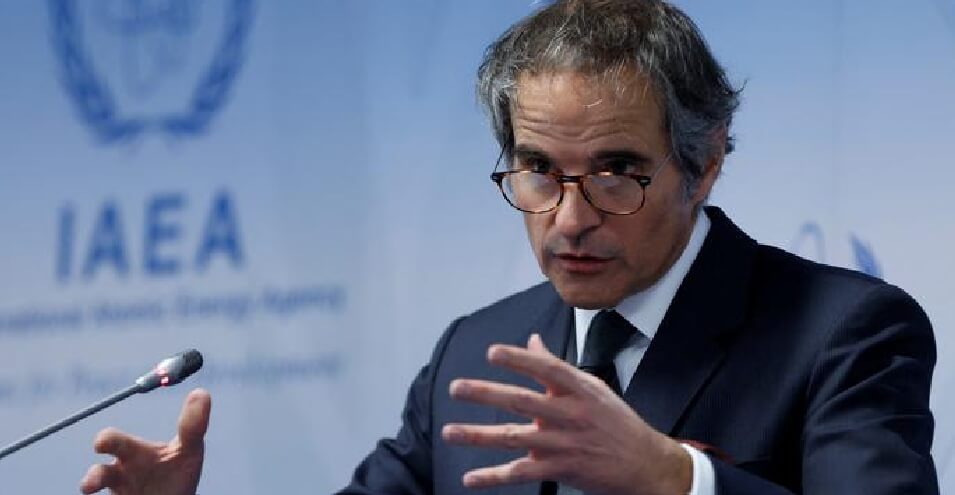
Rafael Grossi, head of the International Atomic Energy Agency, has said that to resume talks with Iran, not months but only weeks remain.
Grossi said on Monday (January 11) in an interview with Reuters that he emphasized the importance of negotiating as soon as possible with the Islamic Republic.
He said Iran is seriously pursuing its uranium enrichment program to 20 percent and could soon produce approximately 10 kilograms of enriched uranium per month.
Iran, in line with reducing its JCPOA commitments, has begun 20 percent uranium enrichment at the underground Fordow facility and has announced its intention to expel IAEA inspectors from Iran next month.
Grossi said that in his view, Iran is “determined” to carry out its threat. He emphasized the need to achieve “a clear understanding of how to recommit to the original terms and conditions of the JCPOA agreement.”
On December 2, the Islamic Consultative Assembly, by approving the law on “Strategic Action to Lift Sanctions,” obligated the government to store 120 kilograms of uranium enriched to 20 percent annually. The parliamentary resolution states that if international sanctions are not fully lifted, Iran will also refrain from fulfilling all commitments undertaken in the JCPOA agreement.
Ali Rabiei, spokesman for Hassan Rouhani’s government, clarified that although “the government does not consider the implementation of this law beneficial,” it is obligated to implement it.
In this regard, Ahmad Amirabad Farahani, a member of the parliament’s presiding board, announced on Saturday, January 9, corresponding to December 29: “If by March 20, America does not lift financial, banking, and oil sanctions, we will certainly expel IAEA inspectors from the country and definitely suspend the voluntary implementation of the Additional Protocol.”
Of course, later, Iran’s Foreign Ministry spokesman attempted to modify Amirabad’s remarks, but Fereidoun Abbasi, head of the Islamic Consultative Assembly’s Energy Commission, said again on Saturday in an interview with the Parliament website: “If by the end of this year the Westerners do not fulfill their commitments, we will prevent IAEA inspections.”
Based on these threats, Joe Biden, who officially assumes the U.S. presidency on January 20, has one month to lift the sanctions imposed on Iran.
“A Very Difficult Path” for Joe Biden
According to experts, 20 percent uranium enrichment makes Iran’s path to preparing an atomic bomb smoother, although the Islamic Republic has repeatedly emphasized that its goal is not to produce nuclear weapons.
Under the JCPOA agreement signed in 2015 (June 2015) between Iran and six world powers, Tehran agreed to suspend many nuclear activities and enrich uranium at low levels that would not be usable for nuclear weapon production.
In return, the six world powers (the P5+1) agreed to gradually lift international sanctions on Iran.
However, with Donald Trump’s arrival at the White House, a staunch opponent of the nuclear agreement with Iran, the United States unilaterally withdrew from the JCPOA in May 2018 and imposed heavy sanctions against Tehran, implementing the “maximum pressure” campaign on Iran.
Joe Biden, who is scheduled to begin work at the White House on January 20, has repeatedly stated in recent weeks that he is willing to bring the United States back to the JCPOA, provided that Iran returns to its commitments under the agreement.
Biden, however, has said that the return of the United States to the JCPOA will not be easy and quick, but rather “a very difficult path” lies ahead, and in future talks with Iran, in addition to the nuclear program, Iran’s missile program and Iran’s “destabilizing role in the region” should also be on the agenda.