India Provides Assistance to Iran to Combat Widespread Locust Invasion
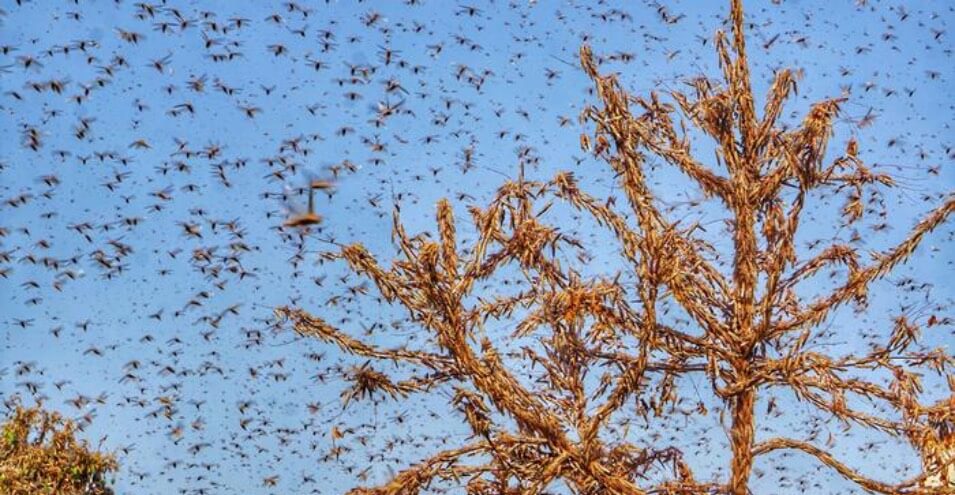
Concerned about the spread of locust attacks to its border areas, India has announced that it will export dozens of tons of pesticides to Iran. Iran-India relations have cooled since last year due to US pressure to enforce sanctions.
The widespread locust invasion affecting various areas in Iran, Afghanistan, and Pakistan has increasingly concerned India as well. Delhi officials are witnessing the severity of locust attacks on farmland in these regions and the possibility of their rapid entry into India’s border areas; a situation that has prompted this country’s reaction.
According to a report by “Hindustan Times,” the Indian government, considering the proximity of the threat to its borders, proposed last week that Iran cooperate with New Delhi to repel the locusts, and this proposal was accepted by Iran as well.
On Wednesday, June 7th (May 27th), the publication “Business Standard” released a statement from the Indian government on this matter. The statement says that based on an agreement between India and Iran, India will export 25 tons of “Malathion Technical” pesticide to Iran.
Iran’s state news agency IRNA also reported on Wednesday that the company “HIL” is producing this pesticide and the export of this product is being carried out based on a governmental agreement between India and Iran. The report states that India’s Ministry of Foreign Affairs has asked the company “HIL” to produce this pesticide and export it to Iran.
The harvest season for agricultural products in India is approaching, and an invasion of millions of locusts into farmland poses a serious threat to Indian agriculture. Farmers in this country have requested assistance from the Indian government. Locusts can devastate all their fields in a short period of time.
Iran-India Relations Under Pressure from US Sanctions
Kersten Knipp, a correspondent for Deutsche Welle and Middle East expert, has raised the question of whether cooperation in locust control efforts can offer hope for closer relations between Iran and India.
Knipp wrote that in emergency situations such as the coronavirus outbreak or the continued US sanctions against Iran and problems resulting from Iran’s crude oil sales, India had not made any proposal to assist Iran; however, now New Delhi, given the locust invasion conditions in the region, has announced that dozens of tons of pesticide will be made available to Iran.
This Middle East expert, referring to the history of economic relations between the two countries, says that the importance of India’s relations with the United States and countries in the Persian Gulf region has caused the cooling of relations with Iran in recent months, and in fact, relations with these countries have been of greater importance to India.
Knipp writes that after the end of the Cold War, cooperation between Iran and India increased at various levels, and the focus of these cooperations was on energy production, trade relations, regional stability, and the expansion of transportation routes. India was the main buyer of Iranian oil until May 2019, exactly one year ago, but after increasing pressures on Delhi to implement and cooperate with US economic sanctions against Iran, this country’s imports from Iran have been significantly damaged.
The Deutsche Welle correspondent refers to an analysis regarding Iran-India relations that was published in the think tank “East Asia Forum.” In this analysis, it is stated that “during the Trump era, India’s friendly relations with the United States have become an extraordinary source of friction in India-Iran relations.”
This Middle East expert further states that the coronavirus outbreak demonstrated how difficult the relationship between the two countries has become. Knipp wrote that Iran’s request to India for medical gloves, masks, and other safety equipment could not be met due to pressures resulting from US sanctions.
Kersten Knipp says that besides this, India does not want to jeopardize important economic relations with Arab countries in the Persian Gulf region. According to him, “These countries are not only the main energy suppliers for India, but since the beginning of the coronavirus outbreak, hundreds of thousands of Indian migrant workers have been employed there.”
This expert has evaluated the joint struggle against the locust invasion in the region as a point of hope in Iran-India relations and considered it an opportunity to improve the trade relations between the two countries.
Source: DW