Iran Announces Installation of Advanced Centrifuges at Natanz and Fordow
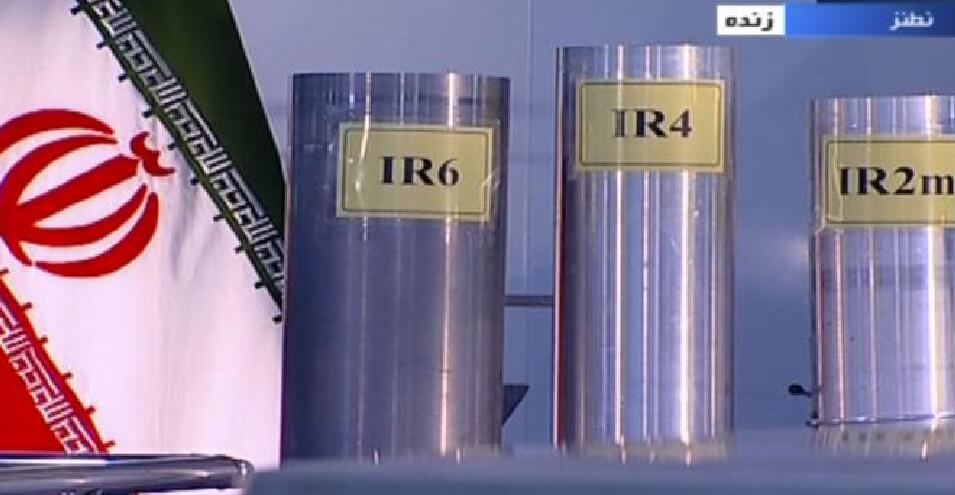
Iran’s permanent representative to international organizations in Vienna announced that the Islamic Republic has installed two chains of 348 IR2m centrifuges at Natanz with a capacity four times greater than previous centrifuges, and two chains of IR6 centrifuges at Fordow.
Kazem Gharibabadi, Iran’s representative to international organizations based in Vienna, announced on his Twitter account that the Islamic Republic has installed chains of centrifuges with greater enrichment capacity at Natanz and Fordow.
The tweet stated: “Thanks to our hardworking nuclear scientists, two chains of 348 IR2m centrifuges with a capacity approximately 4 times that of IR2 centrifuges are now successfully operating with UF6 gas (uranium hexafluoride) at Natanz. Installation of 2 chains of IR6 centrifuges has also begun at Fordow. More will be underway soon.”
Gharibabadi added in the tweet: “The International Atomic Energy Agency is still capable of verification, and this progress has been communicated to them as planned.”
Israel’s Warning
Yuval Steinitz, Israel’s Energy Minister, said in a radio interview that with the Trump administration’s withdrawal from the JCPOA nuclear agreement and the sanctions that were imposed, “a serious blow has been dealt to Iran’s nuclear program.”
Steinitz said Iran needs six months to produce fissile material for its first nuclear weapon.
Steinitz added that producing one nuclear weapon requires 25 kilograms of enriched uranium with a concentration of 90 percent. On this basis, Iran will be able to produce several nuclear weapons within one to two years.
The Islamic Republic announced after the U.S. withdrawal from the JCPOA that, contrary to the agreement’s provisions, it would increase uranium enrichment concentration to 20 percent.
Israel’s Energy Minister said that “regarding enrichment, the current situation is such that if they (Iranians) take all necessary measures, they can accomplish this within six months.”
In the November report of last year, the International Atomic Energy Agency stated regarding Iran that the Islamic Republic had obtained 2,400 kilograms of enriched uranium. This amount is ten times what was allocated for Iran in the JCPOA agreement.
U.S.: First Step is Return of Both Sides to JCPOA
Robert Malley, special representative of the new U.S. administration for Iran affairs, says that the killing of Mohsen Fakhrizadeh, a prominent nuclear expert of the Islamic Republic, regardless of the objectives, has neither changed President Joe Biden’s position on a nuclear agreement with Iran (JCPOA) nor Iran’s position.
In an interview with the Italian newspaper “Corriere della Sera,” he emphasized that President Joe Biden, the current U.S. president, both before and after Fakhrizadeh’s killing, has consistently emphasized that if Iran returns to the JCPOA, the U.S. will also return.
Regarding broadening the JCPOA and including disputed issues such as Iran’s missile program and regional behavior, Malley clarified: “Biden has clearly stated that he wants to return to the JCPOA. But one can only speak of expanding this agreement when all parties have returned to compliance with its provisions and reconciled with each other. It is after that when the possibility of new negotiations arises.”