Iran: Free Maryam Akbari Monfared, Political Prisoner
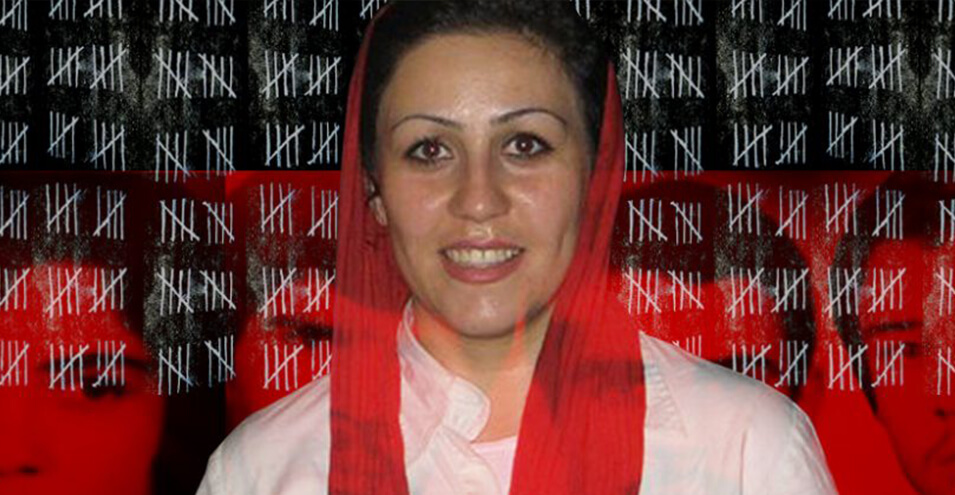
Unjustly imprisoned since 2009, she should have been released in 2017
May 20, 2019: Iran Human Rights Campaign and Justice for Iran announced in a joint statement that Iran must end the cruel and illegal imprisonment of Maryam Akbari Monfared, who has been imprisoned for nearly a decade on baseless charges and should have been released from prison in 2017, and must release her immediately.
These two human rights organizations noted in their statement that not only have the charges against Maryam Akbari Monfared never been proven, but according to new laws in Iran, her conviction should have been terminated. Even if Maryam were reconvicted based on new charges, she could have been eligible for release two years ago. However, Iran’s judicial system refuses to implement the law in this regard.
Hadi Ghemi, Executive Director of Iran Human Rights Campaign, said: “For nearly a decade, Maryam Akbari Monfared has suffered in prison because of a sentence that even Iran’s own laws say should be invalidated. One judge’s personal preferences should not override the law.”
Shadi Sadr, Executive Director of Justice for Iran, said: “As the judge himself has confirmed, the heavy price Maryam is paying is not because of her own actions but only because of the fact that her relatives were members of organizations opposing the Islamic Republic. This is a blatant example of collective punishment and a gross violation of the principle of personal responsibility in criminal law, which is recognized in both Iran’s judicial system and international law.”
Charges That Were Never Proven
Maryam Akbari Monfared was initially tried in June 2010 based on allegations of support for the Mujahedin-e Khalq (MEK), whose activities are banned in Iran, and was convicted of “enmity with God,” a crime in the category of crimes related to Islamic legal penalties and carries specific and serious punishments under Islamic Sharia law.
Maryam was convicted of enmity with God solely for maintaining telephone contact with her relatives who are members of the Mujahedin-e Khalq and visiting them once in Iraq. She has always denied membership in or following the Mujahedin-e Khalq; nor is there any evidence proving otherwise.
In June 2010, she was sentenced to 15 years in prison by Mohammad Moghisseh, the notorious judge of Branch 15 of the Tehran Islamic Revolutionary Court. In September 2010, the Supreme Court upheld his verdict. Maryam has been imprisoned since her arrest on December 30, 2009.
Under New Islamic Penal Law, Her Conviction Could Have Been Nullified
Maryam Akbari Monfared’s sentence was issued under the old Islamic Penal Code, which was replaced by new laws in 2013.
Under Article 186 of the old code, any member or supporter of an organization that aimed to overthrow the Islamic Republic who took up arms was considered to have committed enmity with God, even if they personally did not participate in any of the organization’s armed activities.
In the new laws enacted in 2013, the old Article 186 was revised and replaced by several articles including Articles 278 and 279. These new provisions adopted a significantly narrower scope compared to the traditional interpretation of the crime of enmity with God, including limiting enmity with God to situations where an individual is a member of an armed group or personally takes up arms. Therefore, this crime does not apply to supporters of such organizations and cannot be applied to those who maintain contact with members of such organizations or personally support their views.
For this reason, if Maryam Akbari Monfared had been tried under the new law, she would not have been convicted of enmity with God. Since visiting relatives in Camp Ashraf in Iraq (where her family members lived) is not evidence of membership in or support for the Mujahedin-e Khalq.
Moreover, according to Article 10 of the new law, when such changes in law are implemented and the new law is in favor of the accused, it must be applied retroactively to all those convicted under the old law. Therefore, Akbari Monfared should have been acquitted and immediately released from prison.
In late 2015, Maryam Akbari Monfared sent a request for retrial from prison to the Supreme Court, arguing that according to Articles 10 and 279 of the new law, her conviction should be nullified. In April 2016, the Supreme Court rejected her request for reconsideration of her case, but explicitly referred to Article 10 of the new law and stated that Maryam Akbari Monfared, based on the new law that has been implemented and is in favor of the accused, could petition the primary court to reduce or lower her conviction. Following this ruling, Akbari Monfared’s case was returned to Branch 15 of the Tehran Islamic Revolutionary Court.
In complete disregard of the Supreme Court’s decision and the legal obligation under Article 10 of the new law, Judge Solouti refused to make any changes to Maryam’s original conviction and upheld her original sentence without any explanation or justification. If the court had followed the law and the Supreme Court’s ruling, Akbari Monfared’s conviction for enmity with God should not have stood and should have been changed to acquittal or a lighter conviction for a less serious charge.
Eligible for Release in 2017, According to Iranian Law
Even in circumstances where the retrial request in Maryam’s case resulted in her conviction and the primary court did not acquit her, her conviction could have been based on a lighter charge within the category of discretionary crimes. Under laws related to these crimes, she should have faced lighter and shorter punishments; for example, according to Article 499, a maximum of 5 years in prison.
Under no circumstances should Maryam have been sentenced to a heavy sentence such as the one she originally received for enmity with God. In the worst case, if she had been sentenced to the same 15 years in prison under laws related to discretionary crimes, she could now be eligible for conditional release. According to Article 58 of the new law, when a person is sentenced to more than 10 years in prison for committing discretionary crimes, after serving half of their sentence, they become eligible for conditional release.
Under Iranian law, Maryam’s time in custody before trial and the time she spent in prison before conviction are calculated as part of her total prison time. Therefore, in the case of Maryam Akbari Monfared, even if we consider the remote possibility that her 15-year sentence was re-issued as a discretionary punishment, she should have been released from prison after serving 7.5 years of her sentence, that is, in July 2017.
Denied Medical Care and Furloughs Throughout Prison Term
Maryam Akbari Monfared has suffered harsh and punitive treatment throughout her imprisonment. Authorities have denied her any medical furloughs despite serious thyroid problems and other medical issues requiring treatment. She has not even been granted a single day of furlough from prison. (Prisoners in Iran can temporarily receive furloughs from prison to visit their families).
According to Hassan Jafari, Akbari Monfared’s husband, authorities have ignored repeated requests for medical furlough even with bail posted. In October 2017, in an interview with Iran Human Rights Campaign, Hassan Jafari said: “In 2013, we provided 1.15 billion tomans as bail that authorities had requested for her furlough from prison. But nothing has happened since. They do not issue her furlough and do not say why. They just say the Ministry of Intelligence or the prosecutor is opposed to her furlough.”
Punitive treatment is a price political prisoners in Iran typically pay; especially prisoners who openly speak about their unjust imprisonment or inhumane conditions in prison.
Akbari Monfared protested both issues in an open letter: the daily deprivation of political prisoners from medical care and the extrajudicial executions of her siblings.
Three brothers and one sister of Maryam were executed in the 1980s for activities in opposition political groups. Akbari Monfared filed a formal complaint in October 2016, demanding a judicial investigation into the executions of her siblings and the location of their graves.
She wrote: “My youngest brother, Abdolreza Akbari Monfared, was arrested in 1980 while still a student, at just 17 years old. His crime was distributing the Mujahed publication. He spent three full years in solitary cells in Gohardasht Prison in Karaj and, despite being sentenced to three years in prison by the Tehran Revolutionary Court, was held in prison until 1988 and finally was executed that August along with a large group of prisoners.”
In 1988, thousands of prisoners, mostly supporters of the Mujahedin-e Khalq as well as other prisoners, were secretly and collectively executed by “death committees” formed by Ayatollah Ruhollah Khomeini, the founder of the Islamic Republic. To date, no accountability has been taken for this mass killing and any investigation into it or mourning for the victims is prohibited.
Continuing in her letter, Akbari Monfared wrote: “My other brother, Alireza Akbari Monfared, was arrested on September 8, 1981, and was executed in prison on September 28 of the same year. His entire process of arrest, trial, and execution took place in 10 days. During his memorial service, officers raided our house, arrested several guests, and transferred them to Evin Prison and the Joint Committee. Among those arrested were my mother and my sister, Raghieh Akbari Monfared. My mother was released from prison after five months. But my sister, who had been sentenced to eight years in prison by the court, was executed in August 1988 while serving the final years of her sentence.”
Source: Iran Human Rights Campaign