Iran No More Than Five Years Away from ‘Public Water Catastrophe’
At a conference held to examine the water situation in eastern Iran, a grim picture of the water scarcity crisis in the region was presented. One of the speakers said Iran is not far away from a public water catastrophe.
The National Water Management Conference for Eastern Iran was held last night, Wednesday, December 12 (January 2), at the Khorasan Razavi Chamber of Commerce, Industry and Mines. One of the speakers at this conference was Mohammad Hossein Sharieatmadari, head of the National Center for Strategic Studies of Agriculture and Water of Iran’s Chamber of Commerce.
According to the state news agency IRNA, Sharieatmadari warned about the water scarcity crisis in the region and said: “We are only five years away from a public water catastrophe in the country, which is the result of 50 years of mismanagement in this field.”
He considered organizing, repairing and reviving water resources in Iran feasible, while emphasizing: “We have not yet reached sufficient will to solve this problem and lack a comprehensive, inclusive and national strategy with appropriate scheduling and consensus among the government and private sector in this regard.”
Iran, like most countries in the region, has long been grappling with prolonged drought, reduced rainfall and the consequences of climate change. Nevertheless, senior officials of the Islamic Republic acknowledge that the role of mismanagement, ineffective management and wrong policies has been very decisive in aggravating this situation.
Admitting the Role of Mismanagement and Wrong Policies
Esa Kalantari, Vice President and head of the Environmental Protection Organization, attributed “one-sided approaches” in environmental policies of the past four decades to putting 70 percent of Iran’s population at risk of water shortage last June.
According to ISNA news agency, Kalantari said that since the establishment of the Islamic Republic government, development has always been placed against the environment “due to ignorance and lack of awareness,” and sustainable development has been neglected.
The Vice President, referring to the excessive use of renewable water resources, says that according to international standards this should not exceed 40 percent, whereas in Iran it averages 110 percent.
The secretary of the groundwater revival and balancing plan at the mentioned conference criticized the excessive extraction of groundwater and recalled that Khorasan Razavi accounts for 21 percent of the country’s groundwater deficit.
Excessive Extraction of Groundwater
Abdollah Fazli, in explaining this situation, noted that in the three provinces of Khorasan and Sistan and Baluchestan, eight and a half billion cubic meters of groundwater are extracted annually, a figure that should be a maximum of five billion cubic meters.
Fazli, stating that we witness half a meter decline in the aquifers of these four eastern provinces annually, said: “The government and other branches cannot solve the country’s water shortage problem alone, and there is no way other than stakeholder participation to achieve this.”
In recent years and months, farmers and residents of some cities who are considered “stakeholders” in optimal water use, such as farmers around Isfahan, have protested and continue to protest plans for inter-basin water transfer and non-compliance with their water rights, but instead of participation, the government has sent security forces to suppress and confront them.
Some government officials claim that by launching desalination facilities on the shores of the Persian Gulf and the Sea of Oman and transferring water to provinces like Khorasan, the water shortage crisis can be addressed and prevented from becoming a catastrophe.
Continuation of Ineffective Plans and Policies
Mohammad Hossein Papoli Yazdi, a professor at Tehran’s Tarbiat Modares University, while criticizing plans such as transferring water from the Sea of Oman to Khorasan Razavi at the conference Wednesday night, said: “Show me one country that has desalinated water and transferred it a thousand kilometers further away. Then do this. The maximum desalinated water transfer in the world has been up to 100 kilometers.”
Despite the admission of officials and warnings by experts about the consequences of mismanagement and disregard for the environment in development plans, this situation continues and policies that experts consider wrong continue to be on the agenda.
Gholamhossein Shafei, head of the Chamber of Commerce, Industry, Mines and Agriculture, referring to this situation, said: “We have no plan and all our actions are carried out with eyes closed. For example, in Khorasan Razavi province, in most villages where drinking water is supplied by tanker, we are developing industries. We face a dangerous future ahead.”
Step by Step Toward Catastrophe
Esa Kalantari, also in June, criticizing the continued disregard for “land use planning,” cited Isfahan as an example where, according to him, millions of its residents face drinking water shortage problems, while Iran’s most water-intensive industries have been established there.
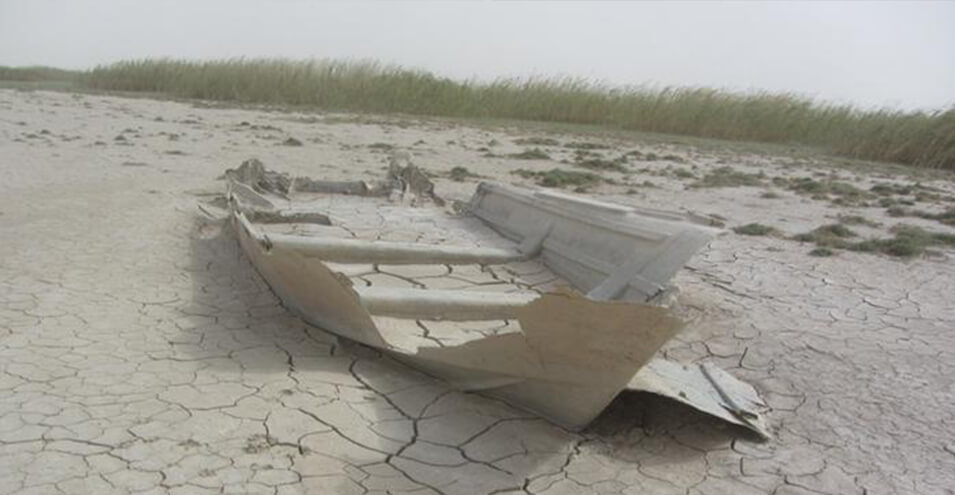
Many experts believe that wrong policies such as excessive dam construction, disregard for optimal water consumption in agriculture, and excessive use of renewable water resources and groundwater resources, which have resulted in ground subsidence and the drying up of lakes and wetlands, will lead in the coming years to an expansion of water refugees and water wars and conflicts.
Eastern regions of Iran have long witnessed the emptying of villages in Sistan and Baluchestan and the displacement of hundreds of thousands of residents to the margins of other cities. These are cities that, even if they are not currently facing a serious water shortage, will soon face it with population growth and increased consumption, and a “public water catastrophe” will occur.
Source: DW