Iran Turns Off 27 IAEA Cameras; Grossi: Continuation of This Process Is a Deadly Blow to JCPOA
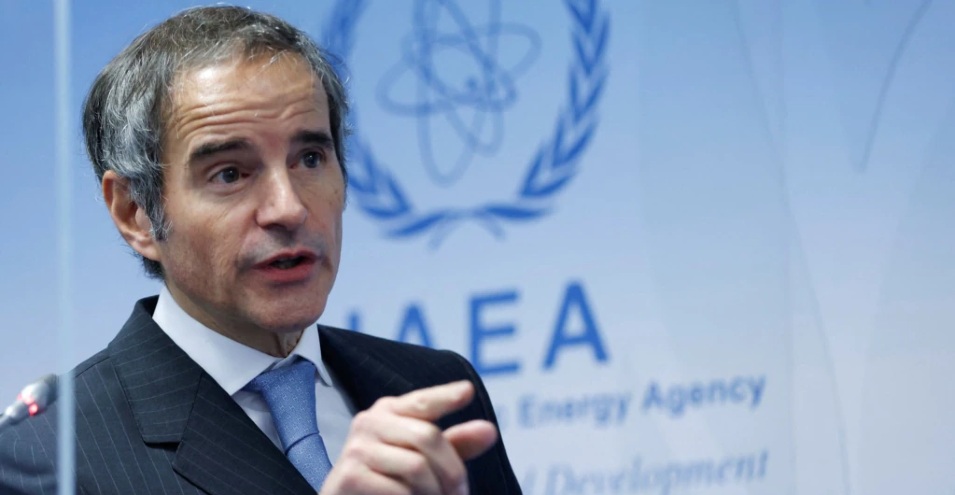
The Director General of the International Atomic Energy Agency announced on Thursday, June 9, that Iran has decided to shut down 27 cameras at its nuclear facilities, describing the continuation of this process as a “deadly blow” to the JCPOA.
Rafael Grossi, speaking at a press conference, responded to a question from Radio Farda by saying that Iran’s latest measures, which appear to be a reaction to a new resolution by the Board of Governors, will reduce the Agency’s monitoring capacity, which is “regrettable.”
The Atomic Energy Organization of Iran announced on June 8 that it had intentionally disconnected two “beyond-design-basis” cameras of the International Atomic Energy Agency at an Iranian nuclear center.
In an official statement by the organization, it was also mentioned that “the operation of the online measurement device for enrichment level and flowmeter (OLEM), belonging to the international organization, will also be suspended.”
Rafael Grossi also stated on Thursday that the number of cameras to be “removed” is not two, but 27 cameras.
According to the Agency Director General, with the removal of these cameras, which are located in various places in Iran including Tehran, Natanz, and Isfahan, “approximately 40 cameras” belonging to the Agency will remain in Iran to monitor Iran’s atomic activities.
He said that if the Agency cannot continue monitoring with the “accuracy and precision” it has always maintained, this process could be a “deadly blow” to the JCPOA.
Grossi further emphasized that such Iranian measures create “a major challenge” in verifying Iran’s activities and continuing cooperation between the international organization and Tehran.
Behrouz Kamalvandi, spokesman for the Atomic Energy Organization, said on Wednesday, referring to the removal of two monitoring cameras of the IAEA in Iran: “Some cooperations that went beyond the agreement and were solely based on good faith and were not part of commitments have been stopped.”
He clarified that through these two cameras, “information was recorded that could later be useful to the Agency,” but Iran will no longer provide this information to the Agency.
This is a point that Rafael Grossi also expressed uncertainty about on Thursday, saying he did not know what would happen to the films that have been recorded so far and have not yet been handed over to the Agency.
According to Grossi, such measures only make the “window of opportunity” much narrower, and in this “tense” situation, it only results in “less transparency and greater uncertainty.”
Rafael Grossi had said on June 7, on the eve of the Board of Governors meeting of the International Atomic Energy Agency: Iran continues to enrich uranium and its achievement of significant amounts that cross the red line “is very close and is only a matter of weeks.”
Responding to a question from Radio Farda about this timeframe of a few weeks, he referred to “three to four weeks” and emphasized that beyond that time, the Agency would no longer be able to monitor Iran’s activities.
The Board of Governors of the International Atomic Energy Agency voted on Wednesday evening, June 8, with a majority of votes to pass a resolution against Iran, criticizing Tehran’s lack of cooperation with the agency.
Iran is accused of not responding to the Agency’s questions about uranium particles found at three undeclared nuclear sites.
Source: Radio Farda