Iranian Activists’ Letter to Belgium: Do Not Pardon Islamic Republic’s Terrorist National
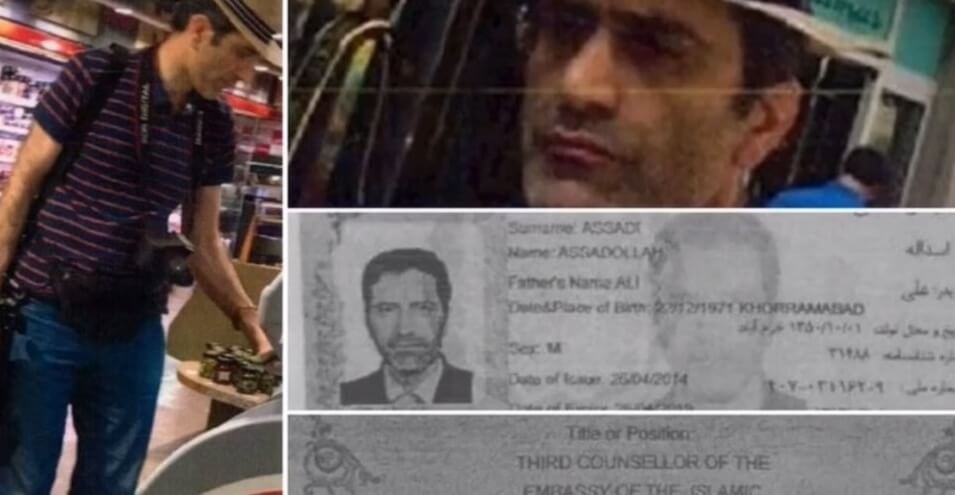
Following intensified speculation about the possible extradition of Assadollah Assadi from Belgium to Iran, numerous Iranian activists have separately urged the Belgian government not to create conditions for “pardoning a terrorist national of the Islamic Republic.”
Assadollah Assadi, a 50-year-old Iranian diplomat who worked at Iran’s embassy in Austria, is accused of providing half a kilogram of explosive material to an Iranian couple living in Belgium to target a gathering of the Mujahedin-e Khalq Organization in the Paris suburbs.
The French government accused Iran’s Ministry of Intelligence of planning and executing this plot, and Assadollah Assadi was sentenced to 20 years in prison following trial.
Now news has emerged that a bill under review in the Belgian Parliament for prisoner exchange with Iran could pave the way for Assadollah Assadi’s release.
In response to this development, more than 300 human rights activists and opposition figures have sent a letter to the Belgian Prime Minister and Parliament members, describing a bill that could facilitate Mr. Assadi’s extradition as “deeply concerning,” writing that “thanks to this law, the Belgian government would be giving the Islamic Republic permission to pardon its terrorist nationals.”
The signatories of this letter, citing “reports from human rights organizations,” stated that “the Islamic Republic has killed several hundred of its opponents outside of Iran” and noting that “some of these killings have occurred in European countries,” emphasized that “passing such a law would enable the Islamic Republic to send its assassination teams to Belgium with less risk to assassinate its opponents, because these assassins would be assured that the Belgian government would directly return them to their country to be released.”
In another letter signed by more than 430 Iranian activists, signatories warned the Belgian Parliament and government that “extraditing someone convicted of terrorist activities is giving a blank check to Iran’s government to continue this process of hostage-taking, kidnapping, and assassination.”
The authors of this letter stated clearly: “If this bill is passed, whenever any other threat from Iran’s government against citizens of Western communities occurs, Belgium’s name will stand alongside Iran’s government.”
Simultaneously, 9 American national security officials, in a letter whose text has been obtained by Radio Farda, called the consideration of such a bill “complete disrespect for law enforcement officials” in Western countries who “have risked their lives” to prevent terrorist acts by the Islamic Republic.
In this letter, signed by General James E. Conway, former Commander of the United States Navy, Louis J. Freeh, former FBI Director, and General James L. Jones, former Commander of NATO, among others, it was emphasized that Assadollah Assadi “had 20 dormant cells” at his disposal in European countries.
The letter’s signatories warned that extradition of Assadollah Assadi would allow these “dormant cells” to travel more easily throughout all European Union countries and law enforcement officials would not be able to properly take necessary action against them.
Meanwhile, on Tuesday, July 5, 600 Iranian-Americans who had participated in the June 3, 2018 gathering of Mujahedin-e Khalq in Paris also strongly condemned Belgium’s new bill.
In this letter addressed to the Belgian Prime Minister and the head of the Belgian Parliament, it was stated that “returning a convicted terrorist is shameful” and Belgium was asked to “uphold the values of human rights and rule of law.”
Georges Dalman, a Belgian Parliament member, said that his country’s government would likely exchange Assadi with Ahmad Reza Jalali, a Swedish-Iranian dual citizen and Brussels University professor who has been sentenced to death in Iran, under the guise of a “humanitarian act.”
However, Vincent van Quickenborne, spokesperson for the Belgian Ministry of Justice, told the French news agency that the aforementioned agreement has no connection to Ahmad Reza Jalali’s case.
Without providing further explanation, he added that the Ministry of Justice will present its position to Parliament this Tuesday.
Source: Radio Farda